Transforming Fire Protection Intelligence: Why An Inert Gas Suppression Company Replaced CypherX With StyleBI For Dynamic Reporting
The Inert Gas Fire Suppression & Clean Agent Systems Services industry operates quietly behind the scenes, protecting some of the world’s most sensitive and high‑value environments. Data centers, semiconductor fabs, aerospace facilities, archival vaults, pharmaceutical labs, and mission‑critical industrial sites all rely on these systems to extinguish fires without water, residue, or equipment damage. Instead of sprinklers, these facilities use inert gases like IG‑55, IG‑541, nitrogen, and argon, or clean agents such as FM‑200 and Novec 1230, to rapidly reduce oxygen concentration or absorb heat.
The company at the center of this narrative—AeroSafe Suppression Technologies—is a mid‑sized service provider specializing in system design, installation, maintenance, room integrity testing, and multi‑site readiness monitoring. With thousands of cylinders deployed across hundreds of customer facilities, AeroSafe manages a massive volume of data: pressure logs, leakage test results, agent concentration calculations, maintenance histories, compliance documentation, and telemetry from modern digitally monitored suppression systems.
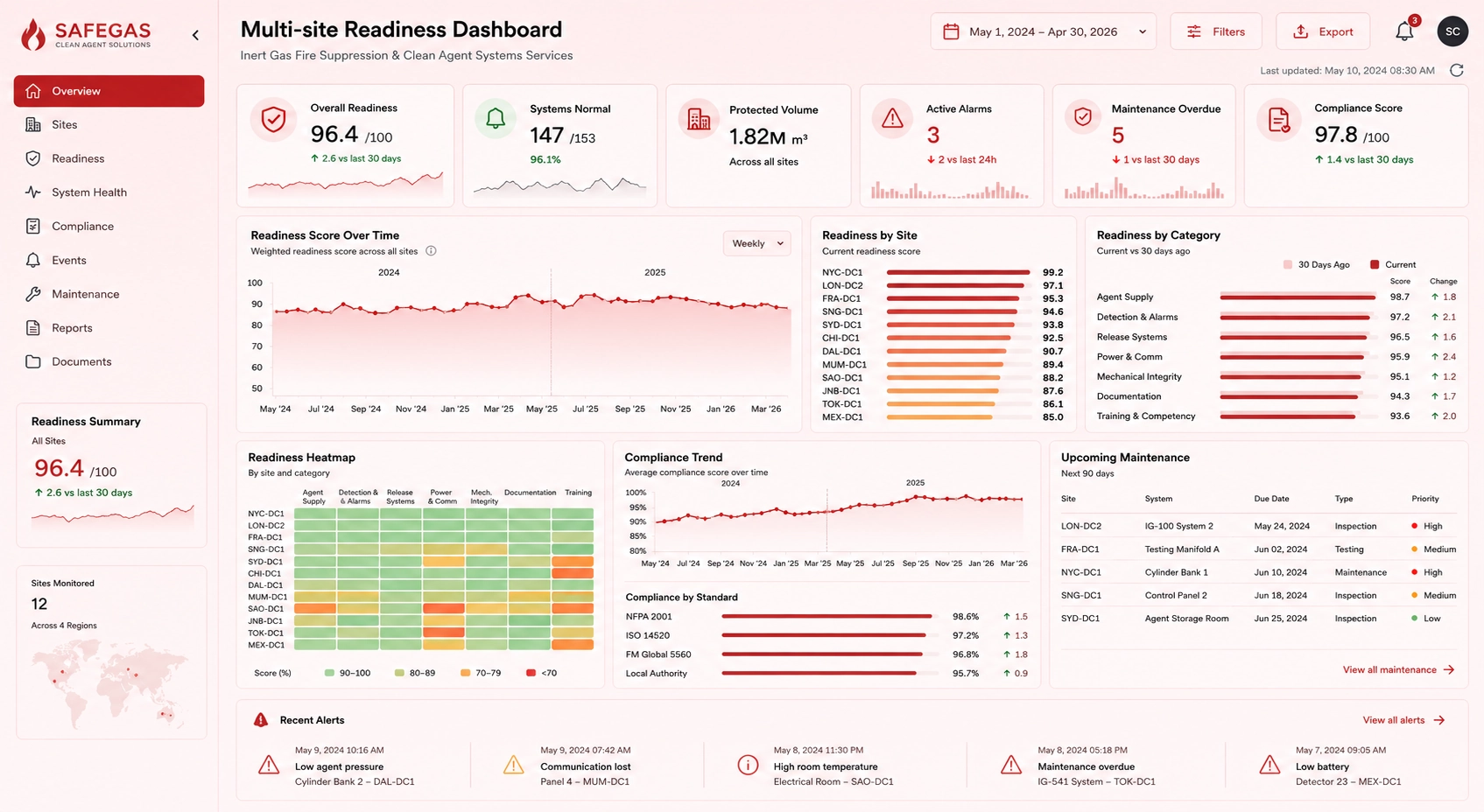
For years, AeroSafe relied on CypherX for analytics and reporting. While CypherX provided basic dashboards and data blending, the company’s rapid growth exposed limitations in flexibility, drill‑down depth, and dynamic reporting capabilities. As customers demanded more transparency and regulators increased documentation requirements, AeroSafe needed a reporting platform capable of adapting to complex, multi‑layered fire protection data.

The Limitations Of CypherX For Dynamic Reporting
CypherX served AeroSafe adequately during its early years, but as the company expanded into multi‑site monitoring and digital telemetry, the platform struggled to keep pace. The first major limitation was the rigidity of its reporting structures. Fire suppression systems involve nested data relationships—cylinders belong to banks, banks belong to rooms, rooms belong to facilities, and facilities belong to customer networks. CypherX could not easily support dynamic drill‑downs across these hierarchies.
Second, AeroSafe needed real‑time visibility into cylinder pressure decay, enclosure integrity trends, and agent readiness across distributed customer sites. CypherX’s refresh cycles and data connectors were not optimized for hybrid environments where some data lived in cloud systems and other data remained on‑premises for security reasons.
Third, customers increasingly requested interactive reporting portals. They wanted to see their own system readiness, leakage test results, and compliance status without waiting for monthly PDF reports. CypherX lacked the flexibility to create customer‑facing dashboards with granular permissions and dynamic filtering.
Finally, AeroSafe’s internal teams—engineers, compliance specialists, field technicians, and account managers—needed different reporting views. CypherX’s limited customization options forced the analytics team to maintain multiple versions of similar reports, creating inefficiency and version‑control issues.

Why AeroSafe Chose StyleBI For Dynamic Reporting
After evaluating several business intelligence platforms, AeroSafe selected StyleBI as its next‑generation dynamic reporting solution. The decision was driven by StyleBI’s ability to support complex hierarchies, hybrid data environments, and highly interactive drill‑down experiences.
StyleBI’s semantic modeling layer allowed AeroSafe to map its entire operational structure—cylinders, rooms, facilities, customers—into a unified data model. This enabled users to drill from a high‑level readiness score into a specific cylinder’s pressure history, then pivot into leakage test results, and finally view the compliance documentation associated with that room. CypherX could not support this level of fluid exploration.
Equally important was StyleBI’s hybrid connectivity. AeroSafe could keep sensitive system telemetry on secure servers while hosting customer‑facing dashboards in the cloud. StyleBI bridged both environments seamlessly, enabling real‑time updates without compromising security.
Finally, StyleBI’s dynamic reporting features empowered AeroSafe to build dashboards that adapted to user roles. Field technicians saw maintenance schedules and cylinder health indicators. Compliance teams saw audit trails and NFPA 2001 documentation. Executives saw multi‑site readiness scores and contract performance metrics. Customers saw only their own facilities, with drill‑downs tailored to their system configurations.
Building A Modern Fire Suppression Reporting Architecture
The transition to StyleBI began with a complete redesign of AeroSafe’s reporting architecture. The analytics team created a semantic model that captured the core entities of fire suppression systems: cylinders, valves, agent types, room volumes, leakage test results, discharge calculations, and maintenance events. Each entity contained dozens of attributes, from pressure readings to agent concentration formulas to enclosure leakage coefficients.
StyleBI’s modeling tools allowed the team to define relationships across these entities, enabling dynamic drill‑downs that mirrored real‑world workflows. For example, a user could start with a facility‑level readiness score, drill into a specific room, view its last integrity test, then drill into the cylinders serving that room, and finally view the pressure decay trend for a single cylinder.
Dashboards were then built for each functional group. Engineers received dashboards showing agent concentration modeling, leakage test pass/fail trends, and system health indicators. Field technicians received dashboards for upcoming maintenance, cylinder hydrostatic test schedules, and valve replacement history. Compliance teams received dashboards for NFPA 2001 documentation, environmental reporting, and agent refill logs. Executives received high‑level KPIs such as customer readiness, contract profitability, and service response times.
Integrating Real-Time Telemetry And Historical Data
One of the most transformative aspects of StyleBI for AeroSafe was its ability to blend real‑time telemetry with historical maintenance and compliance data. Modern fire suppression systems include digital sensors that monitor pressure, temperature, valve position, and system readiness. StyleBI ingested this telemetry and combined it with historical logs, enabling AeroSafe to identify patterns that were previously invisible.
For example, analysts discovered that certain facilities experienced seasonal pressure fluctuations due to HVAC cycling. By drilling into historical data, they identified the root cause and recommended adjustments to room pressurization systems. Similarly, StyleBI revealed that certain cylinder banks consistently approached minimum pressure thresholds earlier than expected, prompting proactive maintenance.
Benefits Realized After Switching To StyleBI
Within the first year of adopting StyleBI, AeroSafe experienced significant improvements in operational efficiency, customer satisfaction, and regulatory compliance. The most immediate benefit was the elimination of manual reporting. CypherX required frequent exports and spreadsheet manipulation, while StyleBI automated data refreshes and report generation.
Decision‑making accelerated dramatically. Engineers could drill into anomalies in real time, identifying issues such as unexpected pressure decay or enclosure leakage. Instead of waiting for monthly reports, they could take corrective action immediately.
Customers benefited as well. AeroSafe launched a customer‑facing portal powered by StyleBI, allowing clients to view their system readiness, leakage test results, and compliance documentation. This transparency strengthened relationships and differentiated AeroSafe in a competitive market.
Regulatory compliance improved significantly. StyleBI’s dynamic reporting allowed AeroSafe to track NFPA 2001 requirements, environmental reporting obligations, and hydrostatic test schedules with precision. Auditors received complete, accurate documentation with minimal effort from AeroSafe’s compliance team.

Challenges And Change Management
The transition was not without challenges. Some technicians were accustomed to CypherX’s interface and were initially hesitant to adopt a new platform. AeroSafe addressed this by creating role‑specific training sessions and appointing internal champions to support colleagues during the transition.
Another challenge was designing drill‑down paths that balanced depth with usability. Fire suppression data is highly technical, and the analytics team worked closely with engineers and compliance specialists to ensure that dashboards were intuitive without oversimplifying critical information.
Future Plans With StyleBI
AeroSafe plans to expand its use of StyleBI into predictive analytics. By combining historical pressure decay data, leakage test results, and environmental conditions, the company aims to build dashboards that forecast cylinder readiness, enclosure leakage risk, and maintenance needs. These predictive insights will help AeroSafe optimize service schedules, reduce emergency calls, and improve customer uptime.
The company is also exploring automated anomaly detection within StyleBI. By defining thresholds for key metrics such as pressure, leakage rates, and agent concentration, StyleBI could automatically flag potential issues and guide users to the relevant drill‑down paths.
A Major Evolution
AeroSafe Suppression Technologies’ transition from CypherX to StyleBI represents a major evolution in how fire suppression service providers manage and interpret system data. StyleBI’s dynamic reporting capabilities, hybrid data connectivity, and intuitive drill‑down features have transformed reporting from a fragmented, manual process into a unified, intelligent analytics environment.
In an industry where every cylinder, every room, and every test result can determine the safety of mission‑critical environments, the ability to explore data dynamically is not just a convenience—it is a necessity. By adopting StyleBI, AeroSafe has positioned itself as a leader in intelligent fire protection, delivering greater reliability, transparency, and value to its customers.