From Datameer to StyleBI: Modernizing Self-Service Enterprise Reporting in Industrial Rope Access
Altitude Access Group, a mid-sized industrial rope access services company, built its reputation on high-risk, high-skill work performed on wind turbines, bridges, industrial stacks, and offshore platforms. Its technicians were among the best in the field, certified under IRATA and SPRAT, and trusted by major energy and infrastructure clients. Yet behind the scenes, the company’s reporting and analytics capabilities lagged far behind the sophistication of its field operations. Project managers, safety officers, and executives were still relying on spreadsheets, emailed PDFs, and ad hoc extracts to understand performance, risk, and profitability.
Several years earlier, Altitude Access had adopted Datameer as a data preparation and modeling layer on top of its cloud data warehouse. The data team used Datameer to ingest and transform information from job management systems, certification databases, equipment tracking tools, and financial systems. Datameer excelled at blending these sources into curated datasets: technician certification histories, rope and gear lifecycle tables, project cost breakdowns, and safety incident logs. For the analytics team, it was a powerful environment to build and maintain data pipelines.
The Tipping Point Came
However, as the business grew, the limitations of this architecture became clear. Datameer was strong at data prep but not designed to be the company’s primary self-service enterprise reporting system. Business users still needed another layer—typically spreadsheets or lightweight visualization tools to consume the curated data. Every new dashboard request turned into a mini-project: the data team would build or adjust a Datameer flow, export the results, and then manually assemble charts and tables for stakeholders. The promise of self-service reporting remained largely unfulfilled.
The tipping point came when Altitude Access won a multi-year contract to provide rope access inspection and maintenance services for a large offshore wind farm. The client demanded near real-time visibility into technician utilization, blade inspection results, defect remediation status, and safety metrics. They wanted a secure web portal where their engineers and project managers could log in, filter by turbine, date, and defect type, and download reports for regulatory submissions. Altitude Access realized that its current stack—Datameer plus manual reporting—could not scale to this level of transparency and responsiveness.
The leadership team launched an initiative to modernize the company’s self-service enterprise reporting system. The goal was clear: provide a web-based BI environment where internal and external stakeholders could explore governed data, build their own views within guardrails, and rely on consistent definitions of key metrics such as time-on-rope, first-time fix rate, near-miss frequency, and equipment utilization. After evaluating several options, including extending their existing tooling with additional visualization products, Altitude Access chose StyleBI as the centerpiece of its new reporting platform.

Why Datameer Was Not Enough for Self-Service Reporting
Datameer had delivered significant value as a data preparation workbench. The data team appreciated its ability to connect to the company’s warehouse, apply complex transformations, and document data flows. But for non-technical users, Datameer was essentially invisible. Project managers could not log into Datameer and build a dashboard; they depended on the analytics team to export curated datasets and then assemble reports elsewhere.
This separation created several pain points. First, report development cycles were slow. A safety manager who wanted a new view of near-miss incidents by technician level and job type had to submit a request, wait for the data team to adjust a flow, and then receive a static report. Second, there was no single, governed semantic layer where business metrics were defined. Calculations such as “time-on-rope per completed task” or “equipment utilization rate” were often implemented differently in different spreadsheets, leading to confusion and misalignment in meetings.
Finally, Datameer did not provide the kind of interactive, web-based experience that Altitude Access needed for its new client-facing portal. The company wanted dashboards that allowed users to drill from a fleet-level view of turbine inspections down to individual defects, photos, and technician notes. They needed row-level security to ensure that each client saw only their own assets, and they wanted the ability to embed these dashboards into a branded portal. Datameer was not built for this role; it was a powerful engine behind the scenes, but not the front-end reporting layer the business required.

Why StyleBI Fit the Rope Access Reporting Use Case
StyleBI offered Altitude Access a web-based BI platform that could sit directly on top of the curated datasets already being produced in the warehouse. Instead of exporting data out of Datameer and into spreadsheets, the data team began to think in terms of semantic views and dashboards. They used StyleBI to define subject areas such as Operations, Safety, Equipment, and Finance, each with its own set of governed fields and metrics.
For example, in the Operations subject area, they modeled entities like project, job, technician, turbine, and time entry. They defined measures such as total time-on-rope, number of tasks completed, and average crew size. In the Safety area, they modeled incidents, near misses, and rescue drills, with dimensions for location, job type, technician level, and root cause. These semantic models allowed business users to build their own reports and dashboards by dragging and dropping fields, without needing to understand the underlying joins or warehouse schema.
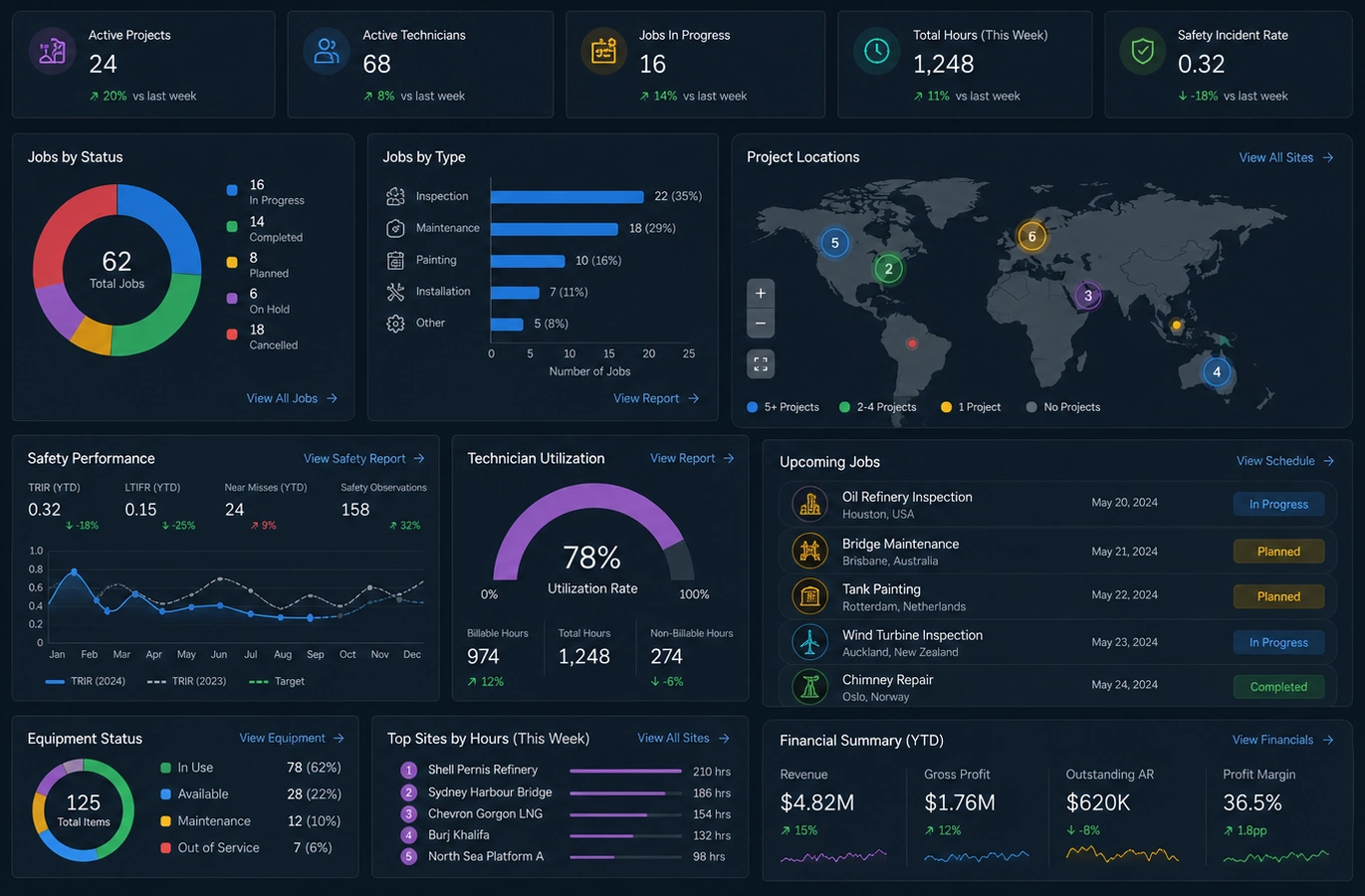
StyleBI’s interactive dashboards were particularly well suited to the rope access context. The operations team built a “Wind Farm Overview” dashboard that showed, for each turbine, the status of inspections, number of identified defects, and remediation progress. Users could click on a turbine to see a detailed view of blade defects, including photos, severity ratings, and technician notes. Filters allowed them to slice by date range, crew, and weather conditions. Similar dashboards were created for bridge inspections, industrial stack maintenance, and high-rise façade work.
The safety department created a “Safety Performance” dashboard that tracked incidents, near misses, and rescue drills over time. They could compare performance across crews, regions, and job types, and quickly identify patterns such as higher near-miss rates on certain types of industrial structures. Because the metrics were defined in StyleBI’s semantic layer, everyone in the organization saw the same numbers, regardless of which dashboard they used.
Migration Strategy: From Data Prep-Centric to BI-Centric
Altitude Access did not discard Datameer; instead, it reframed its role. Datameer remained the primary tool for building and maintaining data pipelines into the warehouse. StyleBI became the self-service enterprise reporting layer on top of those curated datasets. This separation of concerns allowed each tool to play to its strengths.
The migration began with an inventory of existing Datameer flows and the reports they supported. The data team identified the most frequently requested reports: technician utilization by project, equipment retirement and inspection schedules, safety incident summaries, and project profitability analyses. For each of these, they created corresponding semantic views and dashboards in StyleBI, ensuring that the underlying logic matched or improved upon the previous implementations.
Row-level security was a critical requirement, especially for the new client-facing portal. StyleBI’s security model allowed Altitude Access to define rules so that internal users could see data across all projects, while external clients were restricted to their own assets and contracts. This made it possible to use the same dashboards for both internal and external audiences, simply with different security contexts.
Training was another key component of the transition. The company organized workshops for project managers, safety officers, and finance analysts, focusing on how to navigate StyleBI dashboards, apply filters, drill into details, and create personal views. Power users in each department were given additional training to build and modify dashboards within the governed semantic framework. Over time, the volume of ad hoc report requests to the data team decreased, as business users became more comfortable answering their own questions in StyleBI.

Outcomes: A New Culture of Data-Driven Rope Access Operations
Within a year of adopting StyleBI as its self-service enterprise reporting system, Altitude Access saw a noticeable shift in how decisions were made. Daily operations meetings for the offshore wind project moved from static slide decks to live dashboards, where project managers could explore turbine-level data in real time. Safety review sessions used the Safety Performance dashboard to focus on trends and root causes rather than debating whose spreadsheet had the correct numbers.
The client-facing portal became a differentiator in the market. Wind farm operators could log in and see the status of inspections, defects, and remediation work without waiting for monthly reports. They could download standardized reports for regulators and auditors directly from the portal. This transparency strengthened Altitude Access’s relationships with its clients and helped the company win additional contracts.
Internally, the combination of Datameer and StyleBI created a more sustainable analytics architecture. Datameer continued to handle complex data preparation tasks, while StyleBI provided a governed, interactive layer for reporting and analysis. The data team spent less time exporting data and building one-off reports, and more time improving data quality and expanding the semantic models to cover new aspects of the business, such as drone inspection data and digital twin integrations.
For a company operating in the industrial rope access services industry, where safety, efficiency, and client trust are paramount, the move from a Datameer-centric approach to a StyleBI-centered self-service reporting environment marked a significant evolution. It aligned the company’s data capabilities with its operational complexity and strategic ambitions, turning scattered data into a coherent, accessible intelligence layer that supports decisions from the rope team on a turbine blade to the executives in the boardroom.