From Reliability Modeling To Cloud-Flexible Analytics: A Food & Beverage Enzymes Company Switches To StyleBI
Background Of The Food & Beverage Enzymes Company
The company at the center of this story is a mid-sized producer of food and beverage enzymes that serve global baking, brewing, and dairy manufacturers. Its portfolio includes amylases for bread softness, proteases for flavor development, and lactase for reduced-lactose dairy products. The business operates multiple fermentation plants, a network of formulation labs, and regional application centers that help customers optimize recipes and processing conditions.
For years, the company’s analytics focus was dominated by reliability and stability modeling. Enzyme performance over time, shelf-life predictions, and failure rates of critical fermentation equipment were all modeled using ReliaSoft Weibull++. Engineers and quality scientists relied on Weibull++ to fit distributions, estimate failure probabilities, and support decisions on maintenance intervals and product expiry dates. While this approach worked well for reliability engineering, it left a gap in broader business reporting and cloud-flexible analytics.

Limitations Of ReliaSoft Weibull++ For Modern Business Reporting
ReliaSoft Weibull++ is a powerful tool for reliability analysis, but it was never designed to be a full-spectrum business reporting platform. The enzymes company began to feel these limitations as its operations grew more complex and geographically distributed. Reliability engineers could model time-to-failure and degradation curves, yet commercial leaders, supply chain managers, and finance teams struggled to access integrated, real-time views of the business.
First, data lived in silos. Reliability data sat in Weibull++ project files, production data in on-premises databases, and commercial data in separate ERP and CRM systems. Creating a unified report required manual exports, spreadsheet stitching, and ad hoc charts that were difficult to maintain. Second, the desktop-centric nature of Weibull++ meant that insights were often locked to specific machines and users. Remote teams, cloud-hosted systems, and external partners could not easily access or interact with the analysis.
Finally, the company’s leadership wanted more than reliability curves. They needed dashboards that combined enzyme batch yields, customer complaint trends, on-time delivery metrics, and margin analysis by product family. Weibull++ could not serve as the central hub for these multi-domain analytics. The result was a fragmented reporting landscape that slowed decision-making and made it harder to scale the business.
Strategic Drivers For Switching To StyleBI
The decision to switch from ReliaSoft Weibull++ to StyleBI for cloud-flexible business reporting emerged from a strategic review of the company’s digital capabilities. The leadership team identified three core drivers: integration, accessibility, and agility. Integration meant bringing reliability, production, quality, and commercial data into a single analytical fabric. Accessibility meant enabling users across regions and functions to view and interact with reports from any device. Agility meant being able to design, modify, and deploy new dashboards quickly as the business evolved.
StyleBI, with its cloud-flexible architecture and focus on self-service analytics, aligned closely with these goals. Rather than being a specialized reliability tool, StyleBI is a business intelligence platform capable of connecting to multiple data sources, modeling relationships, and presenting interactive dashboards through the web. The enzymes company saw an opportunity to keep reliability modeling where it belonged—inside engineering workflows—while elevating business reporting to a modern, cloud-ready environment.
Designing A Cloud-Flexible Reporting Architecture
The transition began with a redesign of the company’s reporting architecture. Instead of treating reliability analysis as the center of all analytics, the team defined a layered model. At the bottom were data sources: fermentation batch records, lab test results, ERP transactions, CRM opportunities, and maintenance logs. Above that sat a semantic layer in StyleBI, where data models defined entities such as “Batch,” “Customer,” “Complaint,” “Maintenance Event,” and “Enzyme Product.”
StyleBI’s cloud-flexible deployment options allowed the company to host the analytics environment in a way that matched its IT strategy. Some data remained on-premises for regulatory reasons, while other datasets moved to cloud databases. StyleBI connected to both, providing a unified reporting experience without forcing a single infrastructure model. This hybrid approach was particularly important for the company’s European and North American sites, which had different compliance requirements and IT policies.
On top of the semantic layer, the analytics team built dashboards tailored to specific roles. Operations managers received views of batch yields, fermentation cycle times, and downtime by equipment. Quality leaders saw complaint rates, nonconformance trends, and stability test outcomes. Commercial teams accessed margin by product, regional sales performance, and forecast accuracy. All of these dashboards were accessible through a browser, with permissions managed centrally.

Reframing Reliability Insights Within StyleBI
Switching away from Weibull++ for core business reporting did not mean abandoning reliability insights. Instead, the company reframed reliability data as one of several inputs into broader performance dashboards. Time-to-failure estimates for pumps, agitators, and heat exchangers were exported from engineering tools and integrated into StyleBI’s data models. This allowed maintenance planners to see reliability predictions alongside actual downtime, spare parts consumption, and production impact.
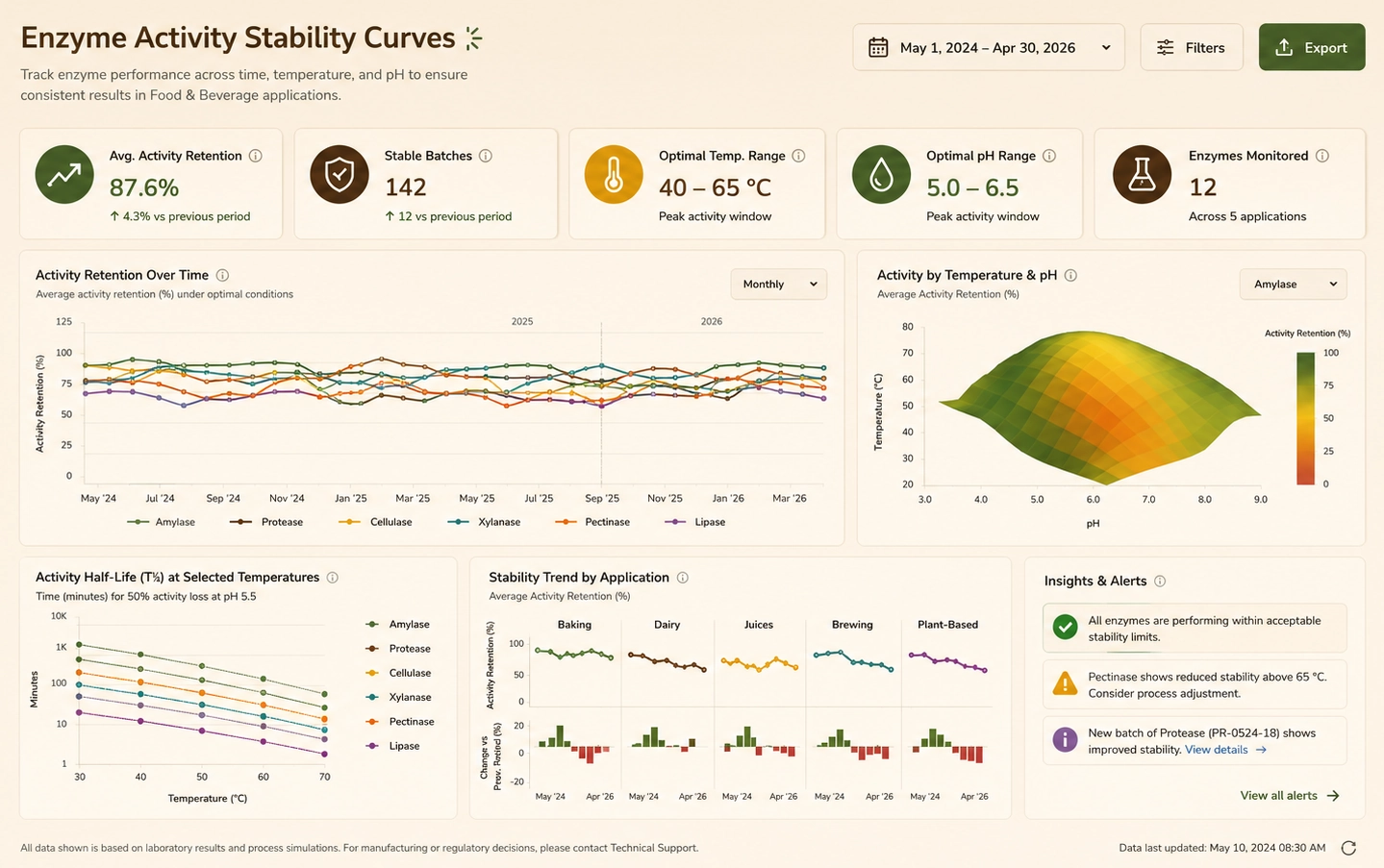
Similarly, enzyme stability curves and shelf-life predictions were incorporated into inventory and supply chain dashboards. StyleBI visualized how product age, storage conditions, and forecast demand interacted with stability models. Planners could see which lots were approaching the end of their recommended shelf life and adjust shipment priorities accordingly. This integration turned reliability analysis from a specialized, isolated activity into a practical driver of everyday decisions.
Benefits Realized After The Transition
Within the first year of adopting StyleBI as its cloud-flexible business reporting platform, the food and beverage enzymes company saw several tangible benefits. The most immediate gain was a reduction in manual reporting effort. Teams no longer had to export data from multiple systems, merge spreadsheets, and rebuild charts for monthly reviews. StyleBI refreshed dashboards automatically, pulling from live data sources and presenting up-to-date metrics.
Decision-making also accelerated. Regional managers could log into StyleBI from any location and see the same standardized dashboards as headquarters. When a fermentation issue arose or a spike in customer complaints appeared, stakeholders across functions could view the same data and collaborate on root cause analysis. This shared visibility reduced the lag between detecting a problem and implementing corrective actions.
Another benefit was improved alignment between technical and commercial perspectives. Reliability engineers, quality scientists, and sales leaders all interacted with the same platform, even if they focused on different dashboards. This fostered a common language around performance: yield, stability, complaints, margin, and service levels. Reliability insights were no longer confined to engineering reports; they were part of the broader narrative about how the business created value and managed risk.

Challenges And Change Management
The transition was not without challenges. Some engineers were initially skeptical about moving away from a familiar tool like Weibull++ for any aspect of reporting. The project team addressed this by clearly defining boundaries: Weibull++ remained the preferred environment for deep reliability modeling, while StyleBI became the platform for sharing high-level results and integrating them with other business data.
Training was another critical component. Users across departments needed to learn how to navigate dashboards, interpret visualizations, and build their own ad hoc views. The company invested in role-based training sessions and created internal champions who could support colleagues. Over time, self-service analytics became part of the culture, with users requesting new slices of data rather than new static reports.
Future Directions With StyleBI
Looking ahead, the enzymes company plans to extend its use of StyleBI into predictive and prescriptive analytics. By combining historical batch data, reliability models, and commercial trends, the team aims to build dashboards that not only describe what has happened but also suggest what should happen next. For example, StyleBI could highlight which fermentation lines are most likely to experience downtime in the next quarter, or which enzyme products are at risk of margin erosion due to raw material price changes.
The company is also exploring customer-facing analytics. Selected key accounts may receive access to tailored dashboards that show enzyme performance in their processes, complaint resolution timelines, and joint innovation project status. This would transform StyleBI from an internal reporting tool into a collaborative platform that strengthens relationships and differentiates the company in a competitive market.

Redefined How It Uses Data
By switching from a reliability-focused desktop tool like ReliaSoft Weibull++ to a cloud-flexible business reporting platform like StyleBI, the food and beverage enzymes company redefined how it uses data. Reliability modeling remains vital, but it now feeds into a broader, integrated analytics environment that supports operations, quality, and commercial strategy. StyleBI’s ability to connect diverse data sources, deliver web-based dashboards, and adapt to hybrid cloud architectures has given the company a more agile, transparent, and collaborative way to manage its business.
In an industry where microscopic catalysts drive macroscopic outcomes, the shift to cloud-flexible analytics has become a catalyst of its own—accelerating insight, aligning teams, and enabling the enzymes company to grow with confidence in a data-driven world.