From No-Code Constraints To Data-Driven Control: A Geotechnical Firm’s Move From Softr To StyleBI
NorthRock Subsurface Services, a mid-sized geotechnical drilling and subsurface investigation company, had a familiar problem for its industry: complex operations, thin margins, and data scattered across rigs, labs, and project sites. What made NorthRock different was its early attempt to modernize performance management using a no-code app builder—Softr—layered on top of various data sources. For a while, it worked well enough. Project managers could see basic job lists, leadership had a few summary views, and the company could say it had “digital dashboards.”
But as NorthRock grew, the cracks in this approach became impossible to ignore. The company needed more than a collection of simple screens; it needed a performance management technology stack that could handle the realities of geotechnical work: rig utilization, borehole productivity, lab turnaround times, safety metrics, and compliance reporting, all tied back to profitability. That realization set the stage for a strategic shift from Softr to StyleBI.

Why Softr Stopped Being Enough
Initially, Softr appealed to NorthRock because it allowed non-technical staff to assemble internal tools quickly. Operations coordinators could spin up pages to track drilling jobs, upload PDFs of borehole logs, and maintain basic status boards. However, as the company’s project portfolio expanded across multiple states and more rigs were added, several limitations became painful.
First, performance metrics were shallow. Softr’s strength in building front-end interfaces did not translate into robust analytics. Project managers wanted to see rig utilization by week, crew productivity by soil type, and correlations between change orders and schedule overruns. Instead, they were stuck with static lists and simple aggregations that required manual exports to spreadsheets for deeper analysis.
Second, data integration became a bottleneck. NorthRock’s data lived in multiple systems: drilling logs in a specialized field app, lab results in a LIMS, timesheets in a payroll system, and financials in an accounting platform. Softr could connect to some of these sources, but combining them into a single, governed performance model was cumbersome and fragile. Each new metric felt like a mini-project, and the operations team was constantly worried about breaking existing pages.
Third, governance and consistency were lacking. Different departments built their own Softr views with slightly different definitions of “job margin,” “rig downtime,” or “on-time completion.” Leadership meetings often devolved into debates about whose numbers were correct rather than what actions to take. The company needed a single version of the truth, not a patchwork of well-intentioned dashboards.
Defining A Performance Management Vision
Recognizing these issues, NorthRock’s leadership team stepped back and reframed the problem. They were not just looking for a better app builder; they were looking for a performance management platform that could support:
- Rig-Level Performance: Utilization, idle time, travel time, and maintenance windows for each rig.
- Project Profitability: Margin by project, client, region, and soil condition, with drill-down to cost drivers.
- Lab Turnaround: Cycle times from sample collection to reported results, including rework rates.
- Safety And Compliance: Incident rates, near-miss reporting, and adherence to regulatory sampling protocols.
- Forecasting And Capacity: Forward-looking views of rig availability, crew capacity, and backlog health.
They also wanted a system that could be owned jointly by operations and finance, not just IT. That meant strong modeling capabilities, reusable metrics, and governed self-service analytics. After evaluating several options, NorthRock chose StyleBI as the backbone of its new performance management technology.
Why StyleBI Fit The Geotechnical Reality
StyleBI appealed to NorthRock for several reasons that aligned directly with the realities of geotechnical drilling and subsurface investigation.
1. Centralized, Reusable Metrics
Instead of each department defining its own KPIs in separate Softr pages, StyleBI allowed NorthRock to build a
centralized semantic layer. Core measures like rig utilization, effective day rate, job margin, and lab
turnaround time were defined once and reused across all dashboards. This eliminated the “dueling spreadsheets”
problem and gave leadership confidence that everyone was looking at the same numbers.
2. Strong Data Modeling For Complex Operations
Geotechnical work generates relational data: rigs, crews, boreholes, samples, lab tests, invoices, and change
orders. StyleBI’s modeling capabilities made it easier to connect these entities into a coherent performance
model. For example, NorthRock could now trace a single borehole from drilling to lab results to invoicing, and
see how delays at any step affected project profitability.
3. Flexible, High-Fidelity Dashboards
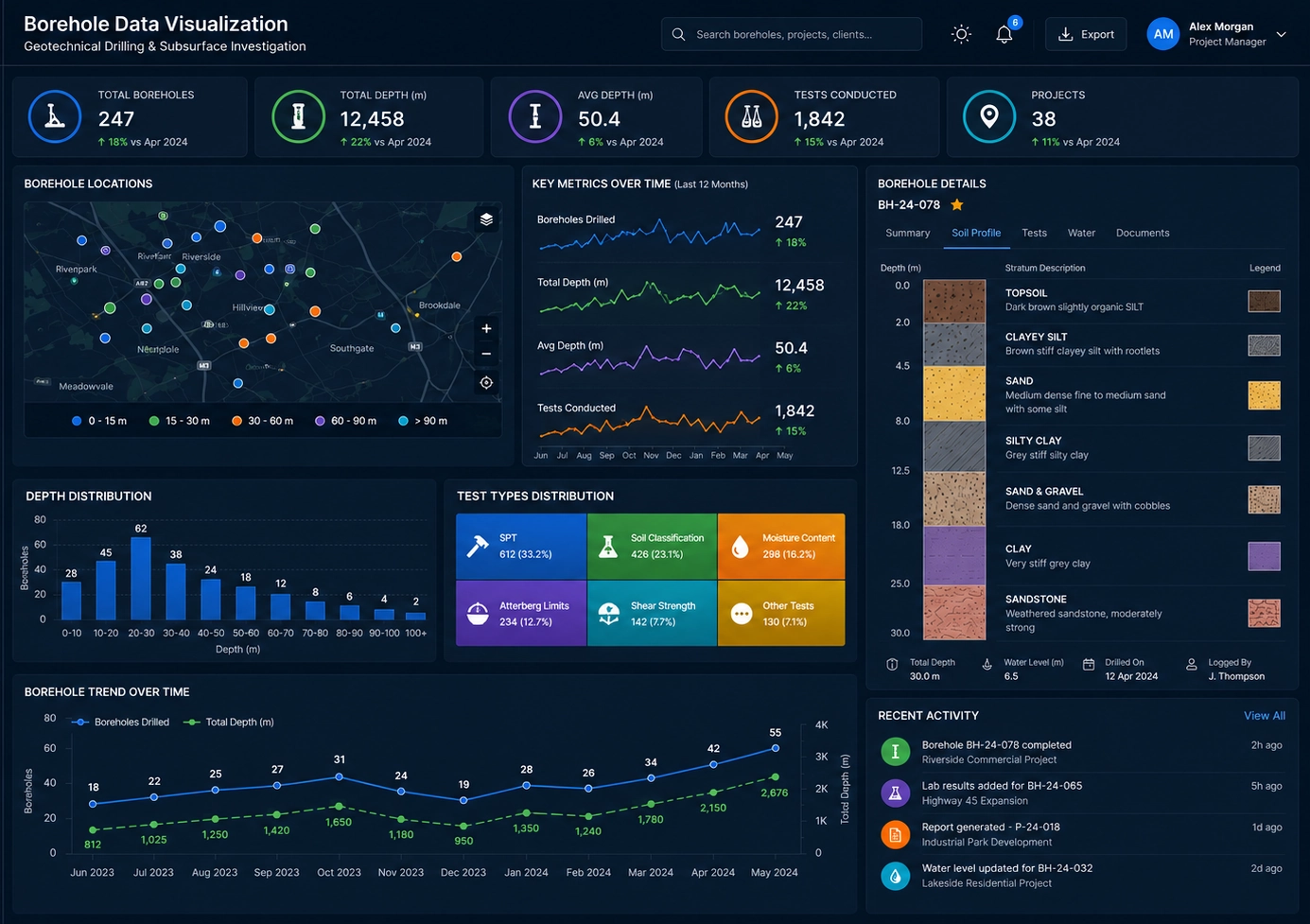
Where Softr excelled at simple internal tools, StyleBI excelled at analytical dashboards. NorthRock’s
operations leaders could now interact with layered visualizations: rig utilization heatmaps, borehole
productivity by formation, and time-series views of lab cycle times. Filters by region, client, and project
manager allowed them to move from a high-level view to specific problem areas in seconds.
4. Governance Without Killing Agility
NorthRock did not want to return to a world where every new report required a long IT queue. StyleBI’s
governed self-service approach allowed power users in operations and finance to build new views using
certified datasets and metrics. This struck the right balance between control and agility: innovation at the
edge, consistency at the core.

The Migration Journey From Softr To StyleBI
The transition was not a simple “lift and shift.” NorthRock treated the move from Softr to StyleBI as an opportunity to rethink how performance was measured and managed.
Step 1: Inventory And Rationalize Existing Softr Apps
The team began by cataloging all existing Softr pages and use cases: job status boards, rig assignment lists,
simple KPI views, and document repositories. Many of these were overlapping or redundant. Rather than
recreating everything, NorthRock identified the core performance questions that truly mattered and mapped them
to a smaller, more focused set of StyleBI dashboards.
Step 2: Build The Data Foundation
Next, the company integrated its key systems into a central data model: field data from drilling rigs, lab
results, timesheets, and financials. StyleBI was layered on top of this model, with carefully defined
dimensions (rig, crew, client, region, soil type) and measures (hours, meters drilled, cost, revenue, margin).
This step was where the real value emerged; for the first time, NorthRock could see end-to-end performance
across the entire subsurface investigation lifecycle.
Step 3: Design Role-Based Dashboards
Rather than one-size-fits-all pages, StyleBI dashboards were tailored to specific roles:
- Operations Managers: Rig utilization, schedule adherence, and field productivity.
- Project Managers: Budget vs. actuals, change orders, and client-specific performance.
- Lab Supervisors: Sample backlog, turnaround times, and quality metrics.
- Executives: Margin by segment, regional performance, and backlog health.
Each dashboard reused the same underlying metrics, ensuring consistency while still speaking the language of each role.
Step 4: Gradual Decommissioning Of Softr
NorthRock did not shut off Softr overnight. Instead, they ran both systems in parallel for a period, directing
users to StyleBI for analytics and keeping Softr only for a few remaining lightweight workflows. As StyleBI
dashboards matured and adoption grew, Softr pages were systematically retired.
Impact On Performance Management
The move from Softr to StyleBI fundamentally changed how NorthRock managed performance.
From Static Views To Continuous Insight
Previously, performance reviews were monthly events, often preceded by frantic spreadsheet work. With StyleBI,
key metrics updated daily, and in some cases hourly. Operations managers could see emerging issues—like a rig
with rising idle time or a lab with growing backlog—before they turned into client problems.
From Anecdotes To Evidence
In leadership meetings, debates shifted from “I think” to “The data shows.” When a regional manager claimed
that a certain soil formation always caused delays, StyleBI dashboards could quickly validate or refute the
claim by filtering across similar projects. This evidence-based culture improved decision quality and reduced
bias.
From Local Optimization To System-Level Thinking
Softr’s fragmented views encouraged local optimization: a project manager might push for more rig time without
seeing the impact on overall fleet utilization. StyleBI’s cross-functional dashboards made system-level
tradeoffs visible. For example, leadership could see that reassigning a rig from a low-margin project to a
high-margin one would improve overall profitability, even if it meant a short-term delay elsewhere.

Lessons Learned For The Geotechnical Industry
NorthRock’s journey offers several lessons for other companies in the geotechnical drilling and subsurface investigation industry considering a similar move.
- App Builders Are Not Performance Platforms: No-code tools like Softr are great for quick internal apps, but they struggle to support deep, governed analytics across complex operations.
- Start With Questions, Not Dashboards: NorthRock’s breakthrough came when it reframed the project around the performance questions that mattered most, rather than simply recreating existing screens.
- Invest In A Shared Data Model: The real power of StyleBI came from a unified data model that connected rigs, projects, labs, and financials into a single performance story.
- Governance Enables Trust: Defining metrics once and reusing them everywhere reduced confusion and built confidence in the numbers.
- Change Management Matters: Running Softr and StyleBI in parallel, training users by role, and celebrating early wins helped drive adoption.

Looking Ahead
With StyleBI in place, NorthRock is already exploring more advanced performance management capabilities: predictive models for rig demand, scenario analysis for pricing strategies, and risk scoring for complex subsurface conditions. What began as a migration away from Softr has become a broader transformation in how the company sees itself—not just as a drilling contractor, but as a data-informed partner in managing subsurface risk.
For geotechnical firms facing similar pressures—tight timelines, demanding clients, and high safety stakes—the shift from simple no-code interfaces to a robust performance management platform like StyleBI can be the difference between reacting to problems and anticipating them. NorthRock’s experience shows that when the subsurface world is made visible through the right analytics, better decisions follow.