Asset Management Dashboards, KPIs, and Performance Improvement
Asset management dashboards are operational control systems, not static scoreboards. A mature implementation combines lifecycle records, maintenance execution data, utilization telemetry, parts and inventory status, and financial cost signals into a governed view of asset performance.
This approach gives reliability teams, operations managers, and finance leaders a shared decision model with consistent metric definitions. Without that consistency, organizations frequently optimize one area while degrading another, such as reducing maintenance labor in a way that later increases downtime and emergency spend. Dashboard quality is therefore measured by decision quality, not just by visual design.
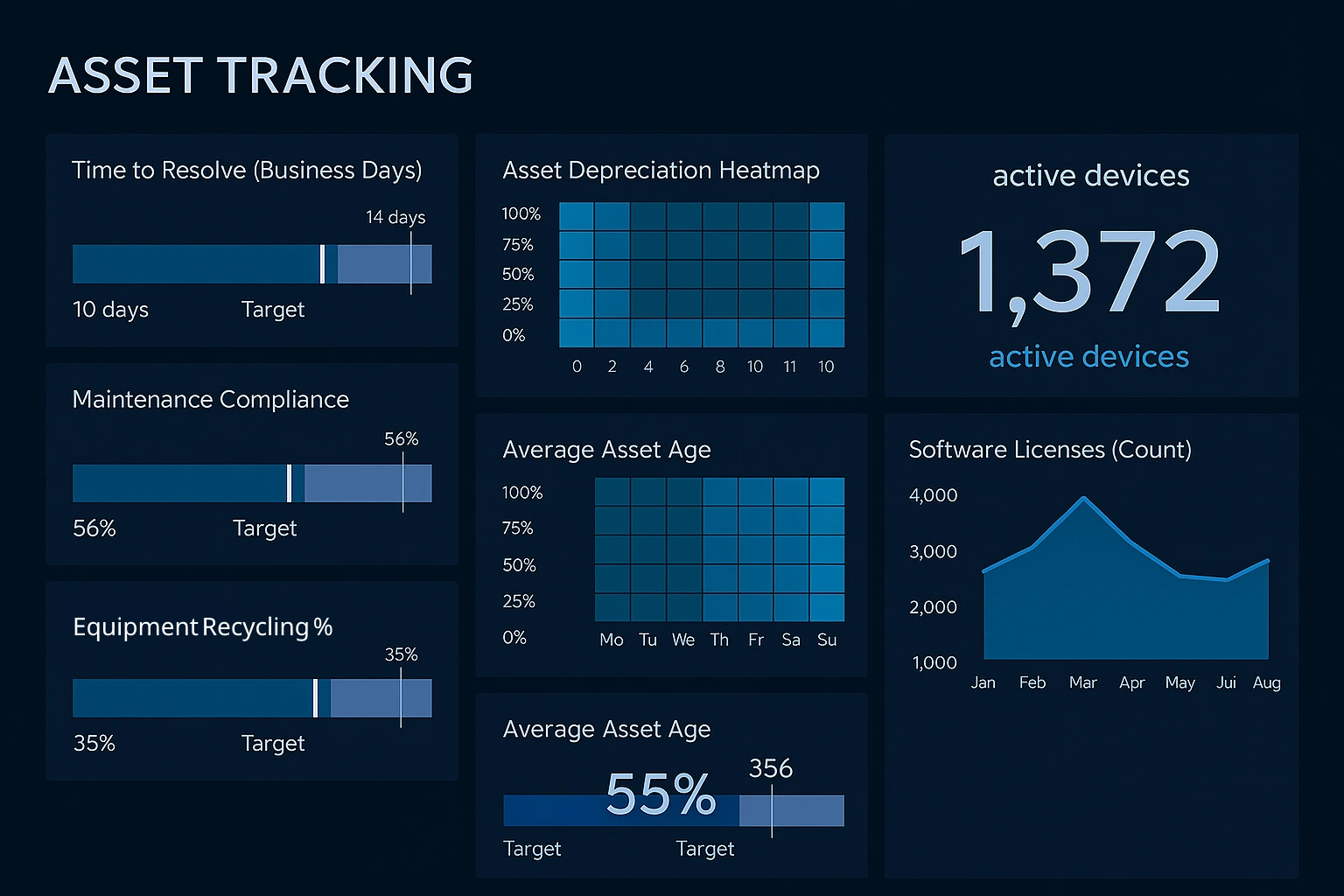
The highest-performing programs use dashboards to shorten the time from detection to correction. Instead of waiting for month-end reports, teams monitor leading indicators such as repeat work orders, deferred preventive maintenance, rising cycle-time variance, and spare stockout risk. When those signals breach thresholds, the dashboard should make ownership and next actions explicit. This allows teams to intervene before performance loss accumulates into major outages or costly replacement events. In practical terms, dashboards move asset management from reactive repair toward risk-based and reliability-centered execution.

1) Reliability and Availability KPIs
Reliability KPIs determine whether assets can consistently deliver service at required performance levels. Core measures include availability percentage, unplanned downtime hours, mean time between failures (MTBF), mean time to repair (MTTR), and failure recurrence rate. MTBF reveals how frequently assets fail, while MTTR reveals how quickly teams restore operations after a failure event. Recurrence rate is especially important because it detects ineffective corrective action and unresolved root causes. Dashboards should segment these KPIs by criticality tier so low-impact assets do not conceal risk in production-critical systems.
To improve reliability metrics, organizations should first standardize failure taxonomy and cause coding. Second, perform root-cause analysis on top repeat faults and verify whether corrective actions are technically complete, not just administratively closed. Third, tighten preventive and predictive maintenance windows for high-criticality assets and automate escalation for overdue tasks. Fourth, connect condition signals such as vibration, thermal drift, and alarm frequency to failure risk scoring. Reliability improves when the dashboard links each intervention program to expected KPI movement and tracks whether that movement actually occurs.

2) Utilization and Throughput KPIs
Utilization metrics indicate whether asset fleets are right-sized, balanced, and scheduled effectively. Important indicators include run hours versus available hours, productive utilization percentage, idle-time distribution by reason code, throughput per asset hour, and constrained-capacity queue levels. High utilization is not inherently positive if it is achieved by overdriving equipment and accelerating degradation. For this reason, utilization should be monitored together with health and reliability indicators. The objective is sustainable throughput, not short-term peak output followed by corrective backlog.
Improving utilization requires coordinated planning between operations and maintenance. Start by classifying assets into production-critical, rotational, standby, and seasonal categories and define target utilization bands for each class. Then use demand forecasts and dispatch rules to balance load across interchangeable assets and avoid concentrated wear. Integrate maintenance schedules with production windows so preventive work is executed during low-demand periods instead of repeatedly deferred. Finally, analyze persistent idle states by cause code, such as staffing gaps, planning errors, or quality holds, and remove bottlenecks systematically.

3) Maintenance Execution KPIs
Maintenance execution quality is a primary predictor of future uptime and cost behavior. Key KPIs include preventive maintenance compliance, schedule attainment, emergency work ratio, backlog age profile, wrench time, and repeat work order percentage. A high emergency ratio typically signals planning weakness and predicts budget volatility. A growing backlog with stable staffing can indicate poor planning quality, unrealistic labor estimates, or weak shutdown coordination. Dashboards should expose these patterns by site, team, and asset class so interventions can be targeted accurately.
To affect maintenance KPIs, enforce planning discipline before work release. Each critical job should include labor standards, parts reservation, safety prerequisites, and access windows. Standardize high-frequency job plans and digital checklists so closure data is analytically usable. Improve wrench time by staging tools and parts near execution zones and reducing unnecessary approvals for routine corrective actions. Use weekly cross-functional review cadences where maintenance and operations jointly prioritize backlog based on business risk rather than ticket age alone.
4) Financial and Lifecycle Cost KPIs
Financial KPIs connect technical performance to economic outcomes. Typical metrics include maintenance cost per operating hour, cost per unit of output, contractor premium ratio, spare parts consumption variance, lifecycle cost trend, and total cost of ownership by cohort. Dashboards should separate controllable from non-controllable cost drivers to support realistic accountability. For example, procurement inflation and avoidable emergency labor require different actions. If cost per hour rises while availability falls, replacement modeling should be triggered immediately.
Improving financial KPIs depends on eliminating avoidable spend and improving decision timing. Create min-max policies for critical spares and monitor stockout probability together with obsolete inventory value. Tie cost attribution to failure modes and asset classes by enforcing high-quality work-order closeout discipline. Use scenario analysis to compare run-to-failure, enhanced preventive maintenance, and phased replacement options. Financial outcomes improve when dashboards explicitly link technical risk to forecasted margin, cash flow, and service-level commitments.

5) Risk, Compliance, and Governance KPIs
Asset programs often underperform because governance controls are weak, even when operational KPIs appear healthy. Risk-oriented dashboards should include criticality-weighted exposure, overdue statutory inspections, unresolved safety exceptions, nonconformance aging, and repeat audit findings. Compliance quality should be measured through evidence integrity, not only completion counts. For regulated environments, immutable snapshots and complete lineage from source data to KPI output are mandatory. This protects teams during audits and reduces legal or contractual exposure.
To improve risk and compliance KPIs, define enterprise KPI dictionaries and assign metric ownership explicitly. Each KPI should include formula logic, source lineage, refresh SLA, and escalation policy. Role-based views should be configured so executives see concentration of risk, managers see control gaps, and frontline teams see actionable tasks. Automate escalation for unresolved high-severity exceptions and track response SLA adherence. Governance improves KPI behavior because it standardizes interpretation and enforces follow-through.
How to Design Dashboards That Actually Move KPIs
Dashboard design directly affects execution speed and decision quality. Every major visualization should answer three operational questions: what changed, why it changed, and who owns the next action. Effective layouts provide drill paths from enterprise overview to site, asset, component, and work-order detail without forcing users into separate systems. Threshold colors should represent business risk bands, not arbitrary percentile bands. Alerting should be tiered to avoid fatigue and preserve signal value.
Data modeling discipline is equally important. Standardize asset hierarchies, failure codes, maintenance types, and cost categories so comparison across sites is valid. Pair lagging KPIs with leading indicators, such as PM compliance and anomaly frequency for downtime, or stockout risk for MTTR. Include freshness indicators on each critical KPI so users can evaluate whether current data is actionable. Dashboards improve KPIs only when users trust the data and can execute decisions in context.

Implementation Roadmap: Baseline, Stabilize, Optimize
A practical rollout starts with baseline and scope discipline. Inventory CMMS, ERP, telemetry, procurement, and inventory sources, then select a constrained initial KPI set to avoid overload. Deploy role-specific dashboards for maintenance supervisors, reliability engineers, operations managers, and executives. Run a stabilization phase where teams tune thresholds, validate data quality, and refine drill workflows based on real incidents. This phase is critical for adoption and trust.
After stabilization, move into continuous optimization with monthly KPI retrospectives. Evaluate whether interventions are producing durable metric movement, then scale successful playbooks and retire ineffective ones. Add predictive layers gradually, starting with failure probability and parts lead-time risk for high-criticality assets. Track dashboard-program KPIs such as issue-detection lead time and emergency work reduction to validate business value. When implemented this way, asset management dashboards become a strategic execution layer that improves uptime, controls cost, and protects long-term asset value.