Searching for the Best Dashboard for your Customer Relationship Management (CRM) Software?
InetSoft provides businesses with easy to use, flexible, and versatile dashboard reporting software compatible with almost any CRM application. CRM software allows a business to manage company interactions with past, present, and future customers. In order to increase revenue, a company must foster effective marketing strategies based on the CRM reports and end initiatives that are performing poorly.
The advantages of using InetSoft Technology's StyleBI in conjunction with your business' CRM software is the versatiliy it offers. StyleBI is compatible with many different CRM applications whether having open connectivity databases via ODBC, such as SugarCRM, to more proprietary database types, including Siebel CRM and salesforce.com. Our technology design is also customed to support other software such as Infusionsoft, InTouch CRM, and Rapportive.

StyleBI for Salesforce
InetSoft's BI solution provides universal capabilities for all types of CRM applications to accomodate all the user needs to increase growth and revenue for their business.
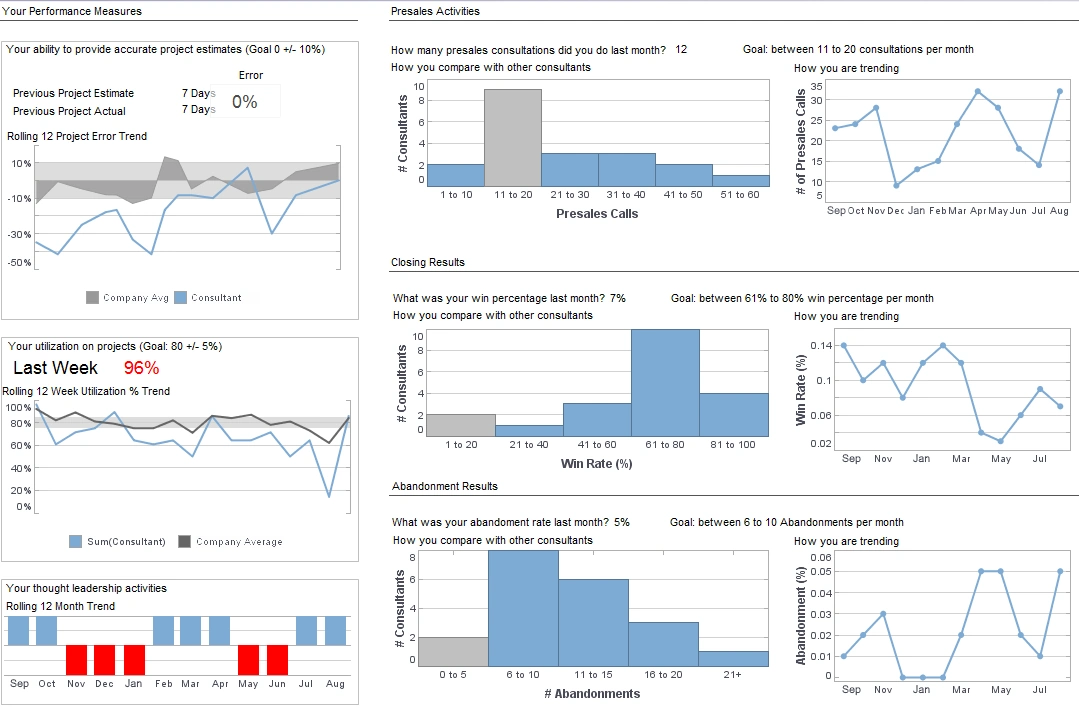
InetSoft's unique design enables salesforce.com users to integrate their data into the StyleBI for Salesforce BI application. The popular proprietary database salesforce.com can conveniently apply InetSoft's easy-to-use data visualization tools for flashier and more interactive reports.
With the abilities to track sales pipelines and market lead data in Salesforce.com, InetSoft's Style Intelligence allows tracking of customer services operations case handling data. Our application's interface provides monitoring services with pre-built dashboard displays of the following key performance indicators:
- Open cases by status, priority, and age
- Current case load by agent and status
- Employee performance by cases closed and time to close
- Overall case open vs. close rate
- Same day close rates - overall and by agent
StyleBI for Salesforce automatically saves daily snapshots of your Salesforce data and records all of the changes. With this data, managers can:
- measure sales success rates of campaigns from start to finish
- compare the current performance of your marketing campaigns to previous ones
- identify outliers in your sales funnel.
- track if year-to-date sales are on track to hit plan using historical patterns.
With StyleBI for Salesforce, you can accomplish things you normally wouldn't be able to with the basic salsforce.com reports. Now you can:
- Schedule reports for email distribution.
- Combine multiple views in a single report.
- Give more options for printing and exporting reports, including Excel, PDF, PowerPoint, and more.
- Build parameterized reports which allow you to select the data you want to view, or automatically see The appropriate data based on security and sharing.
- Organize your reports with sub-folders
Siebel Dashboard Reports
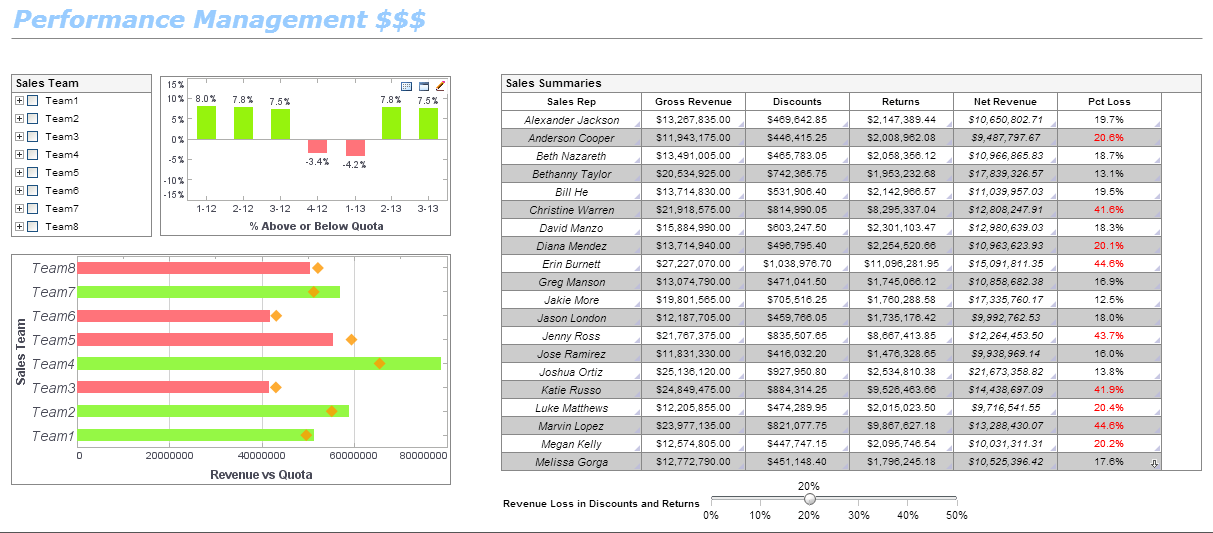
Another example of the successful integration and utilization of the StyleBI dashboarding tool is from Siebel CRM application users. InetSoft BI servers are able to access, monitor, and build reports based on Siebel databases.
Some of the benefits and advantages StyleBI offers include:
- Upgraded dashboards and reports for Siebel users
- Developing Mashups of Your Siebel Data and Other Enterprise Data

About InetSoft
Since 1996 InetSoft has been delivering easy, agile, and robust business intelligence software that makes it possible for organizations and solution providers of all sizes to deploy or embed full-featured business intelligence solutions.
Application highlights include visually-compelling and interactive dashboards that ensure greater end-user adoption plus pixel-perfect report generation, scheduling, and bursting.
InetSoft's patent pending Data Block™ technology enables productive reuse of queries and a unique capability for end-user defined data mashup. This capability combined with efficient information access enabled by InetSoft's visual analysis technologies allows maximum self-service that benefits the average business user, the IT administrator, and the developer.
InetSoft solutions have been deployed at over 5,000 organizations worldwide, including 25% of Fortune 500 companies, spanning all types of industries.
Modernizing Analytics for a Medicinal Leech Farm: Migrating Dashboards from Monday CRM to InetSoft
A niche supplier of therapeutic leeches faced a turning point when growth, regulatory complexity, and international distribution exposed the limits of rudimentary dashboards embedded in a popular CRM. The farm's reporting needs had evolved beyond lead tracking and basic sales funnels: regulatory compliance, batch traceability, cold-chain logistics, and hospital procurement cycles demanded richer, faster, and more auditable analytics. Migrating dashboarding and analytics to a dedicated BI platform provided an opportunity to align operations, quality control, and customer relationship management on a single, flexible reporting layer.
Drivers for Change
Several converging pressures pushed the decision. First, regulatory audits required fine-grained trails tying each shipment to breeding records, feeding schedules, and sanitary test results. Second, partner hospitals requested bespoke performance reports and SLA monitoring, not just CSV exports. Third, the farm expanded into new export markets with varied documentation and language needs, revealing the need for multi-tenant, localized reporting. Finally, in-house analysts wanted interactive visualizations and the ability to blend disparate data sources—lab systems, ERP, CRM, and shipping trackers—without brittle, manual ETL each month.
Why a Dedicated BI Layer
A separate analytics platform promised several advantages. Decoupling reporting from the CRM lessened risk: operational changes in the CRM would no longer break essential compliance reports. A BI layer with mashup capabilities enabled combining structured CRM records with semi-structured lab logs and time-series cold-chain telemetry. Advanced visualizations and parameterized dashboards supported both executive summaries and drillable operational views. Centralized access controls and export controls improved auditability while preserving the CRM for transactional workflows.
Selection Criteria and Requirements
- Data mashup and transformation: ability to join CRM tables with lab and sensor data without complex middleware.
- Regulatory audit features: immutable export logs, versioned reports, and role-based access aligned to GMP-style inspections.
- Performance: sub-second filters for operational dashboards used on packing lines and by logistics coordinators.
- Customization and embedding: ability to embed live dashboards in partner portals and customer portals for recurring reports.
- Localization and scheduling: scheduled delivery of PDFs and CSVs in different languages and time zones, with multi-format export.
Migration Plan
Migration proceeded in staged phases to reduce risk. Phase one focused on discovery: cataloging existing Monday CRM dashboards, listing queries behind them, and mapping data lineage to upstream sources. Phase two implemented a read-only replication of key datasets into a neutral analytics schema. Phase three developed canonical dashboards that replicated existing metrics exactly, enabling side-by-side validation with CRM outputs. Phase four introduced enhanced dashboards that exploited data blending and new KPIs. Final cutover moved scheduled reporting and partner-facing embeds to the BI platform while keeping the CRM as the system of record for transactional edits.
Technical Execution
Data extraction adopted a low-impact, pull-based approach. API connectors harvested CRM tables on a nightly cadence and streamed telemetry and lab results more frequently where latency mattered. Lightweight transformations standardized timestamps, sanitized identifiers, and normalized batch codes so traceability could be preserved across systems. The BI environment supported direct connections to relational stores and flat files, enabling analysts to create joins and calculated fields inside the platform without back-and-forth with engineering.
Dashboard design emphasized actionable clarity. An operations screen displayed live packing throughput, pending quality holds, and cooling-curve deviations flagged by automated anomaly detection. A compliance board presented audit trails with linked batch documents and role-based redaction for sensitive supplier details. Executive views summarized monthly revenue by client type, reorder velocity for major hospital accounts, and forecasted demand by region—using blended CRM orders plus seasonality adjustments derived from historical shipments.
Change Management and Training
Adoption relied on role-specific onboarding. Logistics and lab teams received short, scenario-based training focused on their daily workflows. Analysts learned self-serve features for ad-hoc exploration and storyboarding. Customer success and sales teams were taught how to schedule and customize partner-facing reports. Documentation included runbooks for scheduled exports and a simple rollback checklist in case a scheduled report required urgent correction. Early adopter power-users were empowered to create templates and govern a small catalog of sanctioned dashboards to maintain consistency.
Governance, Security, and Compliance
Governance policies were established to safeguard traceability. Dashboards that pulled sensitive patient-proximate data were restricted to authorized roles and required manual approval for ad-hoc exports. All scheduled report deliveries were logged with checksums and retention policies aligned to regulatory requirements in export target countries. Encryption in transit and at rest, single sign-on integration with existing identity providers, and two-factor authentication for privileged accounts reduced attack surface. Versioning for dashboards enabled auditors to view the state of a report at the time of a past shipment.
Outcomes and Measurable Benefits
After implementation, report generation latency dropped from hours to minutes. Packing-line supervisors used live dashboards to identify temperature excursions and enact corrective actions before shipments left the facility, reducing spoilage rates. Compliance teams produced audit packages in a fraction of the prior time because dashboard drilldowns linked directly to source documents. Sales teams leveraged embedded partner reports to improve communication with hospitals, shortening reorder cycles. Analysts reported a substantial reduction in manual data wrangling, enabling focus on predictive models for demand forecasting.
Lessons and Next Steps
Key lessons included the value of starting with parity dashboards to build trust, the importance of flexible connectors for a specialized supply chain, and the benefits of enforcing governance early to avoid proliferation of inconsistent KPIs. Next steps included expanding predictive maintenance analytics for breeding tanks, integrating more granular cold-chain telemetry into automated SLA alerts, and rolling out customer-facing portals where hospitals could retrieve scheduled compliance bundles and shipment metrics directly.
Transitioning dashboarding from a CRM-embedded solution to a dedicated analytics platform delivered measurable operational, compliance, and commercial improvements for the medicinal leech farm. The migration illustrated how a small, highly regulated supplier can leverage modern BI capabilities to scale responsibly while preserving the traceability and transparency essential to medical supply relationships.