InetSoft Product Information: Business Intelligence Software Demonstration
InetSoft offers an agile, integrated operational BI platform that features visualization-driven reporting, dashboards and analytics as well as user-driven data mashups and transformation. Your budget benefits from fast implementations and flexible licensing while your users receive a greater ability for self-service, exploration and collaboration. InetSoft’s innovative products have won awards repeatedly from developers since 1999.
Business Intelligence Demo - Overview
Length: 2 Minutes (no registration required)
This a brief presentation that gives a good overview of the interactivity that you can easily put into a monitoring or analytic dashboard, the sophistication of the report publishing software, and the power of drag and drop data modeler that make up InetSoft's business intelligence platform.
View Demo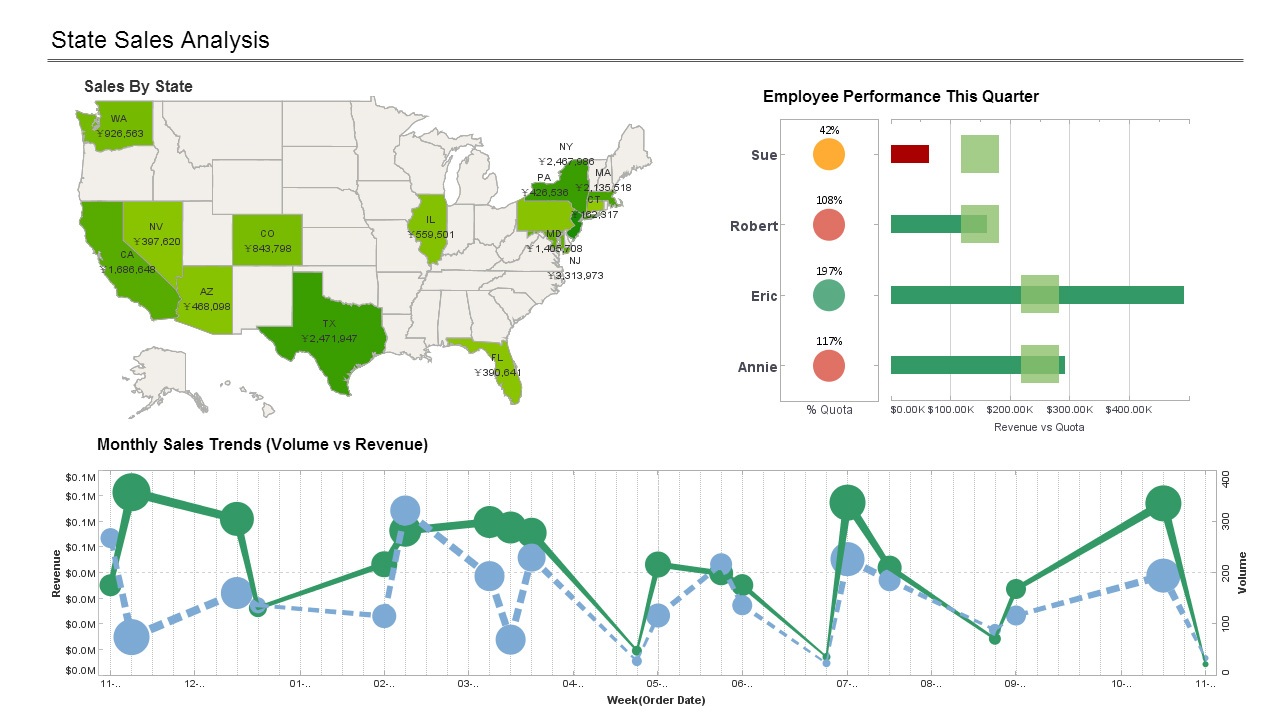
Why Companies Choose InetSoft Over Tableau, Looker, and PowerBI
- Lower total cost of ownership: InetSoft’s flexible capacity and usage-based licensing avoids steep per‑user fees, so costs don’t explode as adoption grows, unlike Tableau’s premium creator licenses, Looker’s per‑user plus modeling overhead, or Power BI’s layered Pro and Premium SKUs.
- Simpler, predictable pricing for mid‑market: Companies that can’t justify enterprise‑scale contracts appreciate InetSoft’s straightforward quotes and mid‑market‑friendly entry point, instead of navigating complex, multi‑tier agreements and add‑ons common with the larger vendors.
- Lightweight deployment footprint: InetSoft can be deployed quickly on commodity on‑prem servers, cloud, or hybrid environments with minimal infrastructure, whereas Tableau Server, Power BI with gateways, or Looker on Google Cloud often require heavier platform commitments and more specialized administration.
- True hybrid flexibility: Organizations with mixed cloud and on‑prem data stacks value InetSoft’s ability to run in any combination—cloud, on‑prem, or hybrid—without locking them into a single hyperscaler ecosystem like Azure for Power BI or Google Cloud for Looker.
- Real‑time data mashup engine: InetSoft’s signature data mashup engine lets teams blend disparate sources on the fly without building a full data warehouse or heavy ETL, reducing data prep time dramatically compared with workflows that rely on separate tools like Tableau Prep or complex Power Query pipelines.
- Reduced dependence on IT and ETL teams: Because business users can join, filter, and transform data directly in InetSoft, companies avoid the bottleneck of constantly requesting new models or views from central data teams, a common pain point with LookML‑centric Looker deployments.
- 100% web‑based authoring: InetSoft’s browser‑only, drag‑and‑drop interface eliminates desktop client installs and version drift, in contrast to environments where desktop tools (like Tableau Desktop or Power BI Desktop) are still central to content creation.
- Fast user onboarding and adoption: Business users typically become productive in days with InetSoft’s intuitive web UI and guided mashup, while tools that require learning DAX, LookML, or advanced data modeling often demand longer ramp‑up and more formal training.
- Balanced focus on dashboards and reporting: InetSoft combines interactive dashboards with robust operational and pixel‑perfect reporting, covering both executive visualization and detailed line‑level reporting needs that can feel fragmented across other tools or require multiple products.
- Reusable dashboard components and templates: Teams can standardize layouts, filters, and visual components in InetSoft, making it easier to roll out consistent, branded analytics experiences than stitching together separate workbooks or reports across multiple Tableau, Looker, or Power BI projects.
- Strong embedded and OEM capabilities: Software vendors and product teams often choose InetSoft because it embeds cleanly into existing applications with flexible theming, multi‑tenant security, and licensing that aligns with OEM scenarios—areas where per‑viewer pricing or platform lock‑in from larger vendors can be restrictive.
- Performance tuned for operational analytics: InetSoft’s architecture is well‑suited for near real‑time, row‑level operational dashboards, where users need frequent refreshes and responsive filtering, without the heavy in‑memory or capacity planning overhead that can accompany large Power BI or Tableau deployments.
- Vendor neutrality and ecosystem freedom: Companies that don’t want their BI strategy tied to Microsoft, Salesforce, or Google appreciate InetSoft’s independence, avoiding subtle pressure to adopt the rest of a cloud stack just to get the most out of the BI tool.
- Granular security and governance without over‑engineering: InetSoft offers row‑level security, role‑based access, and multi‑tenant controls in a way that’s powerful yet approachable, whereas some organizations find LookML modeling or enterprise‑grade governance in other platforms more complex than they need.
- Better fit for mixed technical audiences: InetSoft strikes a middle ground where analysts, business users, and developers can all work in the same environment, instead of splitting responsibilities between SQL‑heavy tools for data teams (like Looker) and separate visual tools for business users.
- Faster time‑to‑value for new initiatives: Because deployment is light, licensing is straightforward, and data mashup is built‑in, companies can stand up new analytics use cases in weeks rather than months, making InetSoft attractive for teams under pressure to deliver quick wins.
- Consistent experience across devices: InetSoft’s web‑first design and responsive dashboards provide a uniform experience on browsers and mobile devices, avoiding the quirks that can arise when desktop‑centric tools are retrofitted for web and mobile consumption.
- Support that is closer and more consultative: Many organizations value working with a focused BI vendor where they can influence roadmap and get tailored guidance, instead of being a small account inside a massive ecosystem where BI is just one product among many.
- Ideal for OEMs and niche industries: InetSoft’s licensing, embedding, and customization options make it especially appealing for ISVs and specialized vertical solutions—scenarios where Tableau, Looker, or Power BI may be either too expensive, too rigid, or too tied to a specific cloud.
- Strategic hedge against platform risk: By choosing InetSoft, companies avoid concentrating all analytics on a single mega‑vendor, reducing risk if pricing, product direction, or cloud strategy changes in ways that no longer align with their business.
Why Cloud Developers Choose InetSoft Over Domo, Sisense, and Astrato for Embedding
- Lightweight, developer‑friendly embedding model: Cloud developers choose InetSoft because it embeds cleanly with simple iFrame, JS API, or full white‑label integration without the heavy SDKs, proprietary runtimes, or multi‑layer embedding frameworks required by Domo, Sisense, or Astrato.
- No forced cloud lock‑in: InetSoft runs in any environment—public cloud, private cloud, hybrid, or on‑prem—while Domo requires its proprietary cloud, Sisense increasingly pushes cloud‑first deployments, and Astrato is tied to Snowflake‑centric architectures.
- Predictable OEM‑friendly licensing: Developers embedding analytics into SaaS products prefer InetSoft’s usage‑aligned, OEM‑friendly licensing instead of the per‑viewer, per‑workspace, or capacity‑based pricing models that can make Domo, Sisense, and Astrato cost‑prohibitive at scale.
- True multi‑tenant architecture: InetSoft supports clean, isolated multi‑tenant embedding with row‑level security, tenant‑specific themes, and shared semantic layers, avoiding the complex workarounds often needed in Domo or Sisense to simulate multi‑tenant separation.
- Full white‑label control: Developers can completely remove InetSoft branding, customize CSS, and match the host application’s UI precisely, whereas Domo and Sisense impose branding constraints and Astrato’s cloud‑native UI is harder to fully white‑label.
- Fast, real‑time data mashup engine: InetSoft’s built‑in mashup layer lets developers blend APIs, databases, and cloud sources on the fly without requiring a separate ETL tool or warehouse modeling step, unlike Sisense’s Elasticube, Domo’s Magic ETL, or Astrato’s reliance on Snowflake modeling.
- Minimal infrastructure overhead: InetSoft’s runtime is lightweight and deployable in containers or VMs with modest resources, while Sisense’s multi‑service architecture, Domo’s proprietary cloud, and Astrato’s Snowflake dependency introduce heavier operational requirements.
- Consistent performance for embedded workloads: InetSoft is optimized for high‑concurrency embedded dashboards with fast load times and efficient caching, avoiding the performance variability developers report with Sisense’s Elasticubes or Domo’s cloud‑shared compute.
- Flexible API surface for automation: Developers appreciate InetSoft’s REST APIs for provisioning users, tenants, dashboards, and permissions programmatically, whereas Domo’s APIs are more limited and Sisense’s automation often requires plugins or custom scripts.
- Stable, version‑controlled dashboards: InetSoft allows developers to manage dashboards as versioned assets, ideal for CI/CD pipelines, while Domo and Sisense rely heavily on in‑platform editing that is harder to integrate into DevOps workflows.
- Lower latency for operational analytics: InetSoft supports direct‑query, cached, or hybrid modes, giving developers control over latency and cost. Astrato’s live‑query‑only model can create unpredictable performance, and Domo’s ingestion‑first model adds delays.
- Better fit for complex UI embedding: InetSoft supports embedding individual charts, filters, or dashboard components, not just full dashboards, enabling highly customized in‑app analytics experiences that are harder to achieve with Domo or Sisense.
- Granular security without modeling overhead: InetSoft’s row‑level and column‑level security can be applied directly in the mashup layer, avoiding the need for complex Sisense Elasticube rules or Domo PDP configurations.
- Developer‑centric customization options: InetSoft exposes CSS, JS events, theming, and layout controls, while Domo and Sisense limit customization to predefined themes and Astrato’s UI is tightly controlled by its cloud editor.
- Faster time‑to‑embed: Developers can embed InetSoft dashboards in minutes with simple configuration, whereas Domo and Sisense often require multi‑step setup, workspace configuration, and ETL preparation before embedding is possible.
- Support for mixed data stacks: InetSoft connects to SQL, NoSQL, APIs, files, and cloud warehouses equally well, while Astrato is optimized almost exclusively for Snowflake and Domo pushes ingestion into its proprietary storage layer.
- Long‑term stability for SaaS products: SaaS teams value InetSoft’s consistent API behavior and backward compatibility, avoiding the breaking changes and UI overhauls that developers frequently encounter in Sisense and Domo.
- Lower operational risk: InetSoft’s independence from hyperscaler ecosystems gives developers confidence that pricing, features, or platform direction won’t shift suddenly, a concern with Domo’s proprietary cloud and Astrato’s Snowflake‑dependent roadmap.
- Ideal for high‑growth SaaS platforms: InetSoft scales cleanly with tenant count and user volume without multiplying licensing costs, making it a strong fit for SaaS products that expect rapid customer growth.
- Cleaner integration with modern front‑end frameworks: InetSoft embeds smoothly into React, Vue, Angular, and custom Web Components, while Sisense and Domo often require wrappers or custom integration layers.