Top 10 Reasons to Select InetSoft as Your Big Data Analytics and BI Dashboarding Vendor in 2024
We prepared a Top 10 list to help point out some of the differences between our solution and the competition's. The list also provides some answers to frequently asked questions.
1. Rapid Implementation – InetSoft's solution requires only a web browser for end-users and developers, so deployment time is minimized. An IT person with basic database administration skills can install and set up the software.
2. Shallow Learning Curve – InetSoft's software enables intuitive visual analyses constructed in real-time by dropping data items into visual elements such as charts, graphs, and gauges. Users need only Excel-level skills to build dashboards or reports.
3. No Dedicated BI Developer Required – Unlike many other solutions that are so complex that one or more dedicated BI developers are necessary, InetSoft's technology has proven to require only fractional headcount. When deeper expertise needs do arise, InetSoft engineers are readily accessible on a one-on-one basis.
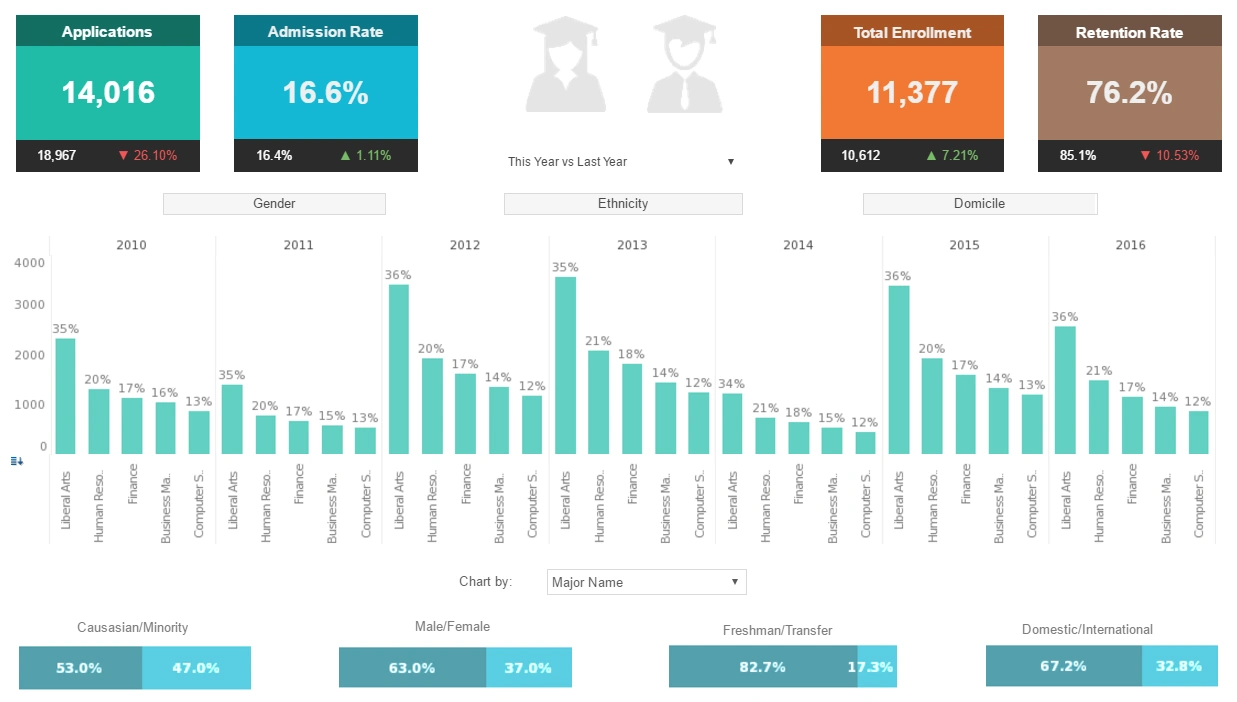

4. Maximum Self-service – From business users to power users, various levels of self-service are possible. Point-and-click visual analysis and drill-through reporting requires no training and meets most ad hoc reporting needs. Complex data transformations and queries are also possible for database analysts. Expensive BI experts or consultants are not needed, which lowers the cost of owning our software.
5. Flexible Adaptation and Big Data Connectivity – Whether you have a data warehouse and ETL processes, or not, InetSoft's robust data access engine, based on our Data Block technology, can access disparate data sources directly. The ability to access virtually any data source, along with special connectors for Hadoop, Cloudera, and other popular Big Data sources, make accommodating transient data source access needs simple.
6. Data Mashup – Our software offers a unique capability for end-user defined data mashup, which enables business users or analysts to combine data from disparate sources ranging from Big Data sources to imported spreadsheets, without the need for formal data models being pre-defined.
7. Simplicity for End-Users – InetSoft's drag and drop software allows end-users to quickly create sophisticated dashboards and reports. Visual analysis and intuitive point-and-click tools like brushing allow end-users to explore data and identify trends. You can provide easy-to-use pre-built dashboards that are personalizable by end-users.
8. Advanced Capabilities for Analysts – Professional report authoring tools for pixel-perfect publishing can reproduce any existing formatted document. Business logic can be embedded in reports or dashboards via parameterization. Hand written SQL queries and complex joins are possible.

9. Optimized for Embedding – ISV, SaaS providers, and enterprise developers can embed InetSoft's dashboards and reports in any web-based application. A full API, the ability to control which functions are available to which users, and support for multi-tenancy all make for an integration-friendly solution.
10. A High Performance, Secure Infrastructure – When necessary, performance is maximized via clustering and caching and can be fine-tuned with optimization techniques, such as automatic pre-aggregation. Data security can be enabled down to the cell level. The security of each visual object, report, and dashboard as well as each operating function is individually configurable.
Manufacturer Improves Efficiency with StyleBI
A mid-sized electronics manufacturer implemented InetSoft StyleBI to enhance production efficiency and reduce downtime across its primary assembly plant. By embedding real-time dashboards into operator workstations and supervisory control systems, the company aimed to provide actionable insights directly within existing workflows.
Real-time shop floor visibility
After deploying StyleBI, the manufacturer replaced static daily reports with live operational dashboards feeding machine telemetry, MES events, and ERP order data. Line supervisors gained real-time KPIs—cycle time, throughput, reject rates—on wall-mounted displays and tablets. The immediate visibility enabled frontline teams to spot stalls and bottlenecks within minutes rather than hours, reducing average incident detection time from 120 minutes to under 15 minutes.
Faster root-cause analysis through drilldown
Interactive drilldown dashboards let engineers move from plant-level OEE trends to individual machine traces and operator logs in a few clicks. One recurring bottleneck that previously took two days of manual log correlation was diagnosed in under three hours after operators used linked filters and contextual annotations. Faster root-cause analysis shortened mean time to repair and increased overall equipment availability by an estimated 6 percent.
Predictive maintenance integration
StyleBI was integrated with the company’s IoT platform to surface vibration and temperature anomalies alongside historical maintenance records. The analytics team created templated alerts and trend widgets that automatically flagged components showing degradation patterns. By turning predictive signals into scheduled maintenance work orders, the plant reduced unplanned downtime events by 22 percent and shifted more maintenance to planned windows, lowering overtime and rush parts costs.
Template-driven dashboards for multiple plants
Instead of bespoke reports for each facility, the team built a library of templated dashboards with parameterized filters for plant, line, and shift. Rolling out a new tenant-branded dashboard to a greenfield plant went from six weeks to three days. Standardized templates also enabled corporate planners to compare metrics across sites consistently, improving benchmarking and best-practice sharing.
Reduced reporting overhead and headcount redeployment
Automated dashboards eliminated recurring manual report preparation that had consumed two analysts full-time. Those analysts were redeployed to higher-value activities—analytics for yield improvement and test design—saving an estimated $160,000 annually in labor while enabling more strategic projects that directly improved throughput.
Improved inventory turns and reduced expediting
By combining production forecasts, WIP levels, and supplier lead-time visualizations, planners could spot impending shortages earlier. Scenario widgets allowed planners to simulate the impact of shifting production mixes and producing critical SKUs sooner. The plant reduced expedited freight spend by 28 percent and increased inventory turns by 12 percent within six months.
Embedded analytics for supervisors and field workers
StyleBI’s embedding capabilities allowed analytics to be integrated directly into the company’s workforce mobile app and operator terminals. Supervisors accessed the same KPI widgets in-context with shift handoff notes and quality checklists, eliminating context switching and ensuring decisions were made with the latest data. Adoption rates for analytics-driven actions rose sharply because insights were presented inside existing workflows.
Faster decision cycles and continuous improvement
Dashboards with built-in annotations and snapshot sharing reduced meeting time and focused follow-ups on action items. Continuous improvement teams used interactive views to run rapid A/B tests of process changes and measure impact within hours rather than waiting for weekly reports. This shortened improvement cycles and produced measurable gains in first-pass yield and throughput across multiple product lines.