Solving Unstructured Operational Data Challenges in Waste and Hauling with StyleBI
Many waste management and hauling companies face a similar challenge: their operational data is scattered, inconsistent, and often captured in incompatible formats.
A mid-sized firm may run dozens of trucks across residential, commercial, and roll-off service lines, yet the underlying data infrastructure is rarely unified.
Dispatch may log activity in one system, billing may rely on a legacy platform, and GPS units may export timestamps in formats that don’t align with anything else.
The result is a patchwork of CSV files, manual reconciliation, and hours spent cleaning data before any meaningful analytics can begin.
When time-on-site, billable hours, and route activity are all recorded differently, analysts end up writing endless normalization scripts instead of building dashboards or predictive models.
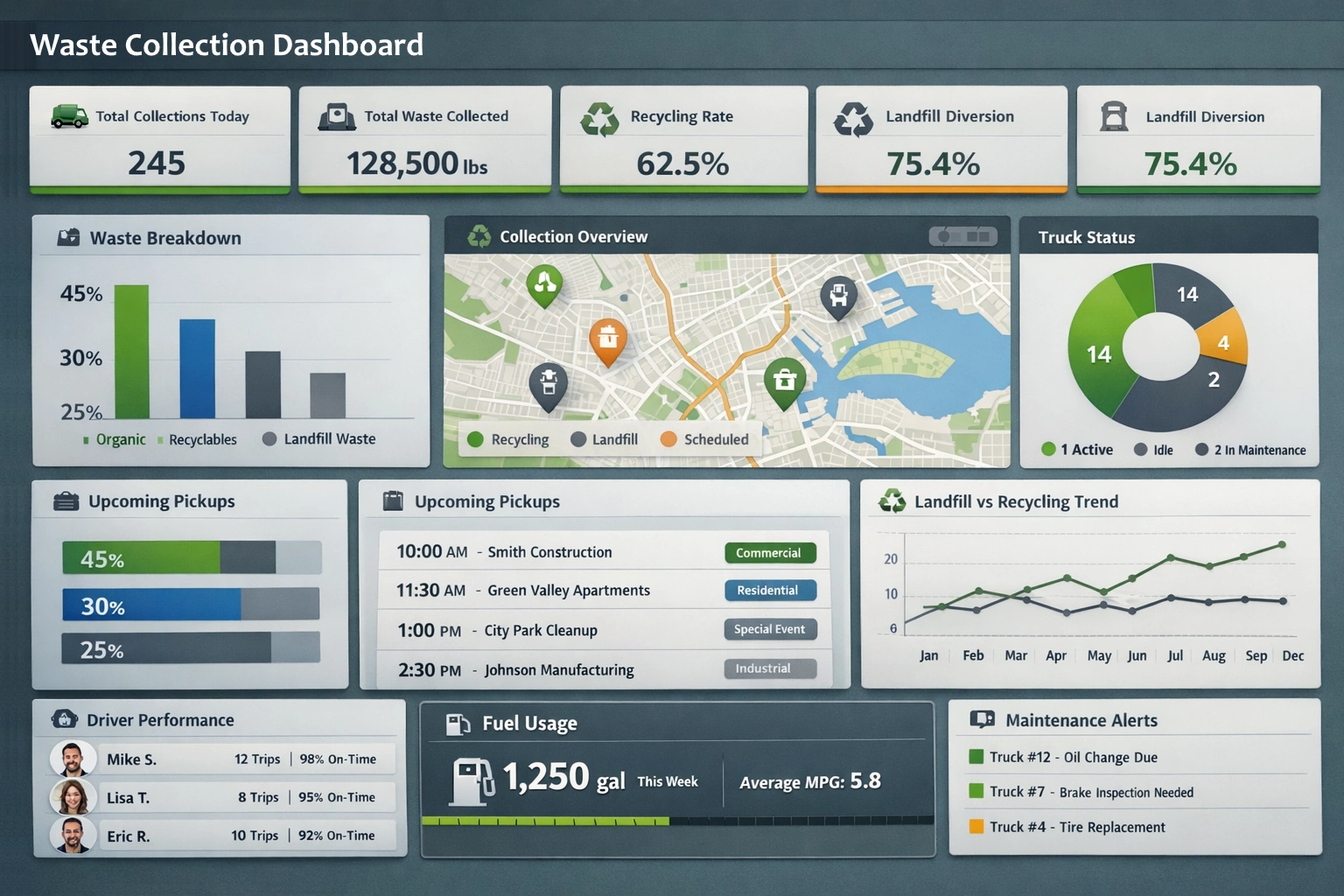
The core question becomes: should the organization overhaul its operational software, or should the BI team build middleware to stitch everything together? Without a strong data foundation, it can feel like constructing a house on sand.
This is exactly the type of environment where StyleBI’s architecture, data pipeline, and modeling capabilities shine. Instead of forcing a full system replacement or relying on brittle custom scripts, StyleBI provides a structured, repeatable, and scalable way to tame unstructured operational data and turn it into reliable, decision-ready intelligence.

How StyleBI Addresses the Core Data Challenges
StyleBI is designed for organizations that operate in messy, real-world environments—where data comes from multiple systems, formats vary wildly, and operational workflows evolve faster than IT systems can keep up. Below is a detailed look at how StyleBI solves each pain point common in the waste and hauling sector.
1. Unifying Disconnected Operational Systems
Waste management firms often rely on a mix of dispatch software, billing systems, GPS trackers, and manual spreadsheets. These systems rarely communicate with one another, creating silos that make analysis difficult. StyleBI’s integrated data pipeline allows teams to ingest data from all these sources—CSV exports, databases, APIs, and legacy systems—into a single, governed environment.
Instead of writing ad hoc Python scripts for every new export, analysts can build reusable transformation flows directly inside StyleBI. These flows automatically clean, merge, and standardize data on a schedule, ensuring that dashboards always reflect the latest reality. This eliminates the need for custom middleware and reduces the dependency on manual reconciliation.
2. Standardizing Timestamps and Operational Metrics
One of the biggest issues in hauling operations is inconsistent timestamp formats. GPS units may log in UTC, dispatch may use local time, and billing may rely on manually entered values. These inconsistencies lead to discrepancies in time-on-site, route duration, and billable hours.
StyleBI’s transformation engine allows teams to define standardized timestamp rules once and apply them automatically across all incoming data. Whether the source uses ISO formats, UNIX time, or ambiguous MM/DD/YYYY strings, StyleBI can normalize them into a consistent structure. This ensures that KPIs such as route duration, service time, and overtime calculations are accurate and comparable across service lines.
3. Automating Data Cleaning and Normalization
Analysts in the waste sector often spend more time cleaning data than analyzing it. StyleBI eliminates this bottleneck by providing a visual pipeline. Instead of writing Python scripts to fix every new batch of CSV files, analysts can build transformations that:
- Standardize column names and formats
- Merge data from dispatch, billing, and GPS systems
- Correct inconsistent units (minutes vs. hours)
- Identify and flag missing or suspicious values
- Apply business rules for rounding, grouping, or classification
Once defined, these transformations run automatically, ensuring that the BI environment always has clean, structured, and analysis-ready data. This frees analysts to focus on modeling, forecasting, and optimization.
4. Creating a Single Source of Truth for KPIs
Waste management operations rely on dozens of KPIs—route efficiency, time-on-site, fuel usage, container turnover, driver productivity, and more. When each department uses its own system, these KPIs become inconsistent and unreliable.
StyleBI allows organizations to define KPI logic centrally within the data model. Once defined, these KPIs are applied consistently across all dashboards, reports, and service lines. This ensures that residential, commercial, and roll-off operations all use the same definitions for time-on-site, billable hours, and route efficiency.
With a unified KPI framework, leadership gains a clear, accurate view of fleet performance across the entire fleet.
5. Supporting Predictive Modeling and Optimization
Once data is clean and standardized, StyleBI makes it easy to build predictive models for:
- Route optimization
- Driver performance forecasting
- Container fill-level prediction
- Maintenance scheduling
- Fuel consumption analysis
Because StyleBI integrates data transformation and visualization in one platform, analysts can iterate quickly—testing new models, validating assumptions, and visualizing results without switching tools or rewriting scripts.
6. Reducing the Need for Operational System Overhauls
Many waste management firms hesitate to replace their operational software due to cost, training, and disruption. StyleBI provides a middle path: instead of forcing a full system overhaul, it creates a unified analytics layer that compensates for the limitations of legacy systems.
By centralizing data transformation and KPI logic, StyleBI allows organizations to modernize their analytics without replacing dispatch, billing, or GPS platforms. Over time, as systems are upgraded, StyleBI adapts easily—ensuring continuity and minimizing disruption.
7. Delivering Dashboards for Every Stakeholder
StyleBI supports interactive dashboards for dispatchers, managers, executives, and field supervisors. Each group can access the metrics most relevant to their role:
- Dispatch sees real-time route progress and exceptions
- Billing sees accurate, standardized service times
- Operations sees driver performance and route efficiency
- Executives see high-level KPIs across all service lines
Because the dashboards are built on a unified data model, everyone sees the same numbers—eliminating disputes and improving decision-making.
8. Building a Stable Foundation for Long-Term Analytics
The feeling of “building a house on sand” comes from relying on inconsistent, unstructured data. StyleBI replaces that sand with a solid, governed foundation. By centralizing data transformation, standardizing KPIs, and automating normalization, StyleBI ensures that analytics are reliable, scalable, and future-proof.
Instead of fighting with CSV files, analysts can focus on delivering insights that improve route efficiency, reduce overtime, optimize container placement, and enhance customer satisfaction.