Agility in Accessing Data Sources
Below is the transcript of a Webinar hosted by InetSoft on the topic of New Features in Version 11 of InetSoft's StyleBI BI Software. The presenters are Mark Flaherty, CMO at InetSoft, and Navish Javed, Product Manager at InetSoft.
Mark Flaherty (MF): Speaking more about agile business intelligence, agility also comes from being able to make quick changes on the backend being able to bring in new data sources to see if these are the ones that you want to bring into a data warehouse or whether you want to just keep them standalone as operational data sources, our software connects them just the same.
In terms of robustness, we have built our solution to be enterprise grade, and that means being able to deploy to large numbers of users or accessing large datasets over a distributed architecture. We support clustering and load balancing and have our own technology, which we call data grid cache, which helps speed up access to large data sets and supports large number of users.
BI Product Overview
Next I just wanted to provide a product overview. StyleBI is our flagship business intelligence software product, which includes all of our technologies. It's built on a data access platform. Data Block is the terminology we use for bringing data from different data sources, again it can be almost any data source out there, whether it’d be an operational data store or a CRM or financial solution, it can be data warehouses, even flat files and spreadsheets, Web services, what have you.
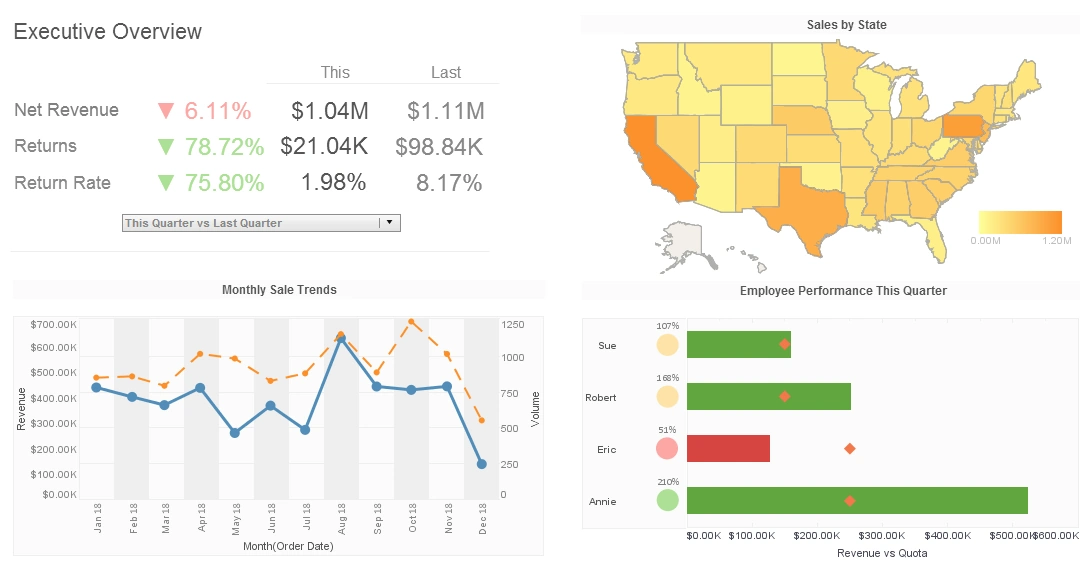
And on top of this data access layer, you can build a visualization. That can be your dashboards and your interactive analyses. You can also use our very mature reporting capabilities, which we call our publishing capabilities; and that’s good for creating those paginated reports, pushing or pulling them as needed.
To give you a little bit of preview what you will see in the demo, this slide is giving a little idea of working with Data Blocks. We have our data modeler there that comes with the application, and that is what you would use to set up your connections to your data sources initially. And then as you are actually trying to build reports or dashboards then you are using a drag & drop design environment which is Web based. This is where you select the different fields that you want to use and be able to visualize in dashboard report.

How Data Block Technology Speeds Up Dashboard Report Development
InetSoft's data block technology is a powerful feature that significantly accelerates the development of dashboard reports by streamlining the process of data integration and visualization. At its core, data blocks are modular components that encapsulate data access, transformation, and presentation logic into reusable building blocks. These blocks can be easily configured and interconnected to assemble complex data queries and visualizations without the need for extensive coding or database expertise. By abstracting away the complexity of data manipulation and visualization, data blocks empower dashboard developers to focus on delivering insights and value to end-users more efficiently.
One of the key advantages of InetSoft's data block technology is its flexibility and adaptability to diverse data sources and formats. Whether accessing structured databases, unstructured data sources, or cloud-based applications, data blocks provide a unified interface for accessing and transforming data regardless of its underlying source or format. This versatility enables developers to quickly incorporate data from multiple sources into their dashboard reports, eliminating the need for manual data wrangling and integration efforts. As a result, dashboard development cycles are greatly accelerated, and organizations can derive insights from their data more rapidly.
Furthermore, InetSoft's data block technology promotes reusability and consistency across dashboard reports by allowing developers to create and manage a library of predefined data blocks. These reusable components encapsulate common data access patterns, calculations, and visualizations, enabling developers to leverage existing blocks and customize them as needed to meet specific reporting requirements. This not only speeds up dashboard development but also ensures consistency and accuracy in data representation across different reports and dashboards within an organization. Additionally, by centralizing the management of data blocks, organizations can enforce data governance policies and maintain a single source of truth for their data assets.
Overall, InetSoft's data block technology revolutionizes dashboard report development by empowering developers to rapidly integrate, transform, and visualize data from diverse sources with ease. By simplifying and automating repetitive tasks, data blocks streamline the development process, reduce time-to-insight, and enable organizations to make data-driven decisions more efficiently. With its focus on flexibility, reusability, and consistency, data blocks represent a key innovation in dashboard development that accelerates the delivery of actionable insights to stakeholders across the organization.

Data Access: A Strategic Requirement
As organizations expand their digital ecosystems, the number of data sources they rely on grows just as quickly. This makes agility in data access a strategic requirement rather than a technical preference. Enterprises must be able to connect to new systems the moment they are adopted, whether they are cloud applications, on-premises databases, or third-party data services. Modern BI platforms support this need by offering broad connector libraries and flexible integration frameworks that eliminate long development cycles. When teams can onboard new data sources rapidly, analytics initiatives maintain momentum and business units stay aligned with fast-changing operational demands.
Another critical factor in achieving agile data access is the ability to blend disparate datasets without requiring complex ETL projects. Traditional data integration approaches often force organizations into rigid pipelines that are difficult to modify once deployed. In contrast, agile BI environments allow users to combine structured, semi-structured, and unstructured data on the fly, creating virtualized datasets that support immediate analysis. This reduces dependency on IT teams and empowers analysts to explore new questions as they arise, accelerating the path from raw data to actionable insight.
Hybrid data environments have also become a defining feature of modern enterprises. Many organizations now operate across a mix of cloud platforms, legacy systems, and distributed storage architectures. Agile data access requires BI tools that can navigate this complexity seamlessly, providing unified visibility without forcing data migration. By supporting both cloud-native and on-premises connections, modern analytics platforms give organizations the flexibility to modernize at their own pace while still delivering consistent, real-time reporting across all systems.

Data Governance and Security in Agile Environments
Data governance plays a central role in ensuring that agile access does not compromise security or compliance. As more users gain the ability to connect to and manipulate data sources, organizations must enforce clear rules around data quality, permissions, and lineage. Enterprise BI platforms address this by embedding governance controls directly into the data access layer, ensuring that agility is balanced with oversight. This approach allows organizations to scale self-service analytics responsibly, maintaining trust in the accuracy and reliability of the insights being produced.
Finally, the rise of API-driven architectures is transforming how organizations think about data access. Instead of relying solely on traditional database connections, enterprises increasingly pull data from real-time services, event streams, and external APIs. Agile BI platforms that support these modern integration patterns enable organizations to incorporate live operational signals into their analytics workflows. This shift allows decision-makers to respond to emerging trends faster and with greater precision, turning data access agility into a competitive advantage that strengthens both strategic planning and day-to-day execution.