Next-generation BI Technologies
Below is the continuation of the transcript of a Webinar hosted by InetSoft on the topic of Business Intelligence Trends and InetSoft Innovations. The presenter is Mark Flaherty, CMO at InetSoft.
Mark Flaherty: So, the big question is how do you really align those very often different and opposite requirements. Well, it's not all bad news, and there are lots of next-generation BI technologies in addition to some of the best practices that can help. There are definitely these next-generation technologies that can indeed bring business and IT closer together and can align them.
The two key ones that we are spending time talking about today are the next-generation technologies that make business intelligence and analytics environment much more agile and that do indeed enable end-user self-service. And among some of these specific technologies, I can name lots of them, but very relevant to today's discussion are databases that are built from the ground up for analytics, not for transaction processing.
When we look at traditional databases, they were all invented thirty or forty years ago for transaction processing, and sometime optimizing them for analytics is almost like trying to have a square peg into a round hole. So we definitely need analytical platforms that are designed from the ground up for business intelligence, not for transaction processing.
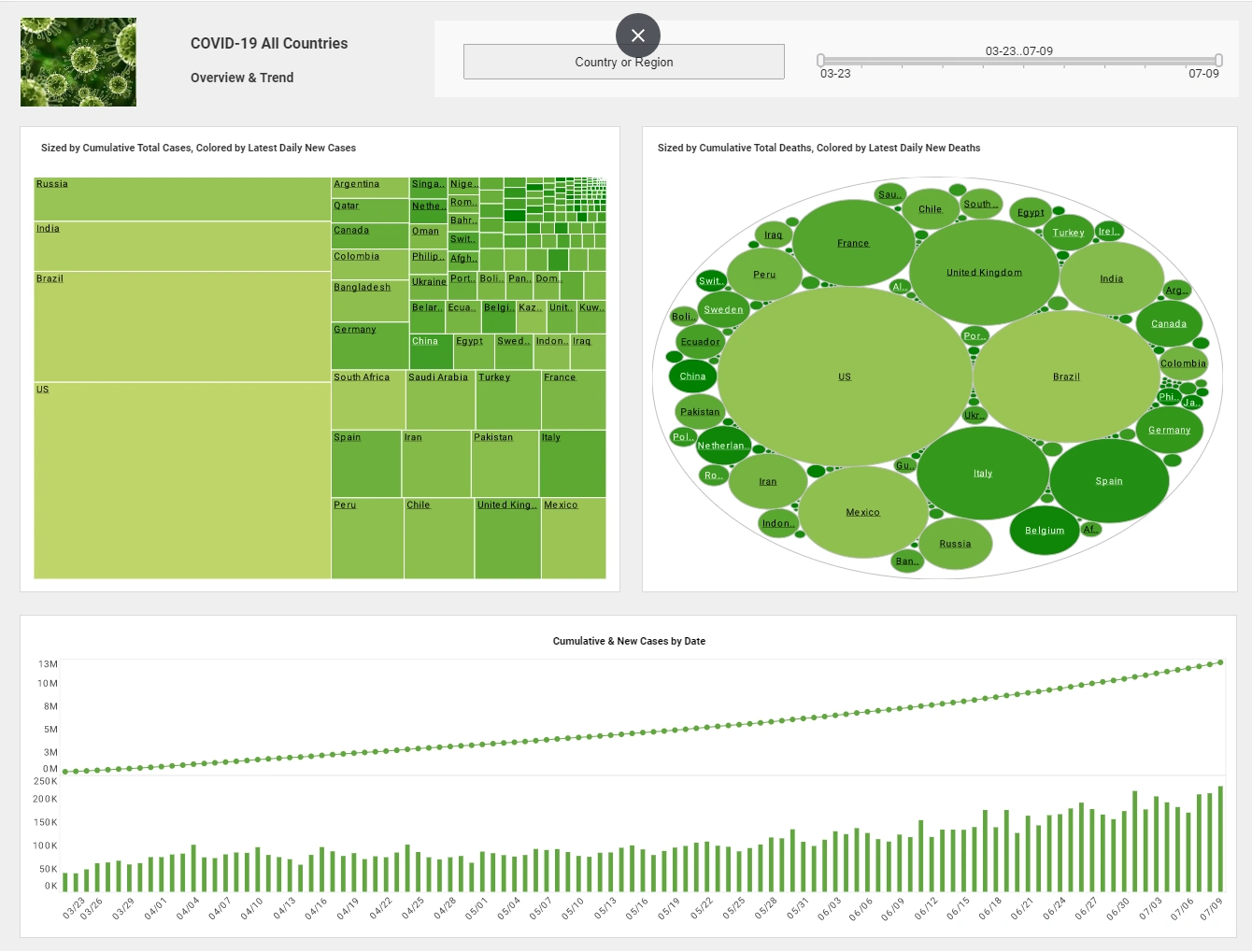

Agility and Self-service
Businesses also spend a lot of time modeling data, and that's precisely what IT does very well. They collect requirements and they transform those requirements into data models. But there is one problem with that. It takes too long, and by the time you are done, the requirements have changed. And my point is that if you didn't foresee some of the requirements, and you didn't model them, well then, guess what, you can't really analyze the that condition. So we definitely need environments that are driven by the data content itself, not by the data models.
I can keep going on and on, but another key feature for agility and self-service is a point-and-click user interface. For many years, vendors have been promoting products that have point-and-click and drag-and-drop, especially for those of us who are old-timers who are used to green mainframe screens and even working with punch cards, obviously graphical user interfaces with point-and-click, drag-and-drop interfaces are much more user friendly. But to non-technical end-users, you really have to design the application smartly to make them really user friendly.

Convergence of BI with AI and ML
The future of BI software is poised for even greater innovation and transformation. One key trend on the horizon is the convergence of BI with artificial intelligence (AI) and machine learning (ML) technologies. By integrating AI and ML capabilities into BI platforms, organizations can automate data analysis, uncover deeper insights, and drive more informed decision-making in real-time. This fusion of BI with AI and ML holds immense potential to revolutionize how businesses leverage data to gain competitive advantages and adapt to rapidly changing market dynamics.
Another prominent trend shaping the future of BI software is the rise of augmented analytics. Augmented analytics refers to the use of AI and ML algorithms to automate data preparation, analysis, and insights generation, enabling business users to explore data and discover actionable insights with minimal manual effort. By leveraging natural language processing (NLP) and natural language generation (NLG) capabilities, augmented analytics platforms empower users to interact with data in a more intuitive and conversational manner, democratizing access to analytics across the organization. As organizations seek to become more data-driven and agile, augmented analytics will play a pivotal role in enabling business users to make faster, more informed decisions based on data-driven insights.
The future of BI software is characterized by the increasing emphasis on data governance, privacy, and security. With the growing importance of data privacy regulations such as GDPR and CCPA, organizations are under greater pressure to ensure the responsible use and protection of sensitive data. In response, BI vendors are enhancing their platforms with robust data governance and security features, such as data lineage tracking, access controls, and encryption capabilities, to safeguard data integrity and compliance. As data continues to proliferate and become more complex, organizations will prioritize BI solutions that not only deliver powerful analytics capabilities but also adhere to stringent data governance standards and security best practices, thereby instilling trust and confidence in their data-driven decision-making processes.
As next‑generation BI technologies continue to evolve, one of the most significant shifts is the move toward fully composable analytics architectures. Instead of relying on a single monolithic BI stack, organizations are assembling modular components—semantic layers, transformation engines, visualization frameworks, and AI services—that can be swapped or scaled independently. This approach gives teams far more flexibility to adapt as data volumes grow or new analytical requirements emerge, while still maintaining a unified user experience across tools.
Another major advancement is the rise of context‑aware analytics. Modern BI platforms are beginning to incorporate situational intelligence, automatically adjusting dashboards based on user role, location, time of day, or operational conditions. This reduces cognitive load and ensures that decision‑makers always see the most relevant information without manually filtering or navigating. As these capabilities mature, BI will feel less like a static reporting environment and more like a dynamic assistant embedded directly into business workflows.
Next‑generation BI also places a stronger emphasis on natural language interaction. While early implementations focused on simple keyword queries, newer systems support conversational analytics that interpret intent, follow multi‑step reasoning, and generate visualizations automatically. This lowers the barrier to entry for non‑technical users and accelerates insight discovery. When paired with governed semantic models, natural language interfaces can democratize analytics without compromising data accuracy or consistency.
Automation is another defining characteristic of modern BI. From automated data quality checks to AI‑driven anomaly detection and insight generation, platforms are increasingly capable of surfacing issues or opportunities without requiring users to hunt for them. This shift from passive dashboards to proactive intelligence helps organizations respond faster to operational changes and reduces the burden on analysts who previously spent hours monitoring metrics manually.
Finally, next‑generation BI technologies are reshaping how organizations think about deployment and scalability. Cloud‑native architectures, containerization, and serverless compute models allow BI workloads to scale elastically based on demand. This ensures consistent performance even during peak usage periods and reduces infrastructure overhead. As these technologies become standard, BI platforms will deliver greater reliability, faster iteration cycles, and more cost‑efficient operations, positioning analytics as a continuously evolving capability rather than a static system.