Thermal Desorption Soil Remediation Company Migrates From EazyBI To StyleBI For Business Activity Monitoring
In the thermal desorption soil remediation industry, business activity monitoring is inseparable from process control and regulatory compliance. Every ton of soil processed, every batch of off gas treated, and every emissions reading captured must be traceable, auditable, and understandable in real time.
One mid sized remediation provider, TerraDesorb Solutions, discovered that its existing analytics stack built around EazyBI was no longer aligned with the complexity and pace of its operations. The decision to migrate to StyleBI for business activity monitoring became a strategic move that reshaped how the company saw and managed its remediation work.
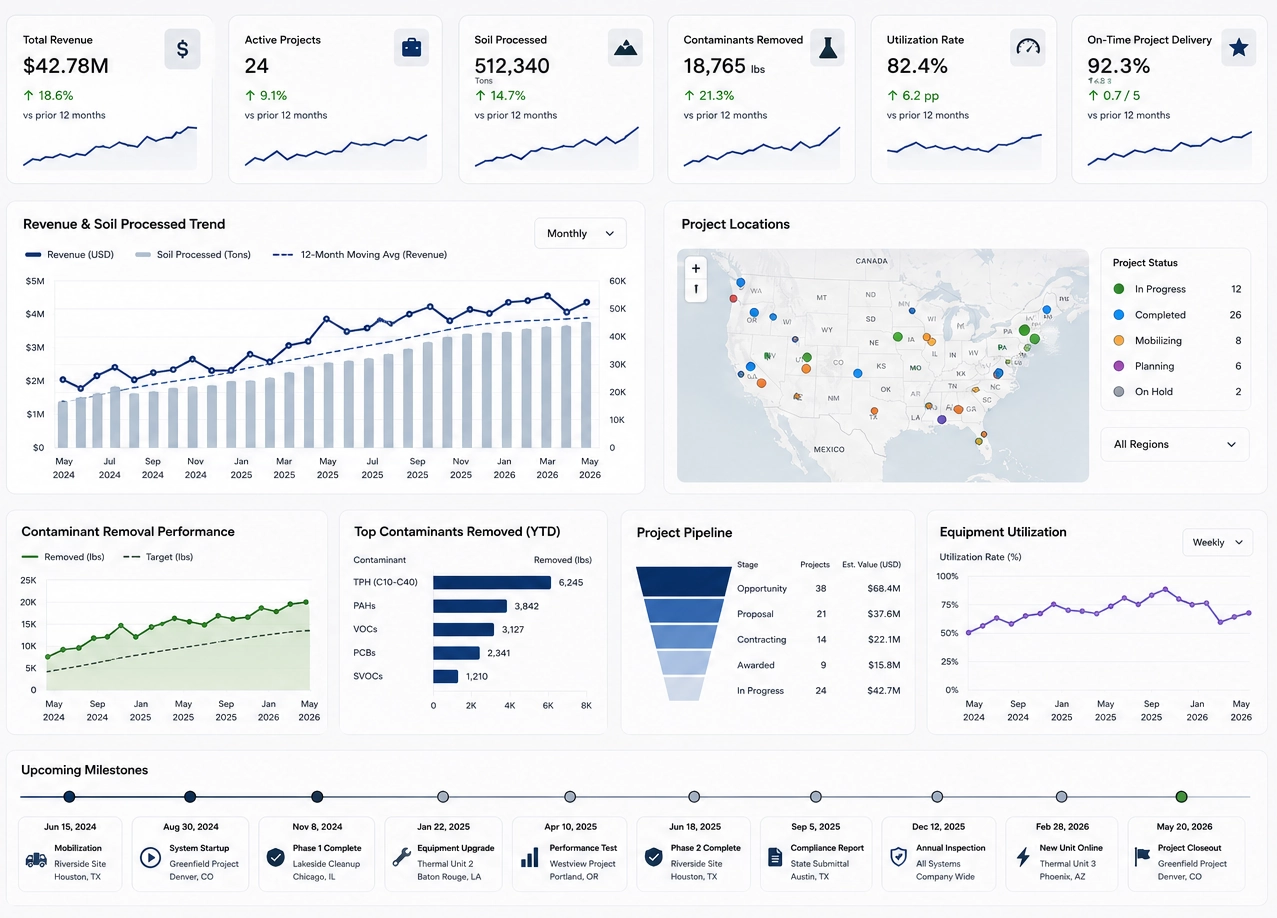

Business Context Of Thermal Desorption Soil Remediation
TerraDesorb Solutions specializes in ex situ thermal desorption for contaminated soils at former industrial sites, manufactured gas plant locations, refineries, and brownfield redevelopment projects. The company operates several thermal desorption units, some mobile and some fixed, handling a wide range of contaminants including petroleum hydrocarbons, PAHs, coal tar residues, and pesticides. Its clients include environmental engineering firms, industrial asset owners, and public agencies.
The company’s data landscape is rich and complex. It includes:
- Soil Feed And Material Handling: tonnage per hour, moisture content, particle size distribution, feed hopper levels.
- Process Parameters: inlet and outlet temperatures, residence time, drum or kiln rotation speed, burner output, fuel consumption.
- Off Gas And Emissions: flow rates, VOC concentrations, thermal oxidizer performance, stack emissions readings.
- Quality And Compliance: pre and post treatment soil sampling results, cleanup verification data, regulatory thresholds.
- Business Activity Metrics: project timelines, unit utilization, cost per ton, revenue per project, change orders, and incident logs.
Initially, EazyBI was used to build real-time dashboards on top of project management and operational data. Over time, however, the limitations of this setup became apparent as TerraDesorb Solutions expanded its fleet, took on more complex projects, and integrated more real time telemetry into its operations.
Limitations Of The Existing EazyBI Based Monitoring
EazyBI provided TerraDesorb Solutions with a way to visualize data from systems like Jira and other business tools, but thermal desorption operations demanded a deeper integration between process telemetry and business activity monitoring. Several pain points emerged.
- Fragmented Data Sources: Process telemetry from thermal units lived in one set of databases, while project and business activity data lived in others. EazyBI was not designed to be the central hub for industrial telemetry, which led to siloed views.
- Limited Real Time Capabilities: Business activity monitoring in a remediation context requires near real time insight into throughput, emissions, and compliance status. EazyBI’s batch oriented reporting made it difficult to support live dashboards for operations teams.
- Rigid Modeling Around Issue Tracking: Because EazyBI is tightly coupled to issue tracking structures, modeling complex relationships between soil batches, process parameters, and business metrics required workarounds that were hard to maintain.
- Customization Constraints: Operations managers wanted dashboards that mirrored the physical layout of thermal units, with clear visual cues for alarms, throughput, and compliance status. Achieving this level of customization was challenging.
- Scaling And Governance: As TerraDesorb Solutions added more units and sites, the number of reports and dashboards grew rapidly. It became difficult to enforce consistent definitions of key metrics such as cost per ton, cleanup success rate, and unit utilization.
These limitations did not mean EazyBI was a poor tool, but they highlighted a mismatch between its strengths and the needs of a thermal desorption soil remediation business that was increasingly data driven and telemetry heavy.
Why TerraDesorb Solutions Selected StyleBI
After evaluating several business intelligence platforms, TerraDesorb Solutions chose StyleBI as the foundation for its business activity monitoring. The decision was based on both technical capabilities and strategic alignment with the company’s growth plans.
- Flexible Data Integration: StyleBI could connect directly to process telemetry databases, project management systems, and financial data sources, allowing a unified view of operations and business activity.
- Richer Semantic Modeling: The team could define entities such as soil batch, thermal unit, project, and client, along with measures like throughput, energy use per ton, emissions compliance rate, and margin per project.
- Real Time Dashboards: StyleBI supported dashboards that refreshed frequently, giving operations teams near real time visibility into unit performance and project status.
- Customizable Layouts: The dashboard builder allowed TerraDesorb Solutions to design control room style views, KPI panels, and workflow oriented boards that matched how teams actually worked.
- Governance And Multi Site Management: Role based access and structured spaces made it easier to manage content across multiple remediation sites and client projects, while maintaining consistent metric definitions.
StyleBI was not just a replacement for EazyBI, it was a platform that could sit at the intersection of industrial telemetry and business analytics, which is exactly where TerraDesorb Solutions wanted its monitoring capabilities to be.

Migration Strategy From EazyBI To StyleBI
The company approached the migration as a structured program rather than a quick tool swap. The goal was to preserve continuity for project managers and operations staff while gradually introducing more powerful dashboards and models.
Phase One Inventory And Assessment
The analytics team began by cataloging all existing EazyBI reports and dashboards. They grouped them into categories.
- Business Activity Dashboards: project status boards, cost tracking, revenue and margin views.
- Operational Performance Dashboards: unit utilization, throughput per day, downtime tracking.
- Compliance And Quality Reports: cleanup verification summaries, emissions reporting, incident logs.
They identified which dashboards were mission critical for daily operations and which were primarily used for periodic reviews. Mission critical dashboards were prioritized for early migration to StyleBI.
Phase Two Designing The Semantic Layer In StyleBI
Next, TerraDesorb Solutions invested time in building a semantic layer that reflected the reality of thermal desorption operations. They defined core entities such as ThermalUnit, SoilBatch, Project, and Client, and linked them through keys and relationships that matched how work flowed in the field.
Measures were standardized. Throughput was defined consistently across units, cost per ton included agreed upon components, and cleanup success rate was tied to specific verification criteria. This modeling step ensured that dashboards built in StyleBI would be based on a single source of truth for metrics.
Phase Three Rebuilding Dashboards With Enhanced Design
With the semantic layer in place, the team began rebuilding key dashboards in StyleBI, taking advantage of its layout and interactivity features.
- Thermal Unit Control Dashboard: A live view showing soil feed rate, inlet and outlet temperatures, residence time, emissions readings, and alarms, with drill downs into specific batches and time periods.
- Business Activity Monitoring Board: A cross project dashboard displaying unit utilization, cost per ton, revenue per project, schedule adherence, and change orders, giving management a clear picture of business performance.
- Compliance And Verification Panel: A dashboard focused on cleanup verification results, regulatory thresholds, and emissions compliance, with filters by site, contaminant type, and client.
StyleBI allowed the team to add KPI tiles, cross filters, and contextual text explaining thresholds and procedures, making dashboards more intuitive for both operations staff and managers.

Phase Four Parallel Operation And Decommissioning
For a period of time, EazyBI and StyleBI ran side by side. Project managers and operations teams were encouraged to use the new StyleBI dashboards while still having access to familiar EazyBI views. This parallel operation helped build confidence and allowed the team to validate data consistency.
Feedback from users was incorporated into iterative improvements. Once usage had shifted decisively toward StyleBI and data parity was confirmed, EazyBI reports were gradually retired, leaving StyleBI as the primary platform for business activity monitoring.
Impact On Operations And Business Performance
The migration from EazyBI to StyleBI delivered benefits that were felt across TerraDesorb Solutions’ operations and management layers.
- Unified View Of Operations And Business Activity: By integrating process telemetry with project and financial data, the company gained a holistic view of how thermal units, projects, and business outcomes were connected.
- Improved Decision Making: Managers could see in near real time which projects were on track, which units were underutilized, and where costs were rising, enabling faster and more informed decisions.
- Enhanced Compliance Confidence: Dashboards that combined emissions data, cleanup verification results, and regulatory thresholds made it easier to demonstrate compliance to regulators and clients.
- Operational Efficiency Gains: Live monitoring of throughput, downtime, and energy use helped operations teams identify bottlenecks and opportunities for optimization.
- Consistent Metrics Across Sites: The semantic layer in StyleBI ensured that key metrics were defined consistently, reducing confusion and improving trust in the numbers.
The analytics team also reported that StyleBI’s flexibility made it easier to onboard new data sources, experiment with predictive models, and create dashboards tailored to specific roles, such as site supervisors, project managers, and executives.
Lessons Learned From The Migration
TerraDesorb Solutions’ experience offers several lessons for other companies in the thermal desorption soil remediation industry and related environmental services sectors.
- Align Tools With Industrial Reality: Business activity monitoring in an industrial context requires tools that can handle both telemetry and business data, not just issue tracking or project management metrics.
- Invest In Data Modeling: A well designed semantic layer is essential for consistent, meaningful dashboards, especially when multiple sites and units are involved.
- Use Migration As A Chance To Standardize: Moving from one platform to another is an opportunity to clean up metric definitions, retire outdated reports, and clarify ownership of dashboards.
- Support Users Through Parallel Operation: Running old and new systems in parallel for a time helps build trust and allows for careful validation of data and functionality.
- View Monitoring As Strategic, Not Just Operational: For a remediation company, business activity monitoring is not just about tracking tasks, it is about understanding how process performance, compliance, and financial outcomes intersect.
Ultimately, the switch from EazyBI to StyleBI for business activity monitoring allowed TerraDesorb Solutions to move from fragmented reporting to integrated insight. In an industry where every project is scrutinized for environmental impact, regulatory compliance, and economic viability, that shift in analytics capability becomes a source of competitive advantage and operational resilience.