From Graphic Walker to StyleBI: Evolving Dashboard Reporting in Specialty Industrial Coatings
CorroShield Coatings, a specialty industrial coatings contractor, had built its reputation on protecting critical infrastructure from corrosion and environmental damage. Its crews blasted and coated bridges, pipelines, water towers, chemical tanks, and offshore structures. Every project involved complex surface preparation, multi-layer coating systems, strict environmental controls, and rigorous inspection. The company’s success depended on executing these steps consistently and documenting them thoroughly for asset owners, regulators, and inspectors.
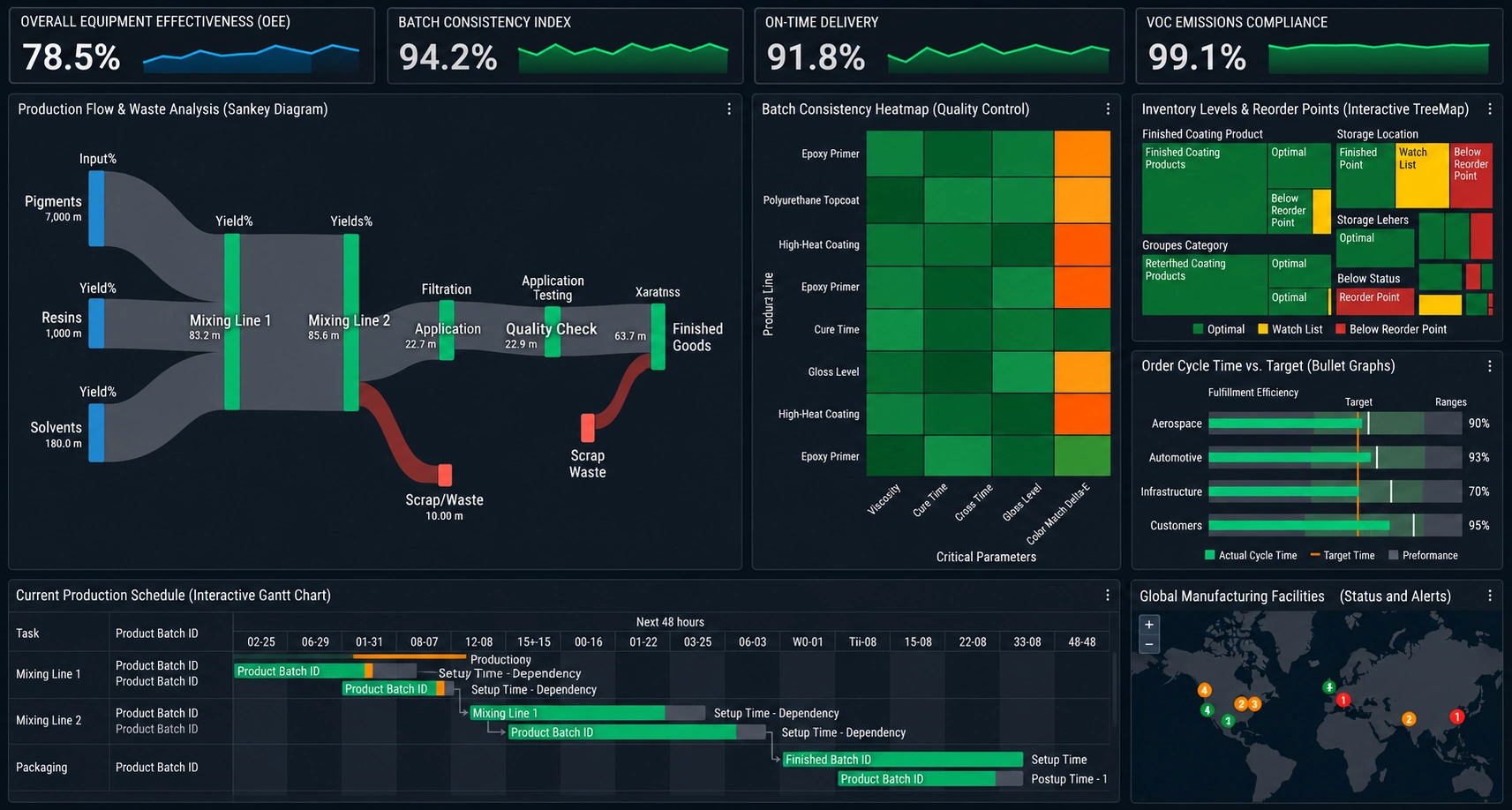
Over the years, CorroShield invested in digital tools to capture field data: blasting logs, coating batch records, environmental readings, dry film thickness measurements, and defect punch lists. The data flowed into a central database, where a small analytics team used Graphic Walker to explore and visualize it. Graphic Walker’s grammar-of-graphics approach gave analysts a powerful way to slice and dice datasets, experiment with chart types, and uncover patterns in productivity, defect rates, and environmental non-compliance.
An Analyst-Centric Approach to Coatings Data
For the analytics team, Graphic Walker was a flexible laboratory. They could quickly build exploratory visuals to answer questions like: Which crews consistently hit target dry film thickness on the first pass? How does relative humidity correlate with rework rates on tank linings? Which projects are consuming more coating material than estimated? These insights helped CorroShield refine its processes and train crews more effectively.
However, as the company grew and took on larger, multi-year contracts, the limitations of this approach became apparent. Graphic Walker was excellent for analyst-driven exploration, but it was not designed to be the company’s primary dashboard report software for a broad audience. Project managers, QA inspectors, and executives needed stable, governed dashboards they could rely on every day, not ad hoc visuals that lived in an analyst’s workspace. Asset owners wanted client-facing portals where they could see project status, inspection results, and coating performance metrics without waiting for emailed reports.
The tipping point came when CorroShield won a major contract to recoat a portfolio of aging highway bridges for a state transportation agency. The contract required detailed, ongoing reporting: surface preparation progress, coating application status by span and component, environmental compliance logs, defect and repair histories, and crew productivity metrics. The agency wanted a web-based dashboard they could access at any time, with the ability to filter by bridge, date, and coating system. CorroShield’s leadership realized that their current toolset, built around Graphic Walker and manual report assembly, would not scale to meet these expectations.
The company launched an initiative to standardize its dashboard reporting on a platform that could serve both internal and external stakeholders. The requirements were clear: a web-based environment, governed semantic models, role-based security, and the ability to embed dashboards into a branded client portal. After evaluating several options, CorroShield chose StyleBI as the foundation for its new dashboard report software.
Why Graphic Walker Fell Short for Enterprise Dashboard Reporting
Graphic Walker had been a valuable tool for the analytics team, but it was never intended to be a full-fledged enterprise reporting platform. Its strengths lay in interactive exploration and flexible chart composition, not in delivering standardized, governed dashboards to a wide audience. Analysts could build sophisticated visuals, but sharing them with non-technical users often meant exporting static images or recreating charts in slide decks.
This created several challenges. First, there was no central semantic layer where business metrics were defined. Calculations such as “blast productivity per crew-hour,” “coating material usage variance,” or “defect rate per square meter” were implemented differently in different analyses. When project managers compared reports, they sometimes discovered that the same metric had been calculated in slightly different ways, leading to confusion and mistrust of the numbers.
Second, Graphic Walker did not provide a robust security and multi-tenant model for client-facing dashboards. CorroShield needed to ensure that each asset owner could see only their own projects and structures, while internal users could see data across the entire portfolio. Implementing this kind of row-level security and role-based access control would have required significant custom development around Graphic Walker, which was not its intended use case.
Finally, the user experience for non-analysts was not ideal. Graphic Walker’s power came from its flexibility and the ability to manipulate visual encodings, but project managers and QA inspectors did not want to design charts; they wanted curated dashboards with clear KPIs, filters, and drill-down paths. The company needed a platform that could turn its rich coatings data into stable, repeatable dashboard reports that anyone could use in a browser.

Why StyleBI Fit the Specialty Coatings Dashboard Use Case
StyleBI offered CorroShield a web-based BI platform designed for exactly the kind of governed, interactive dashboards the company needed. Instead of treating each analysis as a one-off visual experiment, the analytics team could define semantic models that captured the company’s core concepts: projects, structures, surfaces, coating systems, crews, shifts, environmental readings, inspections, and defects.
In the Operations subject area, they modeled entities such as project, structure, surface area, crew, and shift. Measures included blasted square meters per shift, coated square meters per day, and crew productivity indices. In the QA subject area, they modeled inspection points, dry film thickness readings, adhesion tests, holidays, and defect categories. Environmental data—temperature, humidity, dew point, and wind speed—was linked to specific coating activities, enabling analysis of compliance with specification windows.
With these semantic models in place, StyleBI allowed the team to build dashboards that were both interactive and consistent. A “Bridge Portfolio Overview” dashboard showed, for each bridge, the percentage of surface area blasted, primed, intermediate-coated, and top-coated. Users could click on a bridge to see a detailed view by component—girders, diaphragms, bearings, and so on—and then drill into specific spans or work zones. Filters allowed them to slice by date range, crew, and coating system.
The QA team created a “Coating Quality and Compliance” dashboard that tracked dry film thickness distributions, defect rates, and rework volumes across projects. They could quickly identify patterns, such as higher defect rates on night shifts or on certain complex geometries. Because the metrics were defined in StyleBI’s semantic layer, everyone in the organization saw the same numbers, regardless of which dashboard they used.
For client-facing reporting, StyleBI’s embedding capabilities were crucial. CorroShield built a secure portal where asset owners could log in and see dashboards tailored to their projects. A transportation agency could view progress and quality metrics for its bridge portfolio, while a refinery owner could see coating status and defect histories for tanks and piping. Row-level security ensured that each client saw only their own data, while internal users could access cross-client views for benchmarking and strategic planning.

Migration Strategy: From Analyst Lab to Enterprise Dashboard Platform
CorroShield approached the migration from Graphic Walker to StyleBI as an evolution rather than a replacement of analytical capabilities. Graphic Walker remained available as a tool for deep-dive exploration by the analytics team, but StyleBI became the primary platform for dashboard reporting across the organization.
The first step was to inventory the most valuable analyses that had been built in Graphic Walker. The team identified recurring themes: crew productivity comparisons, defect rate analyses, environmental compliance patterns, and material usage variance. For each theme, they defined standardized metrics and dimensions in StyleBI’s semantic layer, ensuring that the logic was documented and agreed upon by operations, QA, and finance.
Next, they designed a set of core dashboards aligned with key stakeholder groups. Operations received project and portfolio dashboards focused on progress, productivity, and schedule adherence. QA received quality and compliance dashboards highlighting defect trends, rework, and inspection coverage. Finance received dashboards that combined production data with cost and revenue, enabling margin analysis by project, client, and coating system. Clients received simplified, branded dashboards that emphasized progress, quality, and compliance in terms they cared about.
Training was essential to making the transition successful. Project managers and QA inspectors were introduced to StyleBI through hands-on sessions where they learned how to navigate dashboards, apply filters, and drill into details. Power users in each department were trained to create and modify dashboards within the governed semantic framework, giving them the ability to adapt reports to evolving needs without breaking metric definitions.
Over time, the role of Graphic Walker shifted. Instead of being the primary environment for all visual analysis, it became a specialized tool for exploratory work and hypothesis testing. When analysts discovered a useful new metric or visual pattern in Graphic Walker, they would formalize it in StyleBI’s semantic layer and incorporate it into a dashboard, making it available to the broader organization.

Outcomes: A Coherent Dashboard Reporting Layer for Coatings Operations
Within a year of adopting StyleBI as its dashboard report software, CorroShield experienced a noticeable change in how information flowed through the organization. Weekly project review meetings moved from static slide decks to live dashboards, where managers could explore progress and quality metrics in real time. QA discussions focused on trends and root causes rather than reconciling conflicting spreadsheets.
Clients responded positively to the new portal. Transportation agencies appreciated being able to log in and see up-to-date progress on bridge recoating projects, complete with inspection summaries and environmental compliance logs. Industrial clients valued the ability to track coating status and defect histories across their assets, supporting better maintenance planning and regulatory reporting. The transparency and professionalism of the dashboards became a competitive differentiator for CorroShield in bids and contract renewals.
Internally, the combination of Graphic Walker and StyleBI created a more balanced analytics ecosystem. Graphic Walker continued to serve as a powerful exploratory tool for analysts, while StyleBI provided a stable, governed layer for enterprise dashboard reporting. The analytics team spent less time manually assembling charts and more time improving data quality, refining metrics, and collaborating with stakeholders on new dashboard designs.
For a company in the specialty industrial coatings industry, where success depends on controlling complex processes and demonstrating compliance, the move from an analyst-centric tool like Graphic Walker to a StyleBI-centered dashboard reporting environment marked a significant step forward. It aligned CorroShield’s reporting capabilities with the scale and complexity of its operations, turning scattered data into a coherent, accessible intelligence layer that supports decisions from the blast nozzle on a bridge girder to the executive reviewing portfolio performance.