From Reveal to StyleBI: Transforming Decision Support in Specialty Industrial Minerals
Five years ago, Granumex adopted Reveal as the core of its Decision Support System (DSS). The goal was straightforward: provide managers and engineers with dashboards for production, quality, and logistics. Over time, however, the company’s needs evolved beyond static dashboards. They wanted governed self-service, tighter integration with complex data sources, and a more flexible semantic layer that could bridge the gap between IT and process engineers. This is where StyleBI entered the picture.

Why Reveal started to fall short
Reveal initially delivered quick wins: visualizations for daily production, basic KPIs for yield and downtime, and some executive scorecards. But as Granumex expanded into higher-value engineered minerals, the limitations became more visible.
- Complex data modeling: Process engineers needed to correlate laser diffraction particle size data, kiln temperature profiles, and lab quality results across multiple systems. Reveal’s modeling capabilities were not flexible enough to support iterative, business-friendly data models without heavy IT intervention.
- Governed self-service: Power users wanted to build their own views of ore-to-product yield, energy intensity per ton, and customer-specific formulations. IT struggled to maintain a single version of the truth while allowing ad hoc exploration.
- Embedded decision workflows: The DSS needed to move beyond viewing charts to guiding actions—such as adjusting kiln setpoints, changing milling schedules, or prioritizing railcar loading. Reveal’s integration into operational workflows was limited and often required custom development.
- Scalability and performance: As data volumes grew—especially time-series data from sensors and lab instruments—some dashboards became sluggish, discouraging daily use on the plant floor.
By the time Granumex launched a new product line of ultra-fine engineered talc, leadership realized they needed a more robust, enterprise-grade BI platform that could serve as the backbone of a true Decision Support System, not just a reporting layer.
Why StyleBI was chosen
Granumex evaluated several options and ultimately selected StyleBI as the new core of its DSS. The decision was driven by a combination of technical and organizational factors.
- Semantic layer for process-centric metrics: StyleBI’s modeling layer allowed IT and process engineers to collaboratively define business concepts such as “effective yield,” “energy per saleable ton,” “on-spec first-pass rate,” and “customer-grade compliance.” These definitions could be reused across dashboards, reports, and ad hoc analysis, ensuring consistency.
- Flexible data connectivity: The platform connected cleanly to their MES, LIMS, ERP, and historian databases, as well as CSV-based lab exports. This made it possible to build unified views of the production process without brittle, one-off integrations.
- Governed self-service analytics: StyleBI provided a controlled environment where engineers and planners could create their own dashboards and analyses using certified data models. IT retained control over security, data lineage, and performance tuning.
- Embedded decision support: The ability to embed dashboards and parameterized reports into internal web portals and plant-floor terminals meant that insights could be placed directly in the context of daily decisions.
- Scalable architecture: StyleBI’s architecture handled the growing volume of sensor and lab data more efficiently, enabling near real-time monitoring of critical processes like milling and drying.
The migration journey: From Reveal dashboards to StyleBI models
The transition from Reveal to StyleBI was not a simple “lift and shift.” Granumex used the migration as an opportunity to rethink how decisions were made and how data should support those decisions. The project unfolded in several phases.
Phase 1: Inventory and rationalization
The team began by cataloging all existing Reveal dashboards and reports. Many were overlapping or underused. Plant managers, quality leaders, and logistics coordinators were interviewed to identify which views truly influenced decisions and which were legacy artifacts.
Out of roughly 80 Reveal dashboards, only about 30 were deemed critical. These became the starting point for the StyleBI redesign, but with a twist: instead of replicating them one-for-one, the team mapped each dashboard to specific decision scenarios, such as:
- Adjusting milling parameters when particle size drifts out of spec.
- Rebalancing kiln loading to reduce energy per ton while maintaining throughput.
- Prioritizing shipments when railcar availability is constrained.
- Identifying chronic quality issues for specific ore sources or product grades.

Phase 2: Building the StyleBI semantic layer
Next, IT and process engineers collaborated to design StyleBI data models that reflected how the business actually thought about performance. Instead of exposing raw tables, they created subject areas such as “Production & Yield,” “Quality & Lab Results,” “Energy & Utilities,” and “Logistics & Fulfillment.”
Within each subject area, they defined calculated measures and hierarchies:
- Production & Yield: ore input, saleable output, rework, scrap, effective yield, and OEE-like metrics.
- Quality & Lab Results: particle size distribution bands, brightness, moisture, and pass/fail rates by product grade.
- Energy & Utilities: kWh per ton, gas consumption per kiln, and cost per unit of saleable product.
- Logistics & Fulfillment: on-time shipment rate, average loading time, and demurrage costs.
This semantic layer became the foundation for all StyleBI content, ensuring that every dashboard and report used the same definitions and logic.
Phase 3: Redesigning dashboards around decisions
Rather than simply recreating Reveal visuals, the team designed new StyleBI dashboards that aligned with specific decision workflows. For example:
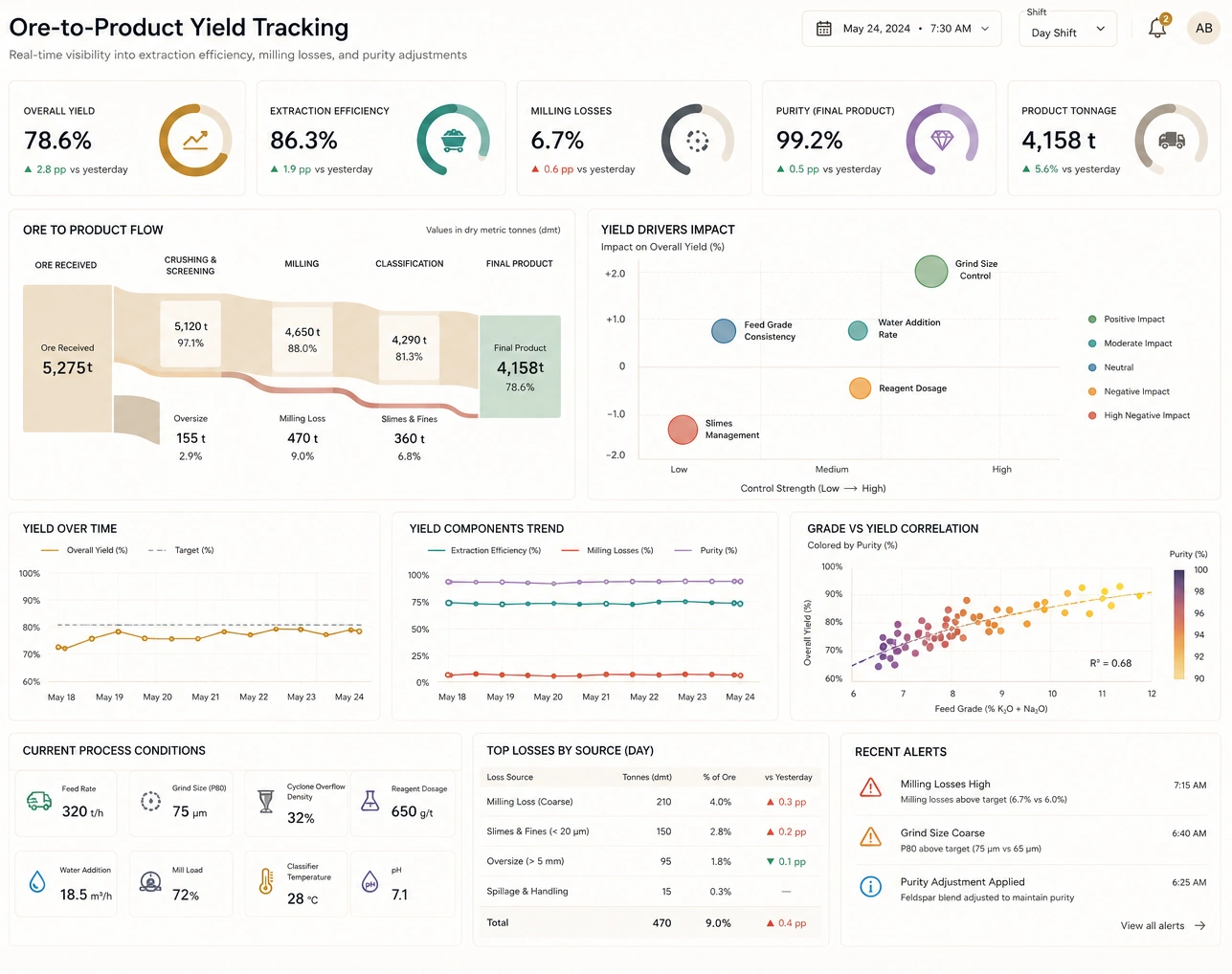
- Plant performance cockpit: A daily view for plant managers showing yield, energy intensity, and quality performance, with drill-downs to line, shift, and product level.
- Quality exception monitor: A near real-time dashboard for lab and QA teams highlighting out-of-spec results, trends in particle size deviations, and recurring issues by ore source.
- Kiln and dryer efficiency panel: A specialized view for process engineers, combining temperature profiles, moisture readings, and energy consumption to identify optimization opportunities.
- Logistics and service level tracker: A dashboard for the supply chain team showing on-time shipments, railcar utilization, and customer service levels by region.
Each dashboard was designed with clear prompts: what decision should the user make after viewing this, and what actions are available? This mindset shifted the DSS from “nice charts” to a practical decision engine.
Organizational impact of the switch
The move from Reveal to StyleBI had effects that went beyond technology. It changed how people at Granumex interacted with data and with each other.
- Shared language around performance: Because StyleBI enforced consistent definitions, discussions about yield, quality, or energy use became more focused. Disputes over “whose numbers are right” diminished.
- Empowered process engineers: Engineers could now build and iterate on their own analyses within governed models, exploring hypotheses about kiln settings, milling parameters, or ore blending strategies without waiting for IT to create new reports.
- Faster feedback loops: With more responsive dashboards and better integration with operational systems, plant teams could see the impact of changes within a shift, not just at the end of the week.
- Executive visibility: Leadership gained a consolidated view of plant performance, product line profitability, and service levels, enabling more confident decisions about capital investments and product strategy.

Measurable outcomes
Within the first year of running StyleBI as its Decision Support System, Granumex recorded several tangible improvements:
- Improved effective yield: By identifying chronic loss points in milling and classification, the company increased effective yield by a few percentage points, translating into significant margin gains.
- Reduced energy per ton: Better visibility into kiln and dryer performance helped process engineers fine-tune operating windows, reducing energy consumption per ton of saleable product.
- Higher first-pass quality: The quality exception monitor enabled earlier detection of drift in particle size and moisture, improving first-pass on-spec rates and reducing rework.
- Better on-time shipments: Logistics dashboards highlighted bottlenecks in loading and railcar utilization, leading to process changes that improved on-time delivery metrics.
While some of these gains might have been possible with Reveal, the combination of a robust semantic layer, governed self-service, and decision-centric design in StyleBI made them more achievable and sustainable.
Lessons learned and future direction
Granumex’s journey from Reveal to StyleBI underscores a key lesson for specialty industrial minerals processors: the value of a Decision Support System lies less in the visuals and more in the alignment between data models, decision workflows, and organizational roles.
By treating the migration as a chance to rethink how decisions are made—from ore selection to kiln tuning to shipment prioritization—Granumex turned StyleBI into a strategic asset rather than just another reporting tool. The company is now exploring predictive models for kiln performance and quality outcomes, planning to surface those insights through the same StyleBI environment that users already trust.
In an industry where margins are tight, processes are complex, and customers demand consistent, high-spec materials, the shift from Reveal to StyleBI has given Granumex a sharper, more reliable lens on its operations—and a stronger foundation for the next generation of data-driven decision making.