A Stratospheric Shift: Why A HAPS Operations Company Replaced Knowi With StyleBI For Drill Down Reporting
Industry Background: The Rise Of High-Altitude Pseudo‑Satellites
The High-Altitude Pseudo‑Satellite (HAPS) Operations & Stratospheric Platform Services industry sits at the intersection of aerospace, telecommunications, and atmospheric science. Companies in this space design, deploy, and operate long-endurance, solar-powered aircraft and stratospheric balloon systems that function as near-space platforms. These vehicles fly at altitudes of 60,000 to 80,000 feet, above commercial air traffic and weather systems, enabling persistent coverage for imaging, communications, and environmental monitoring.
The company in this narrative—SkyReach Stratospheric Systems—is a mid-sized HAPS operator specializing in solar-powered fixed-wing platforms capable of multi-week missions. Its customers include telecom providers seeking rural 5G coverage, environmental agencies monitoring methane emissions, and defense organizations requiring persistent ISR (intelligence, surveillance, reconnaissance). SkyReach’s fleet generates massive volumes of telemetry, payload data, atmospheric readings, and mission logs. Turning this data into actionable insight is essential for mission planning, platform health monitoring, and customer reporting.

The Limitations Of Knowi For Deep Drill Down Reporting
SkyReach originally adopted Knowi to unify data from its flight control systems, payload sensors, and mission operations databases. Knowi’s ability to query NoSQL sources and create dashboards helped the company consolidate early-stage analytics. However, as the fleet expanded and mission complexity increased, the limitations of Knowi’s drill down capabilities became more apparent.
First, the company needed multi-level drill down paths that reflected the hierarchical nature of HAPS missions. A single mission could be broken down into phases—launch, ascent, cruise, payload operation, descent, and recovery. Each phase contained dozens of telemetry variables, energy balance metrics, and atmospheric conditions. Knowi’s drill down structure was too rigid to support the nested, dynamic exploration SkyReach required.
Second, SkyReach needed to correlate data across domains. Engineers wanted to drill from a high-level mission KPI into solar panel efficiency, then into battery discharge curves, then into stratospheric wind shear patterns. Payload analysts wanted to drill from telecom throughput into antenna alignment logs, then into thermal drift data. Knowi’s cross-dataset drill down capabilities were limited, forcing analysts to export data into spreadsheets or external tools.
Finally, SkyReach needed a reporting platform that could scale with its hybrid infrastructure. Some data lived in cloud object stores, some in on-premises mission servers, and some in distributed edge systems at launch sites. Knowi struggled to maintain consistent performance across this architecture, especially when users attempted deep drill downs on large datasets.

Why SkyReach Chose StyleBI For Drill Down Reporting
After a comprehensive evaluation, SkyReach selected StyleBI as its next-generation drill down reporting software. The decision was driven by three core advantages: flexible drill paths, hybrid data connectivity, and a more intuitive reporting experience for both engineers and non-technical users.
StyleBI’s drill down engine allowed SkyReach to design custom hierarchies that mirrored real mission structures. Instead of being limited to a single dimension, analysts could define multi-branch drill paths that reflected the complexity of HAPS operations. A user could start with a mission overview, drill into energy performance, branch into solar input, then pivot into battery temperature—all without leaving the dashboard.
Equally important was StyleBI’s ability to connect to both cloud and on-premises data sources without forcing data migration. SkyReach could keep sensitive flight control data on secure servers while hosting payload analytics in the cloud. StyleBI’s semantic layer unified these sources, enabling seamless drill down across systems.
Finally, StyleBI’s interface made it easier for mission planners, payload specialists, and executives to explore data without relying on the analytics team. The company wanted a platform that democratized insight, and StyleBI delivered that capability through intuitive visualizations and guided drill down paths.
Building A Stratospheric Reporting Architecture
The transition to StyleBI began with a redesign of SkyReach’s data architecture. The analytics team created a unified semantic model that represented the core entities of HAPS operations: missions, platforms, payloads, atmospheric layers, energy systems, and communication links. Each entity contained dozens of attributes, from solar irradiance to antenna beamwidth to stratospheric turbulence indices.
StyleBI’s modeling tools allowed the team to define relationships between these entities, enabling drill down paths that crossed operational boundaries. For example, a user could drill from mission duration into energy consumption, then into solar panel degradation, then into atmospheric opacity. This cross-domain exploration was impossible in the company’s previous reporting environment.
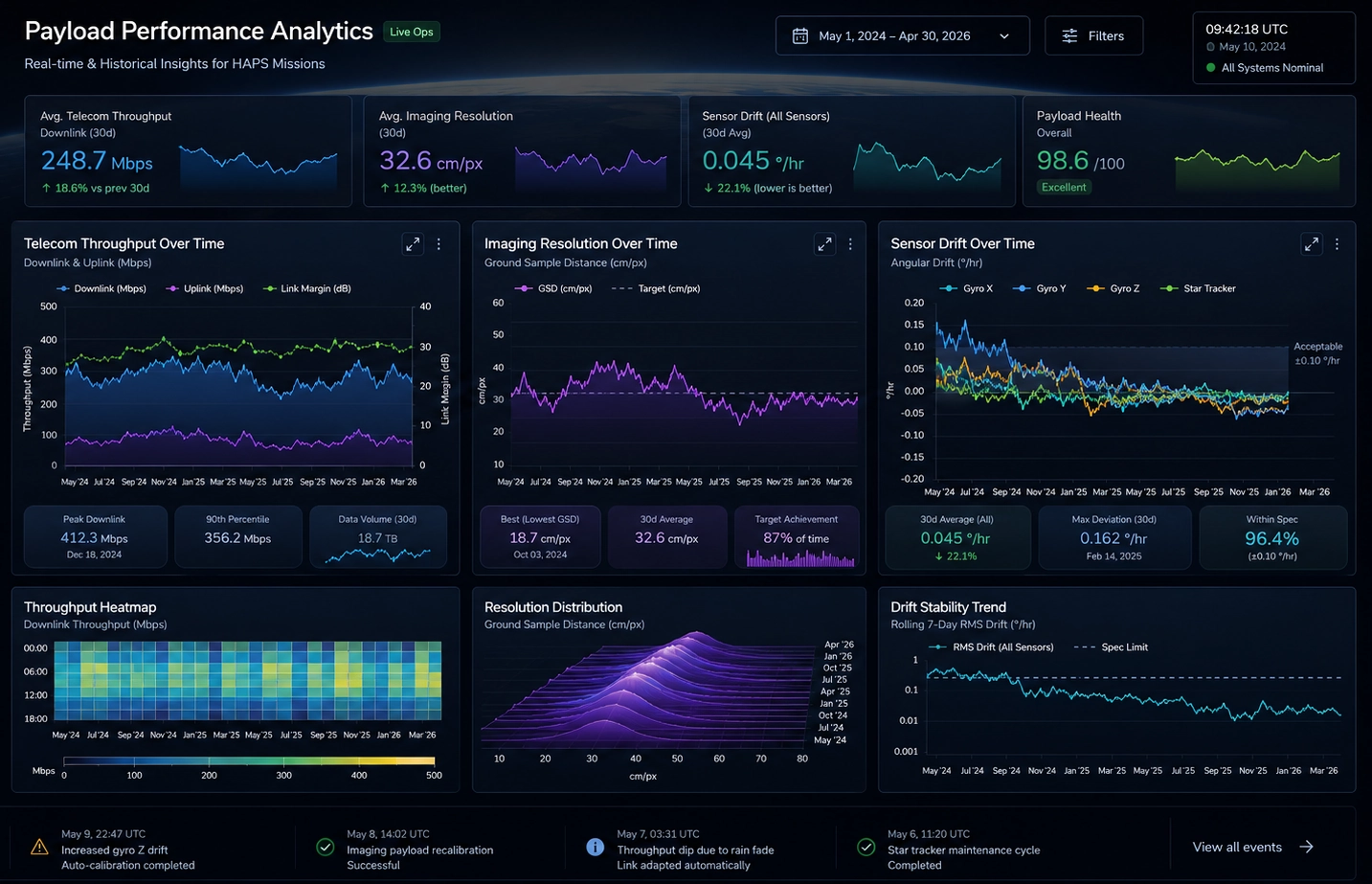
Dashboards were then built for each functional group. Mission operations received dashboards showing flight paths, altitude stability, energy balance, and weather interactions. Payload teams received dashboards for telecom throughput, imaging resolution, and sensor drift. Executives received high-level KPIs such as mission success rate, cost per flight hour, and customer SLA compliance.
Integrating Real-Time And Historical Data
One of the most powerful aspects of StyleBI for SkyReach was its ability to blend real-time telemetry with historical mission data. During active missions, operators could drill into live metrics such as battery charge, solar input, and wind shear. After missions concluded, analysts could compare performance across flights, platforms, and atmospheric conditions.
This integration allowed SkyReach to identify patterns that were previously hidden. For example, analysts discovered that certain stratospheric wind patterns consistently reduced solar efficiency during specific months. By drilling into historical data, they identified the root cause and adjusted mission planning accordingly.
Benefits Realized After Switching To StyleBI
Within months of adopting StyleBI, SkyReach experienced significant improvements in reporting efficiency, mission insight, and operational decision-making. The most immediate benefit was the elimination of manual data stitching. Analysts no longer had to export logs from multiple systems and merge them in spreadsheets. StyleBI handled the integration automatically.
Decision-making accelerated as well. Mission controllers could drill into anomalies in real time, identifying issues such as unexpected battery drain or payload overheating. Instead of waiting for post-mission analysis, they could take corrective action during flight.
Executives gained a clearer understanding of fleet performance. StyleBI’s drill down dashboards revealed which platforms were most efficient, which missions delivered the highest customer value, and which atmospheric conditions posed the greatest risk. This insight informed investment decisions, platform upgrades, and customer pricing models.
Customers also benefited. SkyReach began offering customer-facing dashboards that allowed telecom providers, environmental agencies, and research institutions to drill into mission results. This transparency strengthened relationships and differentiated SkyReach from competitors.
Challenges And Change Management
The transition was not without challenges. Some engineers were accustomed to Knowi’s interface and were hesitant to adopt a new platform. SkyReach addressed this by creating role-specific training sessions and internal champions who supported colleagues during the transition.
Another challenge was defining drill down paths that reflected the complexity of HAPS missions without overwhelming users. The analytics team worked closely with each department to design intuitive hierarchies that balanced depth with usability.

Future Plans With StyleBI
SkyReach plans to expand its use of StyleBI into predictive analytics. By combining historical mission data, atmospheric models, and platform performance metrics, the company aims to build dashboards that forecast mission success probability, energy sufficiency, and payload performance. These predictive insights will help SkyReach optimize launch timing, platform selection, and customer service levels.
The company is also exploring automated anomaly detection within StyleBI. By defining thresholds for key metrics such as battery temperature, solar input, and altitude stability, StyleBI could automatically flag potential issues and guide operators to the relevant drill down paths.

A Major Evolution
SkyReach Stratospheric Systems’ transition from Knowi to StyleBI represents a major evolution in how HAPS operators manage and interpret mission data. StyleBI’s flexible drill down capabilities, hybrid data connectivity, and intuitive interface have transformed reporting from a fragmented, manual process into a unified, dynamic analytics environment. In an industry where every watt of solar energy, every meter of altitude, and every millisecond of telecom throughput matters, the ability to drill deeply and quickly into data is not just a convenience—it is a competitive advantage.
By adopting StyleBI, SkyReach has positioned itself to operate more efficiently, serve customers more effectively, and innovate more rapidly in the rapidly expanding world of stratospheric platform services.