From Superset To StyleBI: A Rope Access Company Reinvents Its Operational Visibility
The specialty industrial rope access services industry lives in the margins of the built world—on the sides of bridges, wind turbines, flare stacks, cooling towers, and high-rise façades. One mid-sized rope access company, VertiReach Services, had grown steadily over a decade, expanding from a handful of technicians to multiple regional crews serving energy, infrastructure, and heavy industrial clients. As the company scaled, leadership realized that their existing analytics stack, centered on Apache Superset, was no longer keeping up with the complexity and urgency of their operations.
VertiReach’s work is high-risk, high-cost, and highly schedulable. Every job involves a choreography of certified technicians, specialized equipment, weather windows, shutdown periods, and strict safety protocols. The leadership team needed a visualization dashboard report tool that could keep pace with this reality, not just display static charts. Their decision to migrate from Superset to StyleBI became a turning point in how they understood and managed the business.

Why Superset Started To Fall Short
Superset had been an attractive choice early on. It was open source, flexible, and capable of connecting to the company’s growing data warehouse. The operations manager could spin up dashboards for job counts, utilization, and revenue by client. For a while, that was enough. But as VertiReach expanded into offshore wind, petrochemical turnarounds, and complex inspection contracts, the cracks began to show.
The first pain point was operational complexity. Rope access jobs are not simple tickets; they are multi-day or multi-week projects with nested tasks, certifications, and risk profiles. Superset’s dashboards tended to flatten this complexity into generic bar charts and time series. Operations leaders had to mentally reconstruct the story behind the numbers, often jumping between multiple dashboards and external spreadsheets.
The second issue was limited self-service for non-technical users. Supervisors and project coordinators were not comfortable editing SQL or building new visualizations. When they needed a new view—say, a breakdown of technicians by certification level and upcoming expiry dates—they had to request changes from the small internal data team. This created bottlenecks and delayed decisions.
Finally, Superset’s governance and customization model did not align well with VertiReach’s need for tightly controlled, client-facing reporting. Some key clients demanded branded, polished dashboards showing inspection progress, defect findings, and remediation status. Achieving this level of polish in Superset required heavy customization and still felt brittle.
Why StyleBI Entered The Conversation
VertiReach’s leadership began evaluating alternatives with a clear set of criteria. They needed a visualization dashboard report tool that could:
- Model complex operations such as multi-crew jobs, weather delays, and safety incidents.
- Empower non-technical users to explore data without writing SQL.
- Support governed self-service with reusable data models and security rules.
- Deliver polished, client-ready dashboards with flexible layout and branding.
- Integrate with existing systems including job management, HR, and equipment tracking.
StyleBI emerged as a strong candidate because it combined a robust semantic layer with highly customizable dashboards and strong support for embedded analytics. For a company like VertiReach, which needed both internal operational dashboards and external client portals, this combination was compelling.
Designing Dashboards Around Rope Access Reality
The migration was not just a technical project; it was an opportunity to rethink how the company visualized its work. With StyleBI, VertiReach’s data team started by building a semantic model that reflected the real entities of the rope access business: jobs, tasks, technicians, certifications, equipment, inspections, defects, and risk scores.
Instead of exposing raw tables and SQL queries, StyleBI presented curated subject areas. Operations managers could drag and drop fields like “Job Risk Category,” “Weather Delay Hours,” or “IRATA Level” into visualizations without worrying about joins or filters. This shift from query-centric to model-centric analytics was transformative.
The company designed several cornerstone dashboards:
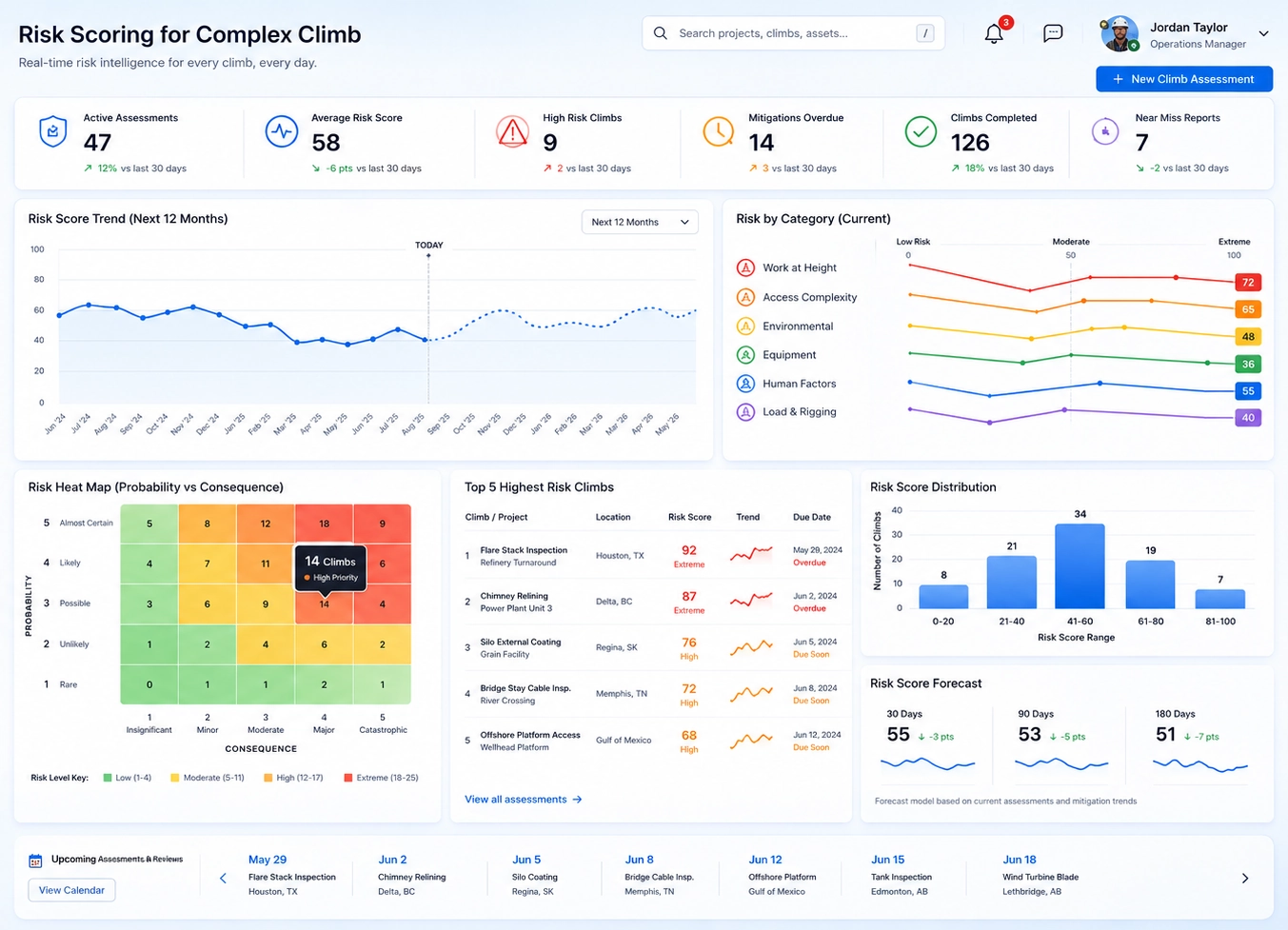
- Operations Command Center: A live view of all active jobs, showing crew assignments, progress percentages, upcoming milestones, and weather risk indicators. Color-coded tiles highlighted jobs at risk of delay or cost overrun.
- Technician Readiness & Certification: A dashboard tracking each technician’s certifications, expiry dates, logged hours, and recent safety observations. Managers could filter by region, client, or job type to see where skill gaps might impact upcoming work.
- Equipment Lifecycle & Compliance: Visualizations showing rope, harness, and hardware usage, inspection dates, and retirement thresholds. Alerts surfaced equipment approaching end-of-life, reducing the risk of non-compliance.
- Client Inspection Portals: Branded dashboards for key clients, showing inspection coverage, defect heatmaps, and remediation status by asset, such as wind turbines or refinery units.
These dashboards were not possible, or at least not practical, in the old Superset environment without significant manual effort. StyleBI’s layout flexibility and component library made it easier to design views that matched how rope access supervisors actually think about their work.

Improving Self-Service Without Losing Control
One of VertiReach’s biggest fears in moving away from Superset was losing control over data definitions and security. They had seen other companies descend into “spreadsheet chaos” when everyone could define metrics differently. StyleBI’s governed self-service model addressed this concern directly.
The data team defined centralized metrics such as “Job Margin,” “Utilization Rate,” and “Lost Time Incident Frequency.” These metrics lived in the semantic layer and were reused across dashboards. Supervisors could build their own views using these metrics, but they could not alter the underlying definitions. This ensured consistency in how performance was measured.
Row-level security rules were applied to ensure that regional managers only saw jobs and technicians in their territory, while client users only saw data for their own assets. StyleBI’s security model allowed these rules to be expressed once and reused across all dashboards, reducing the risk of accidental data exposure.
For non-technical users, the experience shifted from “request a new dashboard” to “assemble the view you need.” Drag-and-drop interfaces, guided filters, and pre-built templates meant that a project coordinator could, for example, create a view of “All jobs in the next 30 days with IRATA Level 3 requirements and open equipment issues” in minutes.
Migration Strategy: From Superset To StyleBI
The migration itself followed a phased approach. VertiReach did not attempt a big-bang cutover. Instead, they identified a set of high-value dashboards in Superset that were frequently used but widely criticized for being hard to interpret or maintain.
The data team rebuilt these dashboards in StyleBI, taking the opportunity to clean up data models, standardize metrics, and improve visual design. During this period, both tools ran in parallel. Users were encouraged to compare the old and new dashboards and provide feedback. This iterative process helped refine the StyleBI implementations and build trust.
Once the core operational dashboards were stable, the team began decommissioning Superset views. They also used StyleBI’s embedded capabilities to replace static PDF reports that had been manually generated for clients. Now, clients could log into a secure portal and see near real-time updates on their assets and projects.
Tangible Outcomes For The Rope Access Business
Within six months of the migration, VertiReach began to see measurable benefits. Operations managers reported faster decision-making because they no longer had to wait for custom reports or manually reconcile data from multiple sources. The Operations Command Center dashboard became a daily ritual, guiding crew assignments and prioritization.
Technician utilization improved as managers gained clearer visibility into who was available, certified, and located near upcoming jobs. Certification lapses dropped because the Technician Readiness dashboard surfaced upcoming expiries well in advance, prompting timely renewals.
On the safety front, StyleBI enabled more nuanced analysis of incidents and near-misses. By correlating safety observations with job types, weather conditions, and crew compositions, the HSE (Health, Safety, and Environment) team identified patterns that were previously hidden in narrative reports. This led to targeted training and adjustments in job planning.
Client satisfaction also improved. The new inspection portals gave asset owners a transparent view of progress and findings. Instead of receiving static reports days or weeks after fieldwork, clients could monitor inspection coverage and defect remediation in near real time. This transparency became a differentiator in competitive bids.
Lessons Learned From The Transition
VertiReach’s journey from Superset to StyleBI offers several lessons for other companies in the specialty industrial rope access services industry. First, the choice of visualization dashboard report tool is not just a technical decision; it shapes how the organization thinks about its work. A tool that cannot express the true complexity of rope access operations will eventually constrain decision-making.
Second, investing in a semantic model pays off. By encoding business concepts like jobs, certifications, and risk categories into the analytics layer, VertiReach reduced reliance on tribal knowledge and made analytics more accessible to non-technical staff.
Third, governed self-service is possible. StyleBI showed that it is feasible to empower supervisors and coordinators to build their own views without sacrificing consistency or security. This balance is especially important in high-risk industries where misinterpretation of data can have serious consequences.
Finally, the migration underscored the value of iterative change. Running Superset and StyleBI in parallel, focusing first on high-impact dashboards, and incorporating user feedback helped the organization adapt without disruption.

A New View From The Rope
For VertiReach, switching from Superset to StyleBI was more than a platform upgrade. It was a shift in how the company saw itself—moving from reactive reporting to proactive, model-driven operational intelligence. In an industry where technicians hang hundreds of feet in the air, every decision on the ground matters. With StyleBI as its visualization dashboard report tool, VertiReach gained a clearer, more actionable view of its world, from the harness to the boardroom.