Landfill Industry Business Intelligence: Migrating From Phocas To StyleBI
Landfills operate at the intersection of environmental engineering, regulatory oversight, and industrial logistics. Every day, operators must track dozens of variables that influence safety, compliance, and profitability. Business intelligence plays a central role in helping landfill managers understand these variables and make informed decisions. Key areas where BI is essential include:
- Environmental Compliance: Monitoring methane emissions, groundwater sampling, leachate levels, and daily cover requirements.
- Operational Efficiency: Tracking inbound tonnage, compaction rates, equipment utilization, and fuel consumption.
- Financial Performance: Analyzing tipping fees, contract profitability, and cost-per-ton metrics.
- Safety And Risk Management: Identifying trends in incidents, near-misses, and equipment maintenance issues.
- Long-Term Planning: Forecasting cell capacity, closure costs, and capital expenditure needs.
GreenHorizon had used Phocas for several years to support these functions. While Phocas provided basic dashboards and reporting, the company found that its needs had outgrown the platform’s capabilities. As landfill operations became more data-intensive, the limitations of Phocas became increasingly apparent.

Limitations Of The Previous Phocas-Based Approach
Phocas served GreenHorizon well during its early digital transformation, but as the company expanded, several challenges emerged. These challenges were not flaws in Phocas itself but rather signs that the landfill’s operational complexity required a more advanced BI platform.
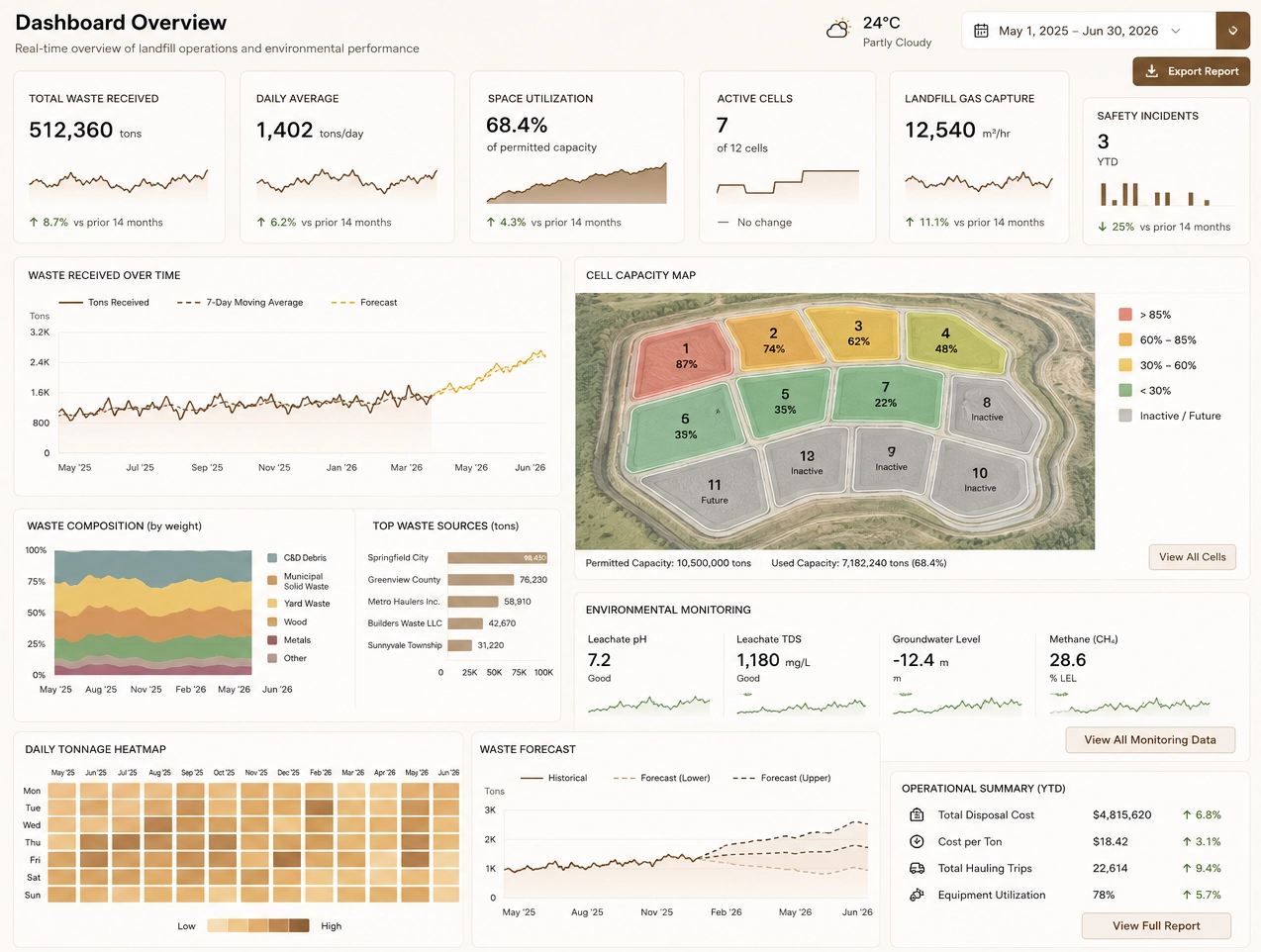
- Static Dashboards: Many dashboards lacked the interactivity needed for real-time decision-making. Managers often had to export data to spreadsheets to perform deeper analysis.
- Limited Environmental Data Integration: Integrating methane sensors, weather feeds, and groundwater monitoring systems required workarounds that were difficult to maintain.
- Slow Performance With Large Datasets: As historical tonnage, compaction, and emissions data accumulated, dashboard load times increased.
- Restricted Customization: Building landfill-specific dashboards—such as daily cover compliance or gas wellfield performance—was cumbersome.
- Challenges For Non-Technical Users: Supervisors and equipment operators found the interface unintuitive, reducing adoption.
These limitations created friction across departments. Environmental engineers wanted more granular emissions analytics. Operations managers needed real-time equipment dashboards. Finance teams required flexible profitability modeling. Leadership wanted unified reporting that tied everything together. It became clear that a more powerful and adaptable BI platform was necessary.
Why GreenHorizon Chose StyleBI
After evaluating several BI platforms, GreenHorizon selected StyleBI for its flexibility, performance, and ability to support landfill-specific workflows. Several factors influenced the decision:
- Advanced Dashboard Customization: StyleBI allowed the team to build dashboards tailored to landfill operations, including gas wellfield analytics, compaction efficiency, and leachate treatment performance.
- Real-Time Data Integration: The platform could ingest telemetry from gas wells, weather stations, weighbridges, and equipment sensors without complex workarounds.
- Self-Service Analytics: Non-technical users could explore data through guided filters, drill-downs, and interactive visualizations.
- High Performance With Large Datasets: StyleBI handled years of historical data without slowing down, enabling long-term trend analysis.
- Unified Reporting Environment: Finance, operations, environmental, and safety teams could all work within the same BI ecosystem.
The decision was not simply about replacing one tool with another. It was about elevating business intelligence from a reporting function to a strategic asset that supported every aspect of landfill management.
Migration Strategy: From Phocas Dashboards To StyleBI Intelligence
GreenHorizon approached the migration methodically to avoid disrupting daily operations. The project was divided into three phases: discovery, redesign, and deployment.
Discovery And Prioritization
The first step was identifying the dashboards and reports that were most critical to landfill operations. These included:
- Inbound Tonnage And Revenue Dashboard: Tracking daily, weekly, and monthly tonnage by waste type, customer, and contract.
- Compaction Efficiency Dashboard: Monitoring compaction rates, equipment hours, and fuel usage.
- Gas Wellfield Performance Dashboard: Analyzing methane flow, vacuum levels, and wellfield balancing.
- Environmental Compliance Dashboard: Integrating groundwater sampling, leachate levels, and emissions data.
- Cell Capacity Forecasting Dashboard: Predicting remaining airspace and planning future cell development.
These dashboards formed the foundation of the StyleBI implementation.

Redesigning Dashboards For Landfill-Specific Workflows
Rather than simply recreating Phocas dashboards, GreenHorizon used the migration as an opportunity to rethink how information should be presented. StyleBI’s flexible layout and interactive components enabled the team to:
- Group Metrics By Operational Questions: For example, “How efficiently are we compacting today?” or “Which wells need balancing?”
- Embed Alerts And Thresholds: Visual indicators highlighted when emissions exceeded limits or when compaction fell below targets.
- Enable Deep Drill-Downs: Users could move from high-level KPIs to specific loads, wells, or equipment units.
This redesign transformed dashboards from static reports into dynamic decision-making tools.
Driving Adoption Across Departments
GreenHorizon recognized that the success of StyleBI depended on widespread adoption. To support this, the company:
- Created Role-Based Dashboards: Operators, supervisors, engineers, and executives each received tailored views.
- Conducted Hands-On Training: Workshops focused on real scenarios, such as diagnosing low compaction or identifying gas well anomalies.
- Integrated StyleBI Into Daily Routines: Morning huddles, environmental reviews, and financial meetings all used StyleBI dashboards.
As users became comfortable with the platform, StyleBI became the central hub for operational intelligence.

Key StyleBI Dashboards For Landfill Operations
Several dashboards emerged as essential tools for GreenHorizon’s landfill management.
Inbound Tonnage And Revenue Intelligence
This dashboard provided real-time visibility into waste streams, customer activity, and revenue performance. Users could:
- Track Tonnage By Waste Type: Municipal solid waste, construction debris, industrial waste, and special waste.
- Analyze Customer Trends: Identifying high-value contracts and seasonal fluctuations.
- Monitor Daily Throughput: Ensuring weighbridge operations remained efficient.
Compaction And Equipment Utilization
Compaction efficiency is one of the most important drivers of landfill profitability. The StyleBI dashboard allowed managers to:
- Monitor Compaction Rates: Comparing actual performance to targets.
- Track Equipment Hours: Ensuring compactors, dozers, and loaders were used effectively.
- Optimize Fuel Consumption: Identifying inefficiencies in equipment operation.

Gas Wellfield Performance And Emissions
Methane management is both an environmental responsibility and a revenue opportunity. The StyleBI dashboard enabled:
- Real-Time Monitoring: Flow rates, vacuum levels, and gas quality.
- Well Balancing Analysis: Identifying wells that required adjustment.
- Emissions Compliance Tracking: Ensuring regulatory thresholds were met.
Environmental Compliance And Leachate Management
Environmental compliance is non-negotiable in landfill operations. The StyleBI dashboard consolidated:
- Groundwater Sampling Results
- Leachate Storage Levels
- Stormwater Monitoring Data
- Daily Cover Compliance
This unified view reduced the risk of missed deadlines or overlooked anomalies.
Business Impact Of Switching To StyleBI
Within the first year of migrating from Phocas to StyleBI, GreenHorizon experienced measurable improvements across operations, finance, and compliance.
- Improved Operational Efficiency: Better compaction tracking and equipment utilization reduced operating costs.
- Enhanced Environmental Oversight: Real-time emissions and groundwater monitoring improved compliance.
- Faster Decision-Making: Managers could answer operational questions in minutes rather than waiting for reports.
- Greater Financial Visibility: Profitability analysis by customer and waste type became more accurate.
- Stronger Cross-Department Alignment: All teams used the same dashboards, reducing confusion and miscommunication.
Perhaps the most significant impact was cultural. StyleBI helped GreenHorizon shift from reactive reporting to proactive management, enabling the company to anticipate issues, optimize operations, and plan for the future with greater confidence.

A Smarter Future For Landfill Intelligence
GreenHorizon’s migration from Phocas to StyleBI was more than a software upgrade—it was a transformation in how the company understood and managed its landfill operations. By adopting a platform designed for flexibility, interactivity, and real-time insight, the company positioned itself for long-term success in an industry where environmental responsibility, operational efficiency, and regulatory compliance are inseparable. StyleBI now serves as the central intelligence layer that empowers every department to make smarter, faster, and more informed decisions.