Technical Ceramics Manufacturer Uses InetSoft To Mash Up Ten Data Sources For Enterprise Business Intelligence
Technical ceramics manufacturing is an industry defined by precision, complexity, and unforgiving performance requirements. Whether producing alumina substrates for semiconductor tooling, zirconia components for medical implants, or silicon nitride bearings for aerospace systems, the margin for error is extremely small. Every batch of powder, every sintering cycle, and every dimensional tolerance must be monitored with scientific rigor. For one global technical ceramics manufacturer, the challenge was not a lack of data but the overwhelming fragmentation of it. Over the years, the company had accumulated ten different data sources spread across ERP systems, laboratory information systems, kiln controllers, quality databases, supplier portals, and spreadsheets maintained by engineering teams. Each system held a piece of the truth, but none provided a complete picture.
The company recognized that its growth and competitiveness depended on unifying these data streams into a single analytical environment. Engineers needed to correlate powder characteristics with sintering outcomes. Quality teams needed to trace defects back to raw material lots or equipment conditions. Executives needed visibility into product-line profitability across regions and customer segments. The existing reporting tools could not keep up with the complexity of the questions being asked. That is when the company turned to InetSoft and its data mashup capabilities, seeking a platform that could integrate all ten data sources into a coherent, governed, and flexible business intelligence layer.

Challenges Created By Fragmented Data Systems
Before adopting InetSoft, the manufacturer struggled with the classic symptoms of data fragmentation. Engineers often exported data from multiple systems into spreadsheets, manually aligning timestamps, batch numbers, and equipment identifiers. This process was slow, error-prone, and difficult to reproduce. Quality analysts faced similar challenges when investigating defects. A single root-cause analysis could require pulling data from the ERP system, the kiln monitoring system, the laboratory database, and supplier certificates of analysis. Each system used different naming conventions, units of measure, and data structures, making it nearly impossible to automate the process.
Financial and operational reporting suffered as well. The ERP system provided high-level cost and production data, but it lacked the granularity needed to understand how specific product families performed across plants. Meanwhile, the manufacturing execution system tracked cycle times and scrap, but it did not integrate with the financial data needed to calculate true cost-to-serve. The result was a patchwork of reports that answered narrow questions but failed to provide a unified view of the business. Leadership knew that without a more integrated approach, the company would struggle to scale its operations and maintain its competitive edge.
Why InetSoft Was Selected For Data Mashup And Analytics
The company evaluated several business intelligence platforms before selecting InetSoft. The deciding factor was InetSoft’s ability to perform data mashups across heterogeneous systems without requiring a full data warehouse rebuild. InetSoft allowed the company to connect directly to all ten data sources, including SQL databases, CSV files, cloud applications, and proprietary equipment logs. More importantly, it provided a semantic layer where business rules, joins, and transformations could be defined once and reused across reports and dashboards.
This approach gave the manufacturer the flexibility it needed to support both operational reporting and exploratory analysis. Engineers could build custom views that combined powder chemistry, particle size distribution, kiln temperature profiles, and dimensional inspection results. Quality teams could create traceability reports that followed a batch from raw material receipt through forming, sintering, machining, and final inspection. Finance teams could blend production data with cost structures to calculate margin by product, customer, or region. All of this was possible without writing code or relying on IT for every new request.
Integrating Ten Data Sources Into A Unified Analytical Layer
The heart of the project was the integration of ten disparate data sources into InetSoft’s mashup engine. The sources included the ERP system, the manufacturing execution system, the laboratory information system, kiln controller logs, supplier quality databases, maintenance records, customer complaint systems, energy consumption logs, regional sales databases, and engineering spreadsheets. Each source provided unique insights, but only when combined did they reveal the full story of how materials, processes, and customer requirements interacted.
InetSoft’s data mashup capabilities allowed the company to define relationships between these systems based on batch numbers, timestamps, equipment identifiers, and material codes. The platform handled unit conversions, data cleansing, and normalization, ensuring that engineers and analysts worked with consistent and reliable data. Once the mashups were defined, they became reusable building blocks for dashboards, reports, and ad hoc analysis. This eliminated the need for manual data stitching and dramatically reduced the time required to answer complex questions.
Transforming Engineering And Process Optimization
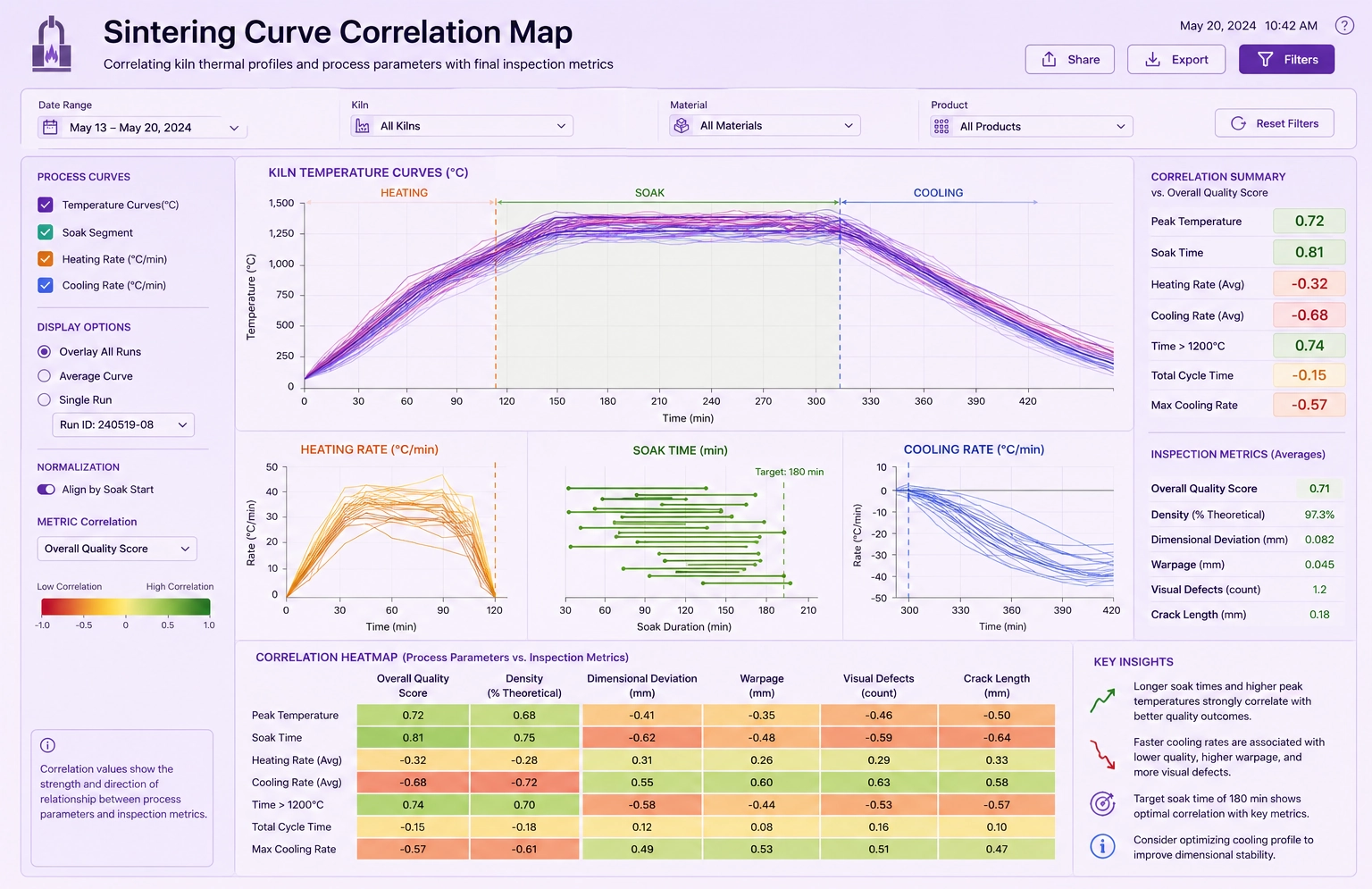
For the engineering team, the impact of InetSoft was immediate and profound. Previously, analyzing the relationship between powder characteristics and sintering outcomes required days of manual data preparation. With InetSoft, engineers could create interactive dashboards that displayed powder chemistry, particle size distribution, forming pressure, kiln temperature curves, and final dimensional results in a single view. They could filter by product family, equipment line, or supplier, allowing them to identify patterns and anomalies that were previously hidden.
This new visibility enabled the team to optimize sintering cycles, reduce scrap, and improve dimensional consistency. Engineers could quickly test hypotheses, such as whether a specific kiln zone was contributing to warping or whether a supplier’s powder lot was causing density variation. The ability to correlate data across systems empowered the team to make data-driven decisions that improved product quality and reduced production costs.
Enhancing Quality Assurance And Traceability
Quality assurance teams also benefited from the unified data environment. Technical ceramics used in aerospace, medical, and semiconductor applications require rigorous traceability. InetSoft allowed the company to build end-to-end traceability reports that followed each batch through every stage of production. These reports combined data from the ERP system, laboratory tests, kiln logs, machining records, and final inspection results.
When defects occurred, quality analysts could quickly identify whether the issue was related to raw materials, equipment conditions, operator actions, or environmental factors. This accelerated root-cause analysis and reduced the time required to implement corrective actions. The company also used InetSoft to automate compliance reporting, ensuring that auditors received consistent and complete documentation without manual effort.
Improving Financial And Executive Visibility
Executives gained a clearer understanding of profitability and operational performance across the organization. InetSoft enabled the finance team to blend production data with cost structures, energy consumption, scrap rates, and warranty claims. This allowed the company to calculate true margin by product line, customer segment, and region. Leaders could see which products were driving profitability and which required process improvements or pricing adjustments.
The executive dashboards provided real-time visibility into key performance indicators such as yield, on-time delivery, equipment utilization, and customer satisfaction. Because these dashboards were built on the same mashup layer used by engineering and quality teams, everyone in the organization worked from a single version of the truth. This alignment improved decision-making and helped the company respond more quickly to market changes.
Building A Scalable Foundation For Future Analytics
The adoption of InetSoft did more than solve immediate reporting challenges; it created a scalable foundation for future analytics initiatives. The company plans to integrate predictive models for equipment maintenance, yield optimization, and demand forecasting. Because InetSoft already unifies data from ten systems, these models can draw from a rich and diverse dataset. The company also intends to expand its use of dashboards and embedded analytics, bringing insights directly into the applications where employees work.
By choosing InetSoft, the technical ceramics manufacturer transformed its approach to data and analytics. What began as a fragmented landscape of disconnected systems became a unified, governed, and flexible environment that supports engineering, quality, finance, and executive decision-making. The company now has the tools it needs to innovate faster, operate more efficiently, and maintain its leadership in the demanding world of technical ceramics manufacturing.