How a Geotechnical Engineering Firm Switched From Kintone to StyleBI for Its Dashboard Chart Tool
In the competitive world of geotechnical engineering, companies manage vast amounts of complex data every day.
Soil test results, borehole logs, settlement monitoring readings, slope stability analyses, project timelines, and client reports all need to be tracked, analyzed, and presented clearly to support critical decisions on construction sites and infrastructure projects.
One mid-sized geotechnical firm based in the Northeast United States recently made a strategic technology switch that dramatically improved how its teams access and act on data.
After years of relying on Kintone for workflow and basic reporting, the company transitioned its dashboard and charting capabilities to StyleBI.
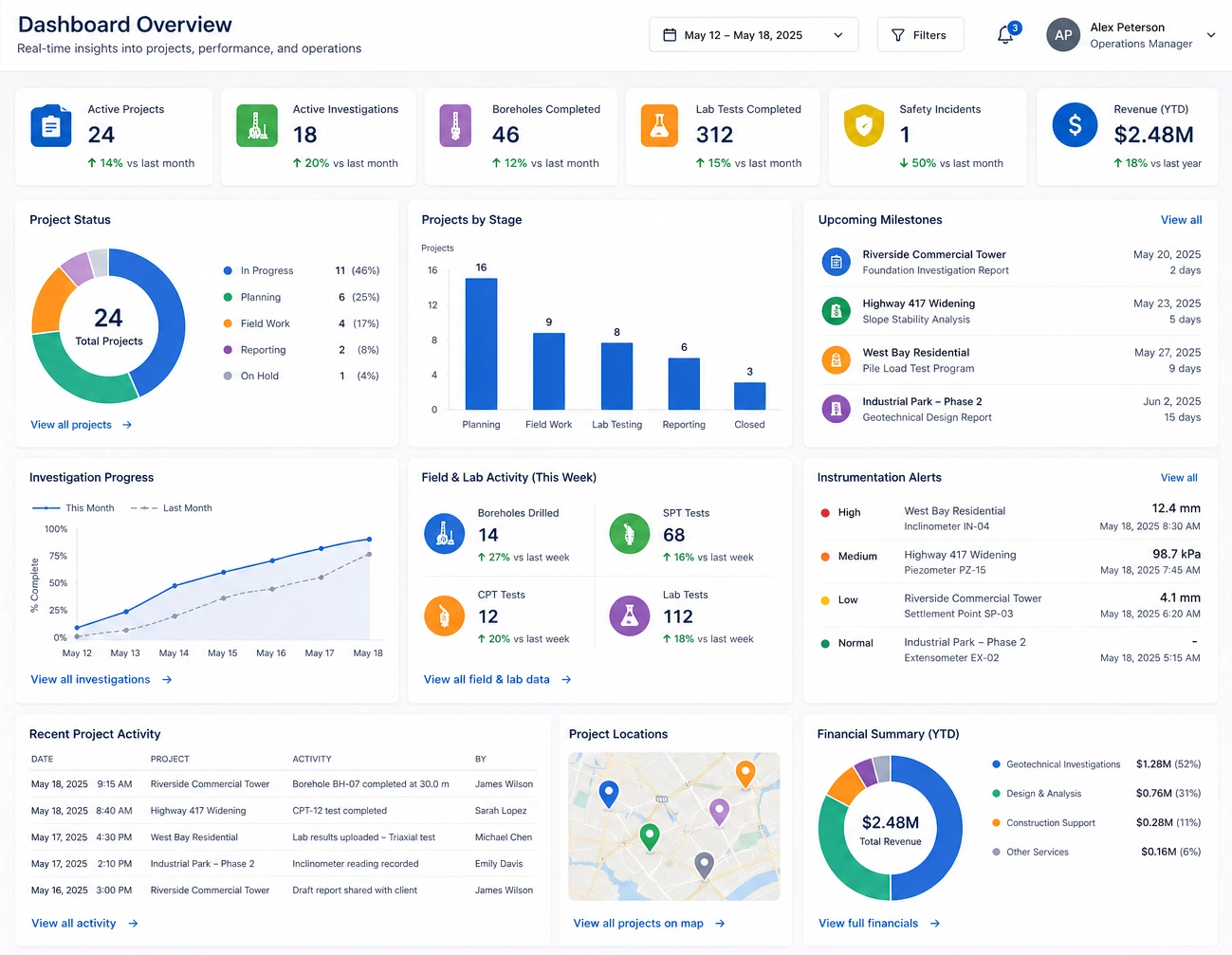
The firm, which we will refer to as GeoTech Solutions for confidentiality, specializes in foundation design, ground improvement, deep excavations, and geotechnical instrumentation for bridges, highways, commercial buildings, and renewable energy projects. With over 150 employees across multiple regional offices, the company handles dozens of active projects simultaneously, generating thousands of data points weekly from field sensors, laboratory tests, and engineering models.

The Limitations of Kintone for Advanced Dashboard Needs
For several years, GeoTech Solutions used Kintone primarily as a low-code platform to manage project workflows, field data collection, and internal approvals. Kintone served the company well for building custom apps to track borehole drilling progress, manage laboratory testing requests, and handle change orders. However, as the volume and complexity of geotechnical data grew, the platform’s built-in charting and dashboard capabilities began to show significant shortcomings.
Kintone’s visualization tools are relatively basic. Engineers and project managers frequently needed to create dynamic charts showing pore water pressure trends over time, lateral displacement rates, settlement forecasts, and comparisons between predicted and actual ground behavior. While Kintone allowed simple bar charts, line graphs, and tables, it lacked the flexibility for advanced visualizations required in geotechnical work. Creating custom dashboards often required workarounds, multiple exports to Excel, or manual updates that consumed valuable engineering time.
Another pain point was performance. When dashboards included data from hundreds of monitoring instruments across multiple project sites, loading times increased and responsiveness suffered. Project teams working in the field or during client meetings needed fast, reliable access to real-time or near-real-time insights. Kintone’s focus on workflow automation rather than deep business intelligence made it difficult to deliver the rich, interactive dashboards that leadership and field engineers demanded.
Furthermore, integrating data from external sources proved challenging. GeoTech Solutions pulled information from specialized geotechnical software, inclinometer readers, piezometer sensors, and laboratory information management systems. Combining these varied data streams into cohesive views within Kintone required significant custom development and ongoing maintenance. As the company expanded its instrumentation monitoring services, these integration limitations became increasingly problematic.

Identifying the Need for a Dedicated Dashboard and Charting Solution
In early 2025, GeoTech Solutions conducted an internal audit of its technology stack. Project managers reported spending up to ten hours per week manually compiling reports for clients and internal reviews. Senior engineers expressed frustration that critical early warning signals — such as accelerating settlement rates or unexpected pore pressure spikes — were not being surfaced quickly enough in existing tools.
The company’s leadership recognized that while Kintone remained valuable for process management and data entry, it was not optimized as a business intelligence and visualization platform. They began evaluating dedicated dashboard tools that could handle the unique demands of geotechnical engineering: handling time-series sensor data, supporting geospatial mapping, enabling drill-down analysis from company-wide overviews to individual borehole details, and providing clear visual indicators for risk thresholds.
After reviewing several options, the team selected StyleBI, a lightweight yet powerful visualization engine known for its flexibility in creating interactive dashboards and charts. StyleBI stood out for its modern charting capabilities, support for complex data transformations, and ability to embed advanced visualizations directly into existing workflows.
The Migration Process from Kintone to StyleBI
The transition began with a six-month pilot project focused on one major infrastructure contract. The IT and engineering teams worked together to export key datasets from Kintone and connect them to StyleBI through APIs and scheduled data pipelines. Because StyleBI is designed as a cloud-native application with a small footprint, deployment was straightforward and did not require heavy infrastructure investment.
Data modeling was a critical first step. Geotechnical data is inherently multidimensional — involving depth, time, location, soil type, and various measured parameters. StyleBI’s data transformation pipeline allowed the team to clean, normalize, and enrich raw sensor readings without disrupting ongoing field operations. Engineers could now define calculated metrics such as movement velocity, utilization percentages of allowable displacement, and forecast settlement curves directly within the platform.
One of the biggest wins during migration was the ability to build interactive dashboards that combined multiple data sources. A single project dashboard now displays real-time charts for pore pressure trends alongside settlement monitoring, weather data correlations, and construction activity timelines. Users can click on any data point to drill down into raw readings or associated borehole logs.
Training was another important aspect. While Kintone had a gentler learning curve for basic app building, StyleBI required some investment in upskilling the team on advanced visualization techniques. However, most engineers adapted quickly because the visual results were immediately useful. Within weeks, project teams were creating custom views tailored to their specific roles — field technicians focused on daily monitoring alerts, while senior managers reviewed portfolio-level risk summaries.

Key Benefits Realized After Switching to StyleBI
The impact of the switch became evident within the first quarter. Dashboard loading times dropped significantly, even when displaying data from dozens of active monitoring points. StyleBI’s optimized charting engine handled large time-series datasets smoothly, allowing users to zoom, filter, and compare trends effortlessly.
Visualization quality improved dramatically. The firm could now deploy professional-grade charts including advanced line graphs with confidence intervals, heat maps for spatial data, gauge indicators for threshold monitoring, and custom combination charts that overlay construction progress with geotechnical responses. These rich visuals made it much easier to communicate complex ground behavior to clients and regulatory bodies.
Actionability increased as well. StyleBI enabled the creation of exception-based dashboards that highlight potential issues automatically. For example, when lateral displacement velocity exceeds predefined limits on a retaining wall project, the system flags the area in red and sends notifications to the responsible engineer. This proactive approach has helped the company prevent minor anomalies from escalating into costly delays or safety concerns.
Integration flexibility was another major advantage. StyleBI connects seamlessly with the company’s existing Kintone apps for data entry while pulling in information from laboratory databases and third-party monitoring platforms. This hybrid approach allowed GeoTech Solutions to keep Kintone for its strengths in workflow and forms while leveraging StyleBI purely for analytics and visualization — a best-of-both-worlds solution.
Geospatial capabilities also proved valuable for a company whose work is inherently location-based. StyleBI supports both lightweight shape-based maps and integration with web mapping services, enabling teams to visualize instrument locations, soil profiles, and risk zones across project sites with clarity.
Impact on Daily Operations and Business Outcomes
Project managers now start their day with a personalized StyleBI dashboard showing key performance indicators across all active contracts. They can quickly assess which sites are performing within expected parameters and which require immediate attention. This has reduced weekly status meeting preparation time by nearly 60 percent.
Field engineers benefit from mobile-friendly views that allow them to review the latest monitoring data while on site. Instead of waiting for emailed reports, they access live charts directly, improving decision-making speed during critical construction phases.
At the leadership level, executives gain a clearer picture of overall business health. Dashboards track not only technical geotechnical metrics but also project profitability, resource utilization, and proposal win rates — all in one cohesive environment. This unified view supports more informed strategic decisions about which types of projects to pursue and where to allocate specialized engineering talent.
Client satisfaction has also improved. GeoTech Solutions now delivers interactive project portals built with StyleBI, giving clients real-time visibility into monitoring results without overwhelming them with raw data. Professional, clear charts have strengthened trust and often become a competitive differentiator during bidding processes.

Lessons Learned and Future Plans
The migration taught the company several valuable lessons. First, separating workflow management from advanced analytics proved more effective than trying to force a single platform to handle both roles exceptionally well. Second, investing time upfront in proper data modeling pays significant dividends in dashboard usability and long-term maintainability.
Looking ahead, GeoTech Solutions plans to expand its use of StyleBI by incorporating predictive analytics for settlement forecasting and exploring automated report generation features. The firm is also evaluating embedding StyleBI visualizations directly into client-facing web portals and internal project management apps.
The switch from Kintone to StyleBI for dashboard and charting needs has allowed this geotechnical engineering company to move from reactive reporting to proactive, data-driven project management. In an industry where small shifts in ground behavior can have major safety and financial consequences, having clear, timely, and actionable insights is not just convenient — it is essential.
By embracing a specialized visualization tool while retaining Kintone for its core workflow strengths, GeoTech Solutions has built a more agile and insightful technology foundation. As the company continues to grow and take on increasingly complex projects involving real-time monitoring and digital twins, robust dashboard capabilities will remain a key competitive advantage.
The experience demonstrates that even in highly technical fields like geotechnical engineering, the right visualization platform can transform how teams understand their data, collaborate on solutions, and deliver better outcomes for clients and infrastructure projects alike.