From Tellius to StyleBI: A Precision Fermentation Company’s Dashboard Graph Solution Pivot
In the precision fermentation industry, data is not a side effect of operations; it is the lifeblood of the business. Every fermentation run, every bioreactor parameter, every downstream purification step generates streams of data that determine yield, quality, and ultimately profitability. For one mid-sized contract biomanufacturer specializing in precision fermentation of dairy proteins and specialty enzymes, the limitations of its existing analytics stack became impossible to ignore.
The company had invested in Tellius for augmented analytics and natural language queries, but as its operations scaled, it needed something different: a robust, governed, and deeply embeddable dashboard and graph solution. That need drove a strategic shift from Tellius to StyleBI.
Operational Context in Precision Fermentation
The company operates multiple facilities with bioreactors ranging from 5,000 to 80,000 liters. Each batch involves dozens of critical parameters: dissolved oxygen, pH, agitation speed, feed rates, temperature profiles, and more. Downstream, filtration, chromatography, and drying steps add additional layers of complexity. On top of that, the company must manage customer-specific formulations, quality specifications, and regulatory documentation.
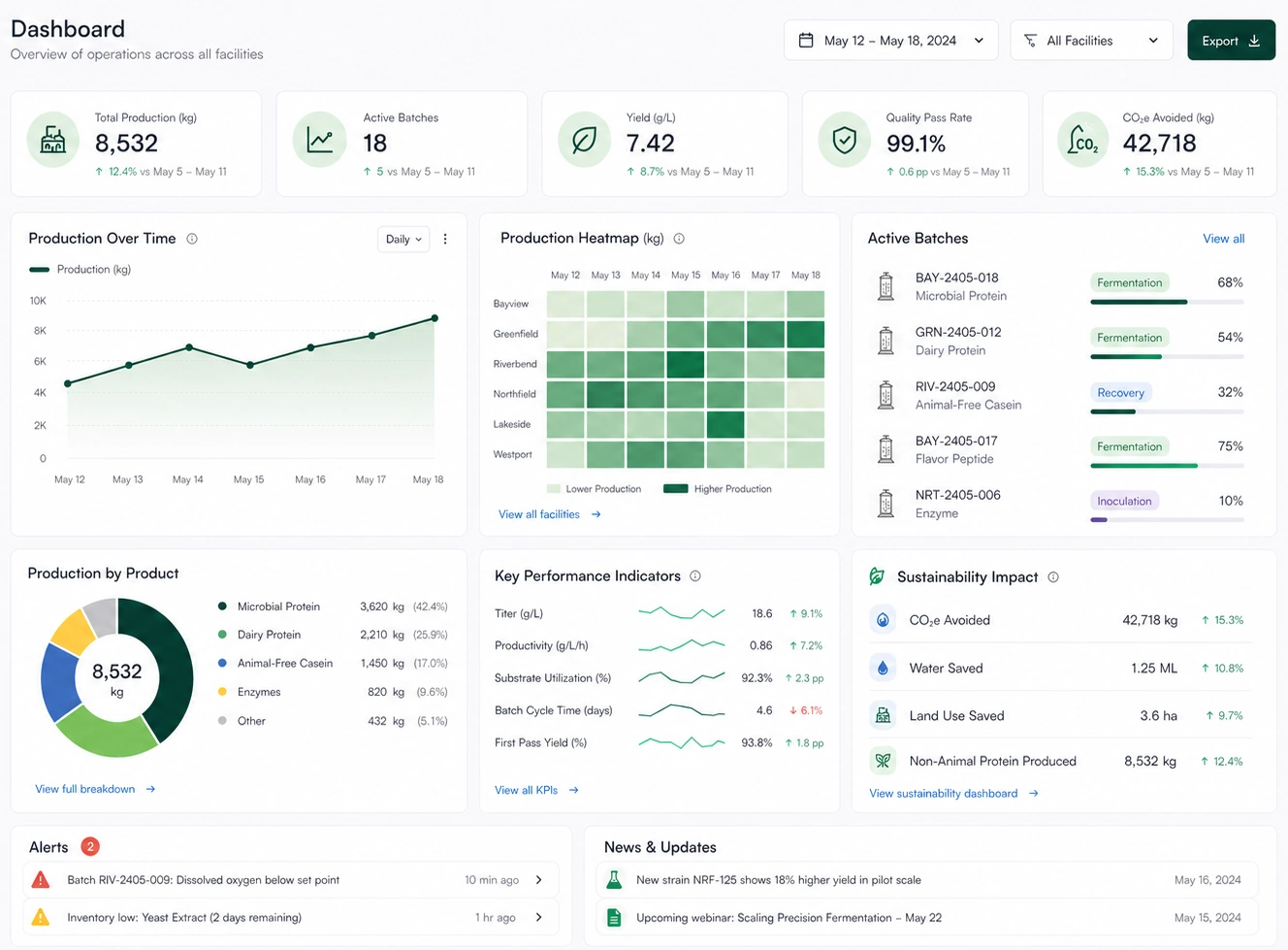
The analytics challenge is not just about exploring data; it is about continuously monitoring and optimizing a living, breathing production environment. Process engineers need real-time dashboards for fermentation health. Quality teams need trend graphs for deviations and out-of-spec events. Commercial teams need capacity and utilization views to negotiate contracts and allocate tank time. The company’s leadership realized that its analytics platform had to be a stable, governed “single pane of glass” rather than a collection of exploratory tools.
Where Tellius Started to Fall Short
Tellius initially appealed to the company because of its augmented analytics capabilities. Process scientists could ask natural language questions like “Which batches had the highest yield for strain X?” and quickly surface insights. For early-stage R&D and exploratory analysis, this was powerful. However, as the company moved from experimentation to repeatable large-scale production, several gaps emerged.
First, the company needed highly controlled, pixel-perfect dashboards that could be standardized across plants and teams. Tellius, while strong in guided insights and automated explanations, was not the ideal fit for building deeply customized, embedded dashboards that mirrored the company’s operational workflows. The process engineers wanted tightly structured graph layouts: multi-axis trend charts for fermentation runs, waterfall charts for yield loss across unit operations, and Gantt-like visualizations for tank scheduling. Achieving and maintaining these designs in Tellius required workarounds and did not scale cleanly.
Second, governance became a concern. As more users joined the platform, the proliferation of ad-hoc analyses and self-created views made it difficult to ensure that everyone was working from the same definitions of yield, on-spec rate, or batch success. The company needed a stronger semantic layer and a more controlled approach to dashboard publishing, where curated datasets and standardized metrics could be reused across many visualizations.
Third, the company wanted to embed dashboards directly into internal manufacturing portals and customer-facing collaboration sites. While Tellius offered integration options, the team found that embedding highly customized dashboards with fine-grained access control and consistent styling was more complex than they wanted for a long-term core platform.

Why StyleBI Emerged as the Preferred Dashboard Graph Solution
The analytics steering committee, which included representatives from operations, quality, IT, and commercial, defined a clear set of requirements for the next phase of their analytics journey. They needed a solution that excelled at:
- Governed dashboards: Centralized control over data definitions, metrics, and visual standards.
- Flexible data connectivity: Direct access to process historians, MES, LIMS, ERP, and cloud data warehouses.
- Advanced graphing: Rich time-series, multi-axis, and comparative visualizations tailored to process data.
- Embedding and white-labeling: Seamless integration into internal and external portals.
- Performance at scale: Responsive dashboards even with millions of rows of sensor and batch data.
StyleBI matched these needs by focusing on being a robust, enterprise-grade dashboard and reporting platform. Its strength lies in building structured, reusable dashboards with a strong separation between data models and visual layouts. For the precision fermentation company, this meant they could design a standard “Fermentation Run Overview” dashboard once and deploy it across all plants, with local filters and security rules applied automatically.
The platform’s graphing capabilities were especially important. Process engineers could configure synchronized time-series charts for multiple tags, overlay setpoints and control limits, and quickly zoom into specific phases of a batch. Quality teams could build Pareto charts of deviation causes and trend graphs of key quality attributes across campaigns. Commercial teams could visualize tank utilization, lead times, and on-time delivery performance in a way that directly supported contract negotiations.

Migration Strategy: From Exploratory to Governed Analytics
The company approached the migration from Tellius to StyleBI as both a technical and cultural shift. Rather than simply “rebuilding dashboards,” they used the transition to clarify which metrics truly mattered and how they should be defined. A cross-functional data governance group cataloged key performance indicators: fermentation yield, volumetric productivity, batch cycle time, right-first-time rate, and more. These definitions were then implemented in StyleBI’s data models.
On the technical side, IT teams connected StyleBI to the company’s process historian, MES, LIMS, and ERP systems. They created curated datasets for different user groups: process engineering, quality, supply chain, and commercial. Each dataset exposed only the fields and measures relevant to that group, with row-level security to protect customer-specific and plant-specific information.
Existing Tellius content was triaged. Some exploratory analyses were archived as reference, while others were translated into standardized dashboards. For example, a popular Tellius analysis that identified correlations between dissolved oxygen excursions and yield loss became a formal “Fermentation Stability” dashboard in StyleBI, with pre-defined filters, drill-down paths, and alert thresholds.
Training focused on the new mindset: Tellius had encouraged ad-hoc questioning, while StyleBI emphasized consistent, shared views of the truth. Users were taught how to navigate dashboards, apply filters, and request enhancements through a structured backlog rather than creating one-off analyses that could not be easily shared or governed.
Impact on Day-to-Day Operations
Within months of the switch, the company began to see tangible benefits. Process engineers reported that they could compare batches more quickly and reliably because the “Batch Comparison” dashboard in StyleBI enforced consistent alignment of phases and time windows. Instead of manually exporting data and stitching together graphs, they used a single dashboard that allowed them to overlay multiple runs and highlight deviations visually.
Quality teams gained a clearer view of trends across products and customers. A standardized “Quality Performance” dashboard showed non-conformance rates, root cause categories, and time-to-closure for investigations. Because the underlying metrics were governed, discussions in quality review meetings shifted from “Which numbers are correct?” to “What actions do we take based on these numbers?”
For commercial and capacity planning teams, StyleBI dashboards provided a unified view of tank utilization, planned versus actual cycle times, and forecasted capacity. This allowed them to identify bottlenecks earlier and negotiate realistic timelines with customers. The ability to embed these dashboards into the company’s internal planning portal meant that stakeholders did not have to switch tools or learn a new interface; the analytics were simply part of their daily workflow.

Customer-Facing Analytics and Differentiation
One of the most strategic outcomes of the move to StyleBI was the company’s ability to offer customer-facing dashboards. Many of its clients—food tech startups, specialty chemical companies, and biotech firms—wanted more transparency into their campaigns: batch status, yield trends, and quality results. With StyleBI’s embedding and styling capabilities, the company created a secure customer portal where each client could log in and see dashboards tailored to their products and campaigns.
These dashboards showed high-level KPIs as well as detailed graphs of batch performance, all filtered to the customer’s data. Access control rules ensured that no customer could see another’s information. This level of transparency became a competitive differentiator in the precision fermentation market, where trust and reliability are critical.
Lessons Learned from the Transition
The company’s journey from Tellius to StyleBI highlights an important lesson for data-driven organizations in complex industries: the right tool depends on the maturity and primary use case of analytics. Tellius excelled when the company’s main need was exploratory insight generation and rapid questioning. As the business matured into a high-throughput, multi-plant operation, the emphasis shifted to governed, repeatable, and embeddable dashboards that aligned everyone around the same metrics.
By choosing StyleBI as its dashboard graph solution, the company gained a platform that could keep pace with the operational rigor of precision fermentation. It did not abandon exploration entirely—data scientists still used other tools for deep statistical analysis—but it recognized that the everyday heartbeat of the business depended on stable, trusted dashboards.
In the end, the transition was not just a technology swap; it was a redefinition of how the company thought about data. Dashboards became part of the production environment, as essential as sensors and control systems. For a precision fermentation company competing on yield, reliability, and customer trust, that shift made all the difference.