From FusionCharts to StyleBI: Transforming Exploratory Visualization in Industrial Odor Control
OdoraTech Solutions, a mid-sized company in the Industrial Odor Control & Emissions Neutralization industry, had a familiar problem: its data had outgrown its visualization stack.
The company designs and operates odor control systems for wastewater treatment plants, landfills, and food processing facilities, managing thousands of sensors that continuously stream data on hydrogen sulfide levels, volatile organic compounds, airflow, scrubber performance, and community complaint logs.
For years, OdoraTech relied on a FusionCharts-based exploratory visualization tool embedded in its internal portal to help engineers and account managers understand what was happening across sites.
But as the business matured, the limitations of that approach became impossible to ignore.

Why FusionCharts Reached Its Limits
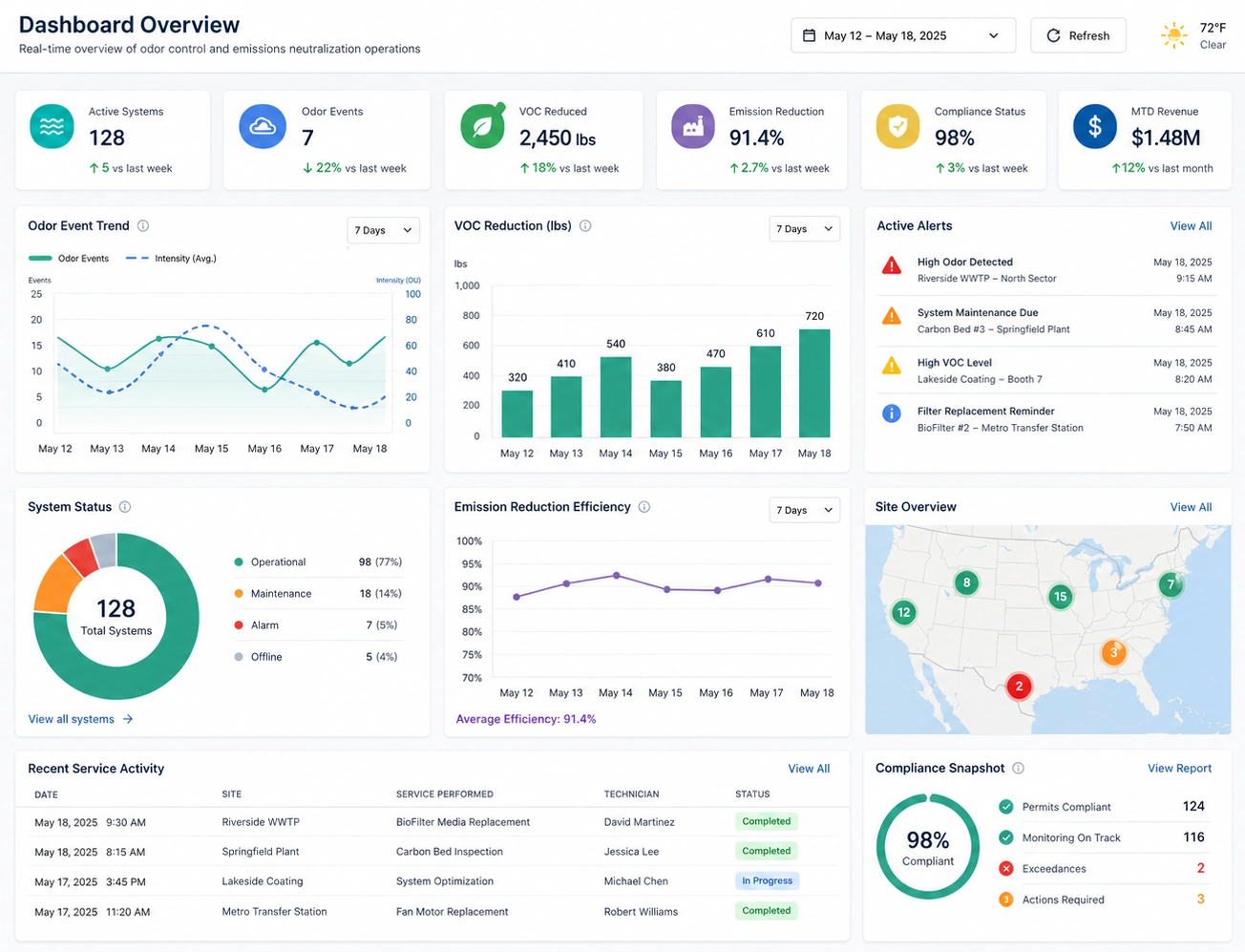
The FusionCharts implementation had started as a quick way to add interactive charts to a custom web application. Over time, however, the company’s needs shifted from static dashboards and pre-defined drilldowns to truly exploratory analysis. Process engineers wanted to slice emissions data by odor source, scrubber configuration, and weather conditions on the fly. Customer success teams wanted to overlay complaint tickets with real-time sensor readings to demonstrate compliance and proactively address community concerns. Executives wanted a unified view of regulatory risk, uptime, and service-level adherence across all client facilities. The existing charting layer simply was not built for that level of ad hoc exploration.
The pain points were clear. Each new view required developer intervention: adding new FusionCharts configurations, wiring up data queries, and testing across browsers. The charts themselves were visually appealing but rigid. Cross-filtering between charts was limited, and there was no native concept of a governed semantic layer that could be reused across projects. As the number of clients and monitored sites grew, so did the maintenance burden. OdoraTech’s small development team found itself spending more time maintaining chart definitions than delivering new analytical capabilities.
The turning point came when OdoraTech signed a multi-site contract with a regional wastewater authority. The authority required transparent, self-service access to emissions and odor performance data, including the ability to explore historical trends, compare facilities, and download evidence for regulatory audits. The existing FusionCharts-based tool could not be safely exposed to external users without extensive customization and security hardening. OdoraTech realized it needed a platform designed from the ground up for self-service analytics, governed data access, and flexible exploratory visualization.

Choosing StyleBI
After evaluating several options, OdoraTech chose StyleBI as the foundation for its next-generation Exploratory Visualization Tool. The decision was driven by three core requirements. First, the platform had to support rich, interactive visual analysis without requiring constant developer involvement. Second, it needed to integrate cleanly with OdoraTech’s existing data infrastructure, including time-series sensor databases, maintenance logs, and ticketing systems. Third, it had to provide a secure, multi-tenant environment where both internal teams and external clients could explore data within clearly defined permissions.
StyleBI’s visual composer immediately changed how OdoraTech thought about dashboards. Instead of hard-coding chart configurations, analysts could drag and drop measures like hydrogen sulfide concentration, odor unit indices, fan energy consumption, and scrubber pressure drop onto a canvas. Dimensions such as facility, odor source, biofilter media type, and weather condition could be added or removed on demand. This meant that a single dashboard could serve multiple questions: an engineer might use it to diagnose a spike in emissions after a media change, while a customer success manager might use the same view to show a client how complaint volume has decreased since system optimization.

Interactive Exploration at Scale
One of the most powerful shifts came from StyleBI’s ability to support cross-filtering and coordinated views. In the old FusionCharts environment, each chart was largely independent. Selecting a time range in one chart did not automatically filter the others, and building that behavior required custom code. With StyleBI, OdoraTech created a “Facility Health Explorer” where selecting a specific odor event on a time-series chart instantly filtered related KPIs, maintenance activities, and complaint records. This gave engineers a holistic view of cause and effect: they could see, for example, how a temporary fan failure led to elevated emissions, which in turn correlated with a spike in community complaints.
The migration also transformed how OdoraTech handled its data model. Previously, each FusionCharts implementation pulled directly from underlying tables or APIs, often with duplicated logic and inconsistent naming. StyleBI encouraged the creation of a reusable semantic layer. OdoraTech’s data team defined business-friendly objects such as “Odor Event,” “Scrubber Performance,” and “Community Impact,” each with standardized measures and dimensions. This not only reduced errors but also made it easier for non-technical users to build their own views without worrying about raw table structures or SQL syntax.

Migration Execution
From a technical standpoint, the transition required careful planning but proved more straightforward than expected. OdoraTech began by cataloging the most heavily used FusionCharts dashboards and identifying the underlying data sources. They then recreated those dashboards in StyleBI, focusing first on parity and then on enhancement. In many cases, what had previously required multiple separate charts could be consolidated into a single, more flexible visualization with interactive filters and drilldowns. The team also took the opportunity to rationalize metrics, eliminating redundant calculations and aligning definitions across departments.
Security and governance were critical considerations, especially given the regulatory sensitivity of emissions data. StyleBI’s role-based access controls allowed OdoraTech to define clear boundaries between internal and external users. Internal engineers could see detailed sensor-level data and maintenance logs, while clients were given curated views focused on compliance, performance against service-level agreements, and high-level trends. Row-level security ensured that each client only saw data for their own facilities, enabling OdoraTech to offer a single multi-tenant portal instead of maintaining separate, custom-built instances.

Operational and Client Impact
The impact on day-to-day work was immediate. Process engineers reported that they could answer complex questions in minutes instead of hours. For example, when a landfill client asked whether seasonal temperature changes were affecting odor capture efficiency, an engineer used StyleBI to overlay emissions data with ambient temperature and wind direction, then filtered by specific phases of landfill cell development. Previously, this would have required exporting data to spreadsheets or scripting custom queries. Now, it was a matter of dragging fields into a visualization and iterating in real time during a client meeting.
Customer-facing teams also saw tangible benefits. The new exploratory visualization tool became a centerpiece of quarterly business reviews. Instead of static slide decks, account managers walked clients through live dashboards, drilling into specific odor events, showing how system tuning had reduced peak emissions, and demonstrating compliance with local regulations. The ability to pivot on the fly—switching from a facility-level view to a specific scrubber train, or from a monthly trend to a single high-impact day—built trust and positioned OdoraTech as a transparent, data-driven partner.
Proactive Risk Management
Over time, OdoraTech began to use StyleBI not just for retrospective analysis but also for proactive risk management. By combining historical emissions patterns with weather forecasts and planned maintenance schedules, the company built dashboards that highlighted facilities at elevated risk of odor incidents in the coming days. Operations teams used these insights to adjust staffing, preemptively inspect critical components, or temporarily adjust process parameters. This shift from reactive reporting to proactive mitigation became a key differentiator in competitive bids.
The migration from FusionCharts to StyleBI also had cultural effects inside the organization. Because StyleBI lowered the barrier to building and modifying visualizations, more people engaged directly with data. Field technicians contributed ideas for new views that would help them correlate on-the-ground observations with sensor readings. Compliance officers requested dashboards that aligned directly with reporting templates for regulators, reducing manual effort and the risk of transcription errors. The exploratory visualization tool evolved from a developer-owned artifact into a shared analytical workspace.
Strategic Outcome
Looking back, OdoraTech’s leadership came to see the move away from FusionCharts as more than a technology upgrade. It was a strategic shift in how the company understood and communicated its value. In an industry where odor and emissions are often perceived only when something goes wrong, the ability to visualize performance clearly and interactively is a powerful asset. StyleBI gave OdoraTech the flexibility, governance, and depth needed to turn raw sensor streams into narratives about reliability, compliance, and community impact. The exploratory visualization tool, once a static collection of charts, became a living, evolving lens on the invisible work of keeping the air around critical infrastructure clean and breathable.