Choosing InetSoft StyleBI Over Oracle BI
Are you evaluating Oracle as a BI provider, and wondering about alternatives? When recently placed head to head in ratings by tech research firm G2 Crowd, InetSoft won in a majority of categories, beating Oracle in 78% of individual ratings.
G2 Crowd is a Chicago based company that provides reviews on other companies' software products, targeting the CRM and marketing automation markets. It prides itself on being an unbiased platform where real users share their feedback. Data from peer reviews, web traffic, and other social media data from LinkedIn, Twitter etc. are fed into a formula that gives more weight to peer reviews over others.
The ratings are categorized based on the visual, analytical, procedural and advanced capabilities of the software. Below is a breakdown of the various categories in which InetSoft outranked Oracle, and the reasons why.
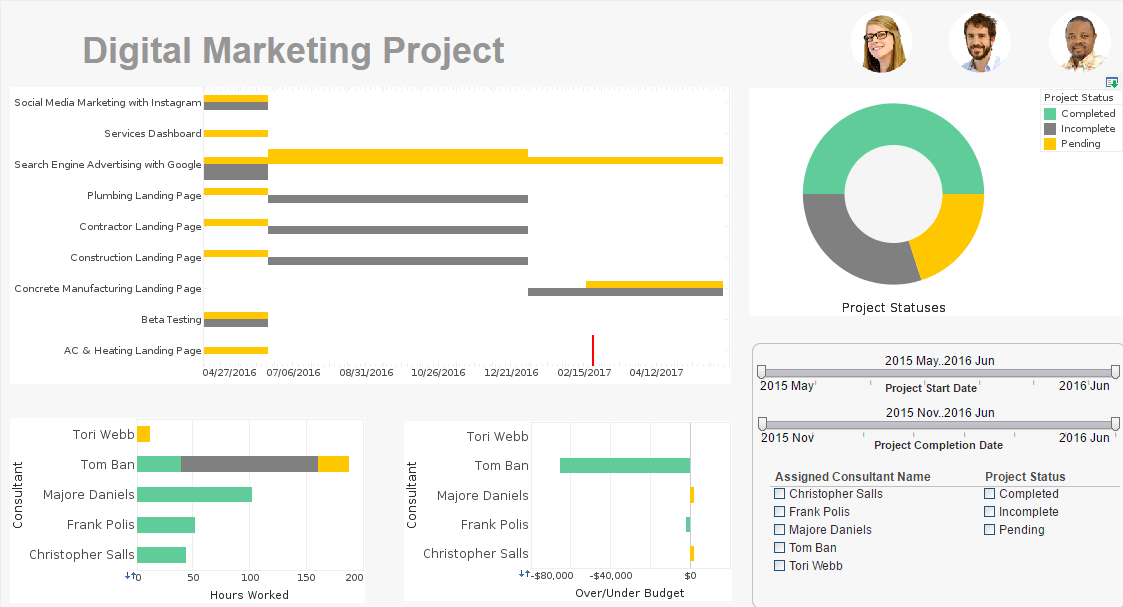

InetSoft's StyleBI leads the way in the general and user-interface aspect of the ratings, winning in categories such as Ease of use, Ease of setup, Quality of Support, Meeting Requirements, and Ease of Admin. Whether the end user is a non-technical business user or a power user building data mashups and white label customizations, Style Intelligence offers a wide range of functionalities in its dashboards, charts, reports, visual analyses, and predictive analytics.
It's intuitive tools allows for a layman to experiment with the software and easily create a dashboard or a report that fits their informational needs. Also, customer support at the business and technical level is reported as top notch.
Oracle scores lower than InetSoft in ease of use and setup because most find it to have a steep learning curve that requires the end user to be tech savvy. Although it has great integration capabilities with Siebel, PeopleSoft, JD Edwards, Hyperion, BI Publisher and other ERP/CRM systems, the software does not always work with non-oracle data sources and is often reported as clunky and outdated.
Another category where InetSoft leads the way is Reports, outscoring Oracle in Steps to Answer, Dashboards, Data Transformation and Report Design. InetSoft's strength lies in the use of a single meta data layer which pulls in data in real-time from a plethora of disparate sources. Whenever the data in one of these sources changes, those changes are immediately reflected on reports and dashboards. The software also allows for the automatic scheduling on reports, so an administrator can "set it and forget it".
InetSoft's robust data mashup technology can even accommodate last minute data integrated from an uploaded spreadsheet, ensuring that reports and analyses never leave out any relevant information. In addition to flexibility in data integration, the freedom to customize the InetSoft portal to include company branding, even allowing for the possibility to oem the InetSoft portal as part of a proprietary software tool, earned InetSoft a high rating of 8.4 in Customization.

Beating Oracle BI in Data Visualization and Big Data Services
InetSoft has a higher rating of 8.2 under Performance and Reliability. Data access happens in real time by default. Since this is not always possible with large volumes of data, it is managed with data caching and pre-aggregation techniques. InetSoft's data grid cache technology can be set to cache data every hour, every day or any interval of time that suits the organization's needs.
InetSoft also scores big under Data visualization and Big Data Services. InetSoft allows for filters, sliders, calendars, tabbed interfaces, tabled data displays and dynamic dashboards, where data can be interacted with directly. It has been highly rated for calculated fields, data column filtering and data search and discovery. InetSoft's dashboard and visualization software can access big data sources such as Apache Spark, Cloudera, Hadoop, MapR, and SAP HANA.
Although Oracle BI is a powerful tool if installed and configured properly and can be set up with differing levels of security, it has a heavy overhead as the cost is per user. With limited user licenses, there is a wait for designated members to write reports. Inetsoft's Style Intelligence, on the other hand, can be paid for per CPU for large deployments, and annual subscriptions are also available, giving an option for every type of business model.
We list the areas where InetSoft StyleBI scored over Oracle BI. Please click here or the G2 logo to go over the individual reviews.

- Meets Requirements
- Ease of Use
- Ease of Setup
- Ease of Admin
- Quality of Support
- Ease of Doing Business With
- Product Direction (% Positive)
- Calculated Fields
- Data Column Filtering
- Data Discovery
- Search
- Collaboration/Workflow
- Automodeling
- Sandbox / Test Environments
- Customization
- User, Role, and Access Management
- Performance and Reliability
- Steps to Answer
- Score Cards
- Dashboards
- Data Transformation
- Data Modeling
- WYSIWYG Report Design
- Integration APIs
- Data Visualization
- Big Data Services
Nickel Foam Electrode Fabrication Company Migrates From Oracle BI To StyleBI
A nickel foam electrode fabrication company recently transitioned its operational business intelligence from Oracle BI to StyleBI to achieve faster insights, more flexible dashboard integration, and reduced infrastructure complexity. The business operates in a highly specialized niche, producing porous nickel foam for batteries, fuel cells, and catalytic applications, where precise monitoring of electroplating parameters, foam thickness, porosity, and surface uniformity is critical. Operational success depends on correlating multiple data sources, from electrochemical sensors and plating baths to quality inspection systems and inventory tracking. The migration was driven by the need for lightweight, embeddable dashboards that provide real-time monitoring and drill-down analytics to both engineers and management without forcing them into a heavy, centralized BI portal.
Business drivers for switching
In the nickel foam electrode fabrication industry, small variations in production parameters can significantly affect product quality and yield. The company needed an operational intelligence solution capable of monitoring plating voltage, current density, bath chemistry, deposition time, and downstream foam quality metrics in real time. Oracle BI provided robust reporting capabilities but presented challenges in deployment, embedding, and scaling access for floor operators. StyleBI offered a zero-client, web-first architecture that simplified distribution, allowed embedding of dashboards directly into lab and production control systems, and provided REST APIs for automated data updates and orchestration. Cost savings, ease of deployment, and agility in creating custom dashboards were key factors in the decision.
Key KPIs and visualizations
The analytics environment was redesigned around operational and production KPIs critical to the electroplating and foam fabrication process. These include:
- Nickel deposition rate (µm/hour) and bath efficiency
- Porosity distribution across foam sheets
- Foam thickness uniformity and standard deviation
- Electroplating bath chemistry metrics (Ni ion concentration, pH, temperature)
- Production throughput (sheets/hour) per line and per batch
- Defect rate and scrap percentage
- Energy consumption per kg of foam produced
- Raw material utilization and cost per batch
Visualizations in StyleBI include interactive line charts showing plating voltage and current trends, heatmaps of foam porosity, scatter plots comparing deposition rates to defect incidence, and trend dashboards correlating chemistry fluctuations with downstream quality metrics. Mini-dashboards were embedded directly into production consoles, allowing operators to monitor live process conditions alongside control panel metrics.

Technical benefits realized
StyleBI’s architecture provided immediate advantages in terms of flexibility and performance. The platform supports server-side data mashups, which allowed combining sensor data, ERP batch records, and lab quality inspections into unified datasets at query time. This reduced the need for heavy pre-processing and complex ETL pipelines that were previously required with Oracle BI. REST APIs and a visualization scripting interface enabled developers to programmatically update charts, trigger alerts, and filter data based on real-time events. This tight integration between analytics and production control systems enhanced responsiveness to deviations in bath chemistry, plating inconsistencies, and quality anomalies.
Query performance was enhanced by leveraging StyleBI’s SQL pushdown capabilities, allowing heavy aggregation and filtering to occur in the source database rather than in memory on the server. The ability to inspect generated SQL statements helped database administrators optimize performance, avoid unnecessary row transfers, and maintain responsive dashboards even with high-frequency telemetry inputs.
Operational and cultural improvements
From an operational perspective, the migration led to faster iteration cycles for dashboard updates and analytics refinement. Engineers could prototype a new chart, embed it in the lab console, and validate its accuracy within hours, compared to the multi-week cycles previously required under Oracle BI. Embedding dashboards reduced context switching for operators and improved adoption across the production floor. StyleBI’s licensing model also allowed broader access for floor operators and QA staff, while limiting authoring rights to power users, reducing total licensing costs.
Culturally, analytics became more integral to day-to-day operations. Operators began using dashboards to identify subtle deviations in plating behavior and propose corrective actions proactively. Production managers could monitor batch-to-batch variability in real time and optimize plating cycles accordingly. Finance and procurement teams gained better visibility into material utilization and energy costs, facilitating data-driven decisions on batch scheduling, raw material sourcing, and process improvements.
Migration approach and risk management
The migration followed a phased approach to minimize operational disruption. Initially, all critical Oracle BI reports and dashboards were inventoried and prioritized based on operational impact. Data definitions, ETL touchpoints, and transformation logic were documented to ensure semantic consistency. High-priority dashboards, such as plating bath monitoring, batch reconciliation, and production throughput dashboards, were rebuilt first in StyleBI and validated against historical outputs to ensure accuracy. Parallel operation was maintained for a limited period, allowing stakeholders to verify outputs and build confidence in the new system.
Risks included potential feature gaps between Oracle BI and StyleBI, particularly around legacy calculated fields, alerts, and complex report layouts. These were addressed by translating advanced calculations into StyleBI’s expression language or SQL-based queries. Governance and security controls were replicated using StyleBI’s role-based access system, ensuring that operators, engineers, and managers had appropriate access while maintaining audit compliance. Data lineage and traceability were verified to meet regulatory and internal quality standards.
Trade-offs and ongoing considerations
While Oracle BI offered deep enterprise reporting features, StyleBI delivered more agility and ease of integration. Some complex historical reports required redevelopment rather than direct translation, which represented a short-term workload increase. The company focused on creating reusable visualization components and programmatic templates to speed future development. Continuous monitoring of query performance, dashboard load times, and data quality remains a priority to maintain operational responsiveness. Further enhancements include automating alert notifications based on KPI thresholds and expanding embedded dashboards across additional production lines.
Business outcomes
Within six months of full deployment, the company observed faster insights into production performance, higher dashboard adoption among floor operators, and reduced licensing and infrastructure costs. Real-time visibility into plating conditions and foam quality allowed operators to make rapid adjustments, improving yield and reducing scrap. Energy and material utilization became more transparent, enabling proactive scheduling and cost management. Management reported better alignment between engineering, QA, and procurement teams, leading to smoother operations and data-driven decision-making. Overall, the migration to StyleBI provided a lighter, more integrated, and flexible operational intelligence environment, empowering the company to optimize production and maintain competitive performance in the specialized nickel foam electrode market.