InetSoft StyleBI v/s Oracle Essbase - How do they compare?
How does InetSoft compare to Oracle Essbase? Business software comparison site G2 Crowd weighed in and showed that InetSoft beat Oracle Essbase hands down by 93% of user ratings. G2 is known for its unbiased platform where real certified reviewers share their feedback. These reviews are weighed against data from web traffic including LinkedIn, Twitter and other social media platforms.
The ratings are broken up into multiple categories that cover all aspects of the software so businesses can choose a BI vendor that meets their specific needs. In General Ratings, InetSoft beat Oracle Essbase in all 7 categories: Ease of Use, Ease of Setup, Ease of Admin, Quality of Support, Ease of Doing Business With, and Product Direction. This is not surprising since InetSoft is known for its highly scalable, robust platform with sophisticated data mashup capabilities that supplement or eliminate the need for IT-intensive ETL and data warehouses. With InetSoft, you do not need to be a data scientist or programmer to utilize sophisticated, interactive dashboards and reports.
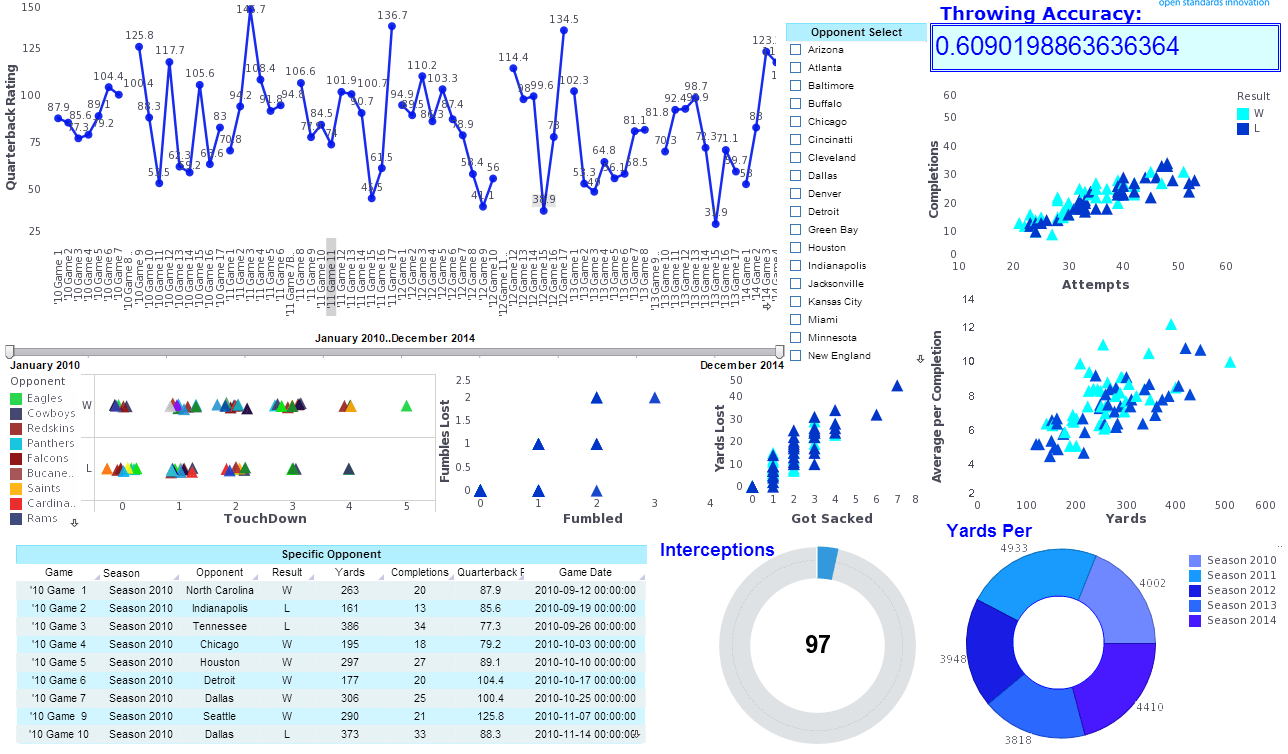
A More Flexible Alternative to Oracle Essbase
On the G2 Crowd website, reviewers raved about InetSoft's flexibility that allows end users to do almost anything they can imagine with their data, including complicated mashups and reporting that delivers valuable insights with ease. The highly visual graphics and drag-and-drop features were noted amongst consumers for saving time, resources, and increasing company efficiency.
On top of all that, InetSoft's open source web based architecture allows for faster and easier use due to its easy integration with multiple data sources. Another aspect that favored InetSoft was its quality support. End users were in agreement about the good communication received from the product managers and team.
Quality Support
Not only does InetSoft deliver excellence in business intelligence and reporting software, but they value customer satisfaction and happiness. Their team of dedicated developers and account managers all work together to ensure quality service and experience. They also provide an array of resources to help customers stay informed. InetSoft offers a developer portal that includes five categories of useful resources broken down and organized in a clear, easy to manage manner which are:
- Documentation- Access to all InetSoft product documents
- Tutorial Videos- Library of product training and how-to videos
- Support Center- Easy access to InetSoft support staff where you can submit support issues and review them
- Download- For first time users who would like to try InetSoft's free software
- Test Drive- This free web portal is available for unlimited use so customers can make an informed decision before making a purchase. Customers can also request a personalized demo to see how InetSoft can help their specific needs within their company.
InetSoft also provides a forum to its users that includes the latest updates to StyleBI, tutorial videos, webinars, and everything end users would need to ensure maximum use and benefits are received. Independent users liked that the Style Iintelligence tool is so easy to use that they were able to teach it to themselves and noted that the reference videos provided clear help with troubleshooting. With the tutorial videos, documentations, forum, ease of communication between end users and InetSoft's team, low costs, and drag-and-drop features it's no wonder people are trusting InetSoft for their reporting, dashboard, and visual analysis needs.
Reports | Building Reports
Independent users were happy with InetSofts Reporting capabilities and chose InetSoft in all 9 out of 9 feature categories including WYSIWYG report design. In the computing world WYSIWYG stands for "what you see is what you get," referring to the extent to which content such as text and graphics can be edited in a manner that maintains the desired appearance when the finished product is printed or displayed. In addition to WYSIWYG, InetSoft outshined the competition in Reports Interface, Steps to Answer, Graphs and Charts, Scorecards, Dashboards, Data Transformation, Data Modeling, and Integration APIs.
Advanced Analytics
In advanced Analytics InetSoft won 67% of categories, including Data Visualization and Big Data Services. These categories are crucial because the whole purpose of business intelligence products are to provide companies with easy visual analysis. As the pioneer of data mashup capabilities it is no surprise that InetSoft excels in visual analytics. InetSofts data mashup engine integrates data in real time from a large variety of sources, giving users immediate access to fresh information. Another aspect that sets InetSoft apart from the crowd is its low footprint, ensuring that for companies that implement this software on their own systems, critical applications will be able to run smoothly and unhampered.

StyleBI Advantages Over Oracle Essbase
StyleBI offers a set of capabilities oriented toward embedded analytics, rapid templating, and developer-driven customization that differ materially from Oracle Essbase’s multidimensional OLAP focus. First, StyleBI provides an API and SDK-centric embedding model designed for white-labeling and deep product integration. Developers can embed discrete visualization components with JavaScript callbacks, apply CSS-like theming, and wire analytics interactions directly into application workflows. This contrasts with Essbase’s emphasis on cube-based analytical engines, which typically require separate front-end tooling or BI suites for embedding and often rely on more heavyweight integration patterns.
StyleBI’s lightweight container-friendly runtime and web-first architecture support quick, low-cost deployments and local proof-of-concept instances. Teams can run single-node instances or horizontally scale containerized deployments to match tenant load without the full stack provisioning that Essbase environments commonly require. This deployment agility shortens time-to-value for SaaS providers and product teams that need analytics embedded in customer portals.
Another distinguishing feature is StyleBI’s templating and widget library. Designers can build reusable dashboard templates with parameterized placeholders and programmatically generate tenant-specific dashboards. This templating model allows rapid rollout of hundreds of branded dashboards with consistent UX. Essbase, by contrast, centers on cube modeling and calculation scripts; while powerful for financial planning and complex aggregations, it lacks the same out-of-the-box templating and UI component model aimed at multi-tenant embedded experiences.
StyleBI also supports hybrid data access patterns that are pragmatic for operational apps: direct SQL queries for live access, cached in-memory datasets for performance, and simple runtime mashups combining multiple sources. This flexibility enables teams to balance latency, cost, and complexity by choosing the appropriate access pattern per dashboard or tenant. Essbase’s strength is in pre-modeled multidimensional cubes and fast aggregation, but it is less focused on ad hoc hybrid mashups across arbitrary transactional sources without additional ETL and modeling work.
For developers, StyleBI exposes programmatic content management via REST endpoints, enabling automated provisioning, versioning, and content orchestration as part of CI/CD pipelines. This facilitates automated tenant onboarding and dashboard lifecycle management inside product workflows. Essbase typically requires administrative and modeling steps that are more manual or tied to separate administration tools.
Finally, StyleBI emphasizes embedded interaction patterns where chart selections can trigger application actions, open records, or start workflows directly in the host application. This close coupling of analytics and operational UI shortens the path from insight to action. Essbase excels at complex aggregations, multi-dimensional calculations, and enterprise planning use cases, but it does not inherently provide the same developer-focused, embeddable visualization components and templating framework that enable rapid productization of analytics.