Why Upgrading from BambooHR Dashboards to StyleBI Makes Sense as Analytics Matures
BambooHR does an excellent job at what it was designed to do: simplify core HR operations for small and mid-sized organizations. Its dashboards are clean, approachable, and tightly integrated with employee records, time-off tracking, and basic reporting. For many teams, especially early on, that is more than enough.
Problems start to appear when HR data stops being purely operational and begins to play a strategic role across finance, leadership, and other business functions.
As organizations grow, expectations around HR analytics change. Leadership wants trend analysis, not just snapshots. Finance wants workforce data blended with compensation, budgeting, and forecasting. Managers want self-service views tailored to their teams. At that point, BambooHR’s dashboards begin to show their limits. They are helpful, but constrained, opinionated, and ultimately designed to live inside the BambooHR product rather than operate as part of a broader analytics ecosystem.
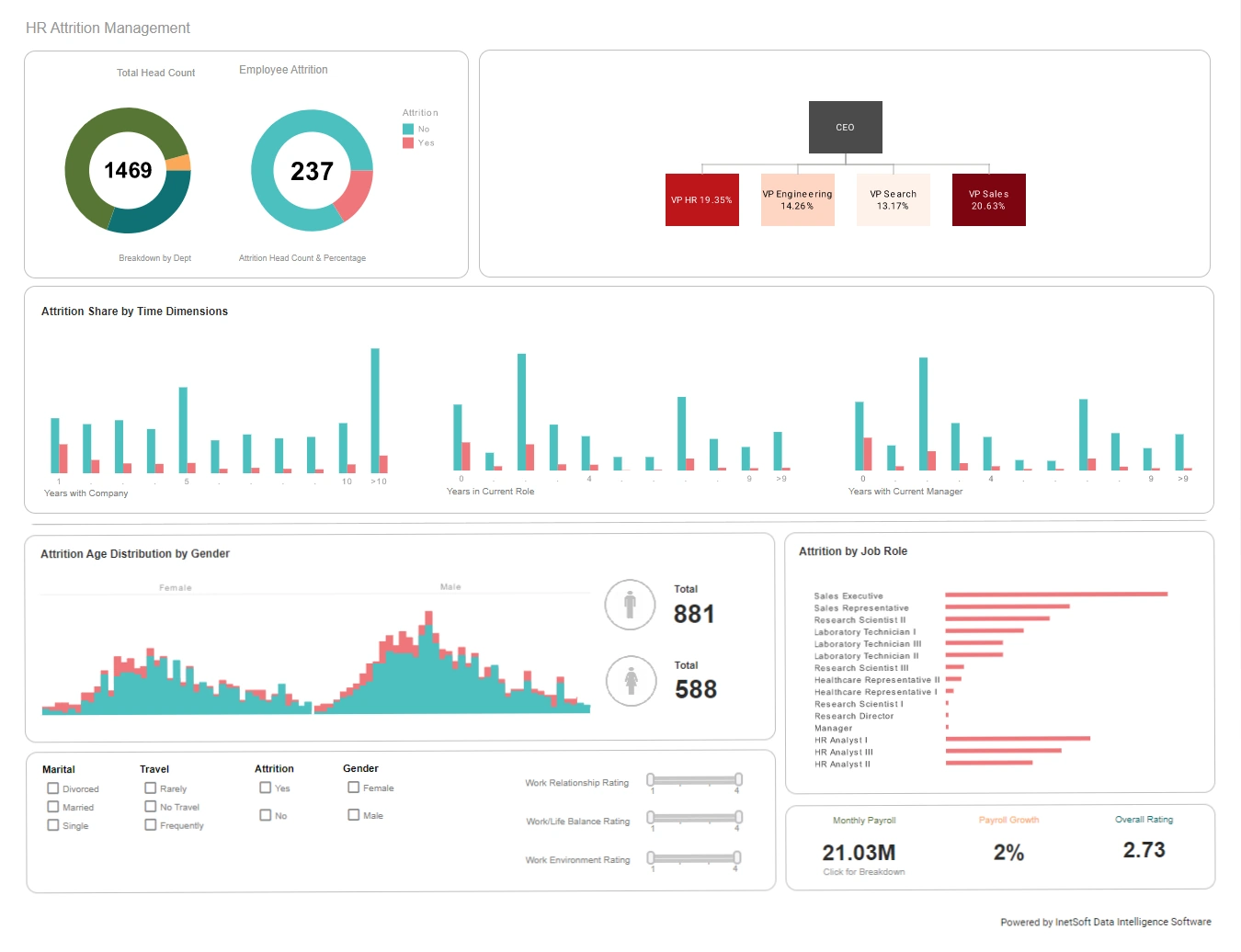

BambooHR Dashboards Are Operational, Not Analytical
The most fundamental limitation of BambooHR dashboards is that they are built for monitoring, not exploration. Headcount, turnover, time-off balances, and compliance metrics are presented clearly, but the underlying assumptions are fixed. Metrics cannot be deeply redefined, combined, or extended without exporting data and working elsewhere. For organizations trying to answer evolving questions, this quickly becomes a bottleneck.
StyleBI approaches this problem from the opposite direction. Instead of locking users into predefined KPIs, it treats metrics as something to be modeled, refined, and reused. HR teams can define turnover once, apply consistent logic across dashboards, and then adjust that logic as definitions evolve. This flexibility matters because HR metrics are rarely static; definitions change as the business matures, reorganizes, or enters new markets.
Data Rarely Lives in One System
BambooHR dashboards assume BambooHR is the system of record and the primary analytical surface. In reality, HR data is increasingly fragmented. Compensation may live in a separate system, recruiting data in an ATS, performance reviews in another platform, and engagement data in survey tools. BambooHR’s dashboards struggle to represent this broader picture because they are not designed to blend external data sources meaningfully.
StyleBI is designed around data mashups rather than single-system reporting. HR data from BambooHR can be combined with payroll systems, financial databases, learning platforms, and even operational systems. This allows organizations to analyze workforce data in context. Questions like “How does attrition impact delivery timelines?” or “What is the cost of turnover by department?” become answerable without building brittle, one-off spreadsheets.
From Static Dashboards to Living Analytics
One common frustration with embedded HR dashboards is how static they feel over time. The initial setup looks polished, but six months later the same charts remain unchanged while the organization’s questions have moved on. Updating dashboards often requires working around product limitations or duplicating logic in multiple places.
StyleBI dashboards are built on a semantic layer that separates data logic from presentation. This means new questions can be answered by reusing existing models rather than rebuilding everything from scratch. Dashboards become living assets that evolve alongside the business instead of frozen artifacts that slowly lose relevance.

Self-Service Without Losing Control
BambooHR dashboards are intentionally simple, which helps prevent confusion but also limits self-service. Users can view what is provided, but customization is shallow. As a result, analytics requests tend to pile up with a small number of administrators who export data and create custom reports manually.
StyleBI enables controlled self-service. Analysts can build and govern core metrics, while business users explore data through filters, drill-downs, and custom views without redefining logic. This reduces reporting backlogs while maintaining consistency, a balance that becomes critical as HR analytics usage expands beyond the HR team.
HR Analytics Is No Longer Just for HR
In many organizations, HR dashboards start as internal tools but quickly attract attention from executives and department heads. Unfortunately, BambooHR dashboards are not designed to be embedded, branded, or extended beyond the HR application itself. Sharing insights often means screenshots, PDFs, or manual exports.
StyleBI treats dashboards as first-class assets that can be embedded into internal portals, management tools, or even external applications. Role-based access ensures managers see only what they should, while executives get high-level views that connect workforce data to business outcomes. This turns HR analytics into a shared language rather than a siloed function.
Performance and Scale Matter More Than Expected
As data volumes grow, performance becomes an issue many teams do not anticipate. BambooHR dashboards work well at modest scale, but complex queries or long time horizons can feel sluggish. This subtly discourages exploration and pushes users back toward offline analysis.
StyleBI is built to handle larger datasets and more complex queries efficiently. Its architecture supports caching, incremental refreshes, and optimized queries across multiple sources. The result is faster dashboards that encourage interaction rather than discourage it, which has a direct impact on adoption and trust.
Cost Is About More Than Licensing
On paper, BambooHR dashboards appear cost-effective because they are bundled with the HR system. In practice, hidden costs emerge over time. Analysts spend hours exporting data, reconciling metrics, and maintaining parallel spreadsheets or BI tools. These costs rarely appear on an invoice, but they are very real.
StyleBI’s open source foundation changes the cost equation. Licensing is transparent, and teams pay primarily for the value they derive rather than per-seat access to dashboards. More importantly, time spent on manual reporting drops significantly when analytics workflows are centralized and reusable.
Governance Without Rigidity
HR data is sensitive, and governance is non-negotiable. BambooHR handles access control well within its own boundaries, but struggles when data leaves the platform. Once exported, governance depends on process rather than technology.
StyleBI provides fine-grained security at the data, metric, and dashboard level. Sensitive fields can be masked, row-level security enforced, and access audited. This allows organizations to expand analytics access confidently without compromising compliance or privacy.

A Natural Evolution, Not a Rip-and-Replace
Upgrading from BambooHR dashboards to StyleBI does not require abandoning BambooHR. In fact, the most effective approach is to keep BambooHR as the system of record while elevating analytics into a dedicated BI layer. BambooHR continues to manage HR processes, while StyleBI handles analysis, integration, and insight delivery.
This separation of concerns reflects how mature analytics organizations operate. Operational systems do operations well. Analytics platforms do analytics well. Trying to force one to be the other inevitably leads to compromise.
When the Questions Get Harder, the Tools Must Change
BambooHR dashboards are perfectly adequate when the primary goal is visibility. StyleBI becomes compelling when the goal shifts to understanding, prediction, and decision-making. As HR becomes more data-driven and more closely tied to business outcomes, the limitations of embedded dashboards become harder to ignore.
Upgrading to StyleBI is less about replacing charts and more about unlocking a different way of thinking about HR data. It enables organizations to move from reporting what happened to understanding why it happened and what to do next. For teams reaching that stage, the upgrade is not just justified, it is inevitable.