8 Reasons Why Supply Chain Management Benefits From Big Data
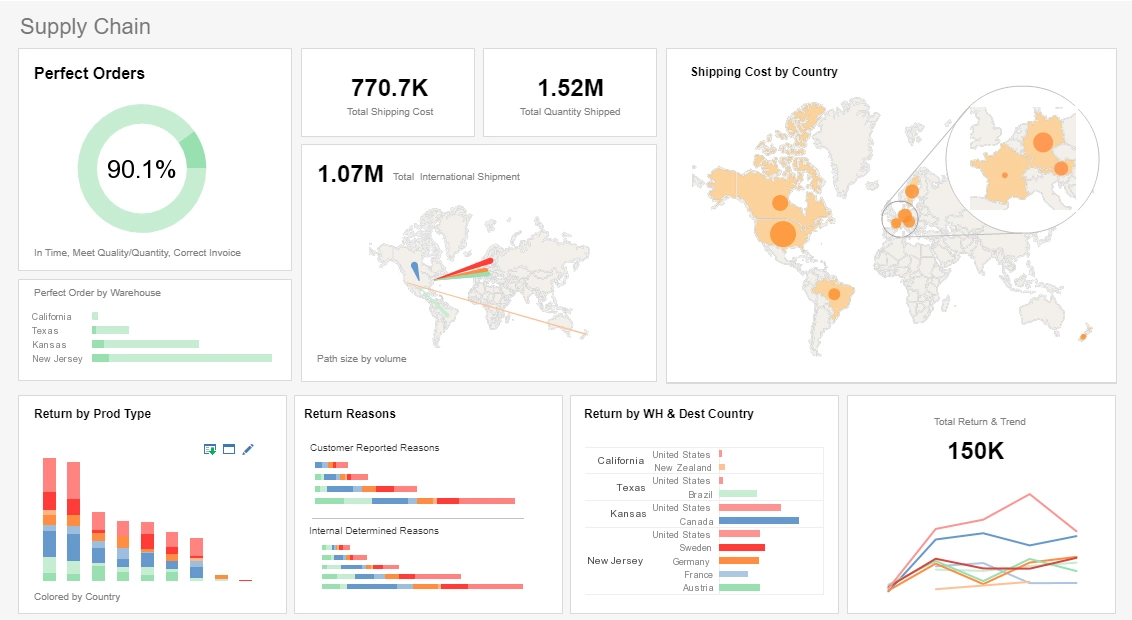
Big data analytics plays a huge role in improving supply chain management, because it helps out various parts of a company, like:
- Strategy
- Operations, AND
- Tactics
Big data helps companies focus more on things like:
- Improving delivery times
- Reducing the communication gap between manufacturers and suppliers
- Having decision-makers achieve operational efficiency
- Having management monitor performance to improve productivity
- Having management make augment data-driven decisions to reduce costs and improve service levels.
In this article, we'll explain the 8 reasons why supply chain management benefits from the analytics generated by big data.

1. Product Traceability Is Possible With Big Data
It's important to have product traceability in your supply chain operations. With great product traceability, supply chain managers can easily trace a product by using barcode scanners and radio frequency identification devices attached to certain products. With big data, businesses can gather accurate product information, so that operators can carry out a successful distribution cycle – from production to retail.
2. The Risks Are Better To Understand With Big Data
If you're wary about risks that can happen in supply chain management, then fear not! Big data ensures that supply chain analytics will help determine the unknown and known risks. Analytics can also forecast future risks by identifying patterns and trends that occur within the supply chain.

3.Sourcing Is More Optimized And Simplified
In the sourcing process, supply chains will work with vendors. This process consists of:
- Working with numerous vendors
- Making orders
- Taking into account how many individual items are in each order, AND
- Taking into account how each order is shipped
Now, keep in mind that these tasks don't include variables such as:
- Emergency orders
- Damaged materials, AND
- Other things that happen unexpectedly
Big data allows you to connect all status and pricing data from your vendors worldwide.

4. Data Is Safe In The Cloud
The cloud lets you save the data that you can use later on to handle supply chain management in a number of ways. By storing your data in the cloud, metrics are unified and updated in real time. As a result, in-depth analytics can be used to provide insights, including:
- Real-time alerts that notify supply chains on gaps and issues
- Organizing all vendors, regardless of consistency on shipping/timing issues
- Finding materials with consistent quality issues
- Getting rid of unnecessary steps in the process
5. Inventory Management Is More Enhanced
If you're a big-box retailer or an online store, and you have a sizeable inventory, you'll most likely run into several issues. But with big data, analytics allows operation managers to get a real-time overview of operations and identify anything that might be hindering supply chain processes. Plus, consumer trends show businesses how to promote great products, while optimize inventory.

6. Big Data Lets You See Consumer Behavior And Usage Patterns
Nowadays, many businesses can't function without big data, because the analytics tell them how consumer behavior and usage patterns are faring. With this valuable information at businesses' fingertips, they can find new ways to retain their customers and increase sales.
7. Fulfillment Processes Are Made Easier
Fulfillment analytics can help maximize revenue and retain customers by having supply chain management look at both customer fulfillment and the warehouse itself. This allows management to formulate the final steps of production. Such data will have management keep the following objectives in mind:
- For customers, determine whether they'll receive their orders on time or earlier.
- For the shipping process, determine which vendor(s) is consistently delivering late.
- For warehouses, have inventory stored efficiently, and see if there are any trends in accidents or injuries.
8. Big Data Lets You Prepare For The Future
Finally, big data can help businesses see what's to come in future projects. If you want to get ahead of the curve, then look at the data. Companies can leverage analytics to process both unstructured and structured data, and formulate predictions on what can happen if something goes wrong, or what's to come based on any trends and issues, thus reducing risks.

Transforming Supply Chain Management with Advanced Analytics
Advanced analytics has become one of the most transformative forces in supply chain management, reshaping how organizations forecast demand, manage inventory, optimize logistics, and respond to disruptions. What once relied on historical data and manual planning is now driven by predictive models, real-time intelligence, and automated decision engines that continuously learn from operational patterns. The result is a supply chain that is faster, more resilient, and far more capable of adapting to volatility.
At the core of advanced analytics is the ability to generate highly accurate demand forecasts using machine learning models that incorporate dozens of variables such as seasonality, promotions, weather, economic indicators, and even social sentiment. Unlike traditional forecasting, which often treats each product line independently, modern algorithms detect cross-category relationships and emerging trends that humans might overlook. This allows organizations to anticipate demand shifts earlier, reduce stockouts, and avoid costly overproduction. In industries with thin margins or short product lifecycles, these improvements can dramatically enhance profitability.
Advanced analytics also strengthens inventory optimization by determining the ideal balance between service levels and carrying costs. Machine learning models evaluate lead times, supplier reliability, transportation variability, and historical consumption patterns to recommend optimal reorder points and safety stock levels. Instead of relying on static rules, organizations can dynamically adjust inventory positions as conditions change. This is especially valuable in global supply chains where disruptions such as port delays, geopolitical events, or raw material shortages can ripple across the network.
In logistics, advanced analytics enables more efficient route optimization and transportation planning. Algorithms evaluate traffic patterns, fuel costs, delivery windows, and fleet constraints to generate the most efficient routing strategies. Real-time data from IoT sensors and telematics systems further enhances these models, allowing companies to reroute shipments instantly when disruptions occur. This reduces transportation costs, improves delivery reliability, and supports sustainability goals by lowering emissions.
Predictive Maintenance
Another major application is predictive maintenance for equipment and vehicles. By analyzing sensor data such as temperature, vibration, pressure, and performance metrics, machine learning models can detect early signs of equipment failure. This allows organizations to schedule maintenance proactively, reducing downtime and extending asset life. In manufacturing and distribution environments where equipment reliability directly affects throughput, predictive maintenance becomes a critical competitive advantage.
Advanced analytics also enhances risk management by identifying vulnerabilities across the supply chain. Models can simulate the impact of supplier failures, transportation disruptions, or demand spikes, enabling organizations to develop contingency plans before issues arise. Scenario modeling helps leaders evaluate trade-offs and choose strategies that balance cost, resilience, and speed. As supply chains become more global and interconnected, this ability to anticipate and mitigate risk is essential.
Finally, advanced analytics supports end-to-end visibility by integrating data from ERP systems, warehouse management platforms, transportation networks, and external sources into a unified analytical environment. This holistic view allows organizations to monitor performance in real time, identify bottlenecks, and coordinate decisions across departments. When combined with automated workflows and prescriptive analytics, supply chains can move from reactive problem-solving to proactive, data-driven orchestration.
Advanced analytics is no longer optional; it is the foundation of modern supply chain excellence. Organizations that embrace these capabilities gain speed, resilience, and strategic clarity, positioning themselves to thrive in an increasingly unpredictable global environment.
About the Author
Katherine Rundell is a supply chain writer. She is also a proofreader at Writingpopulist and Top Canadian Writers. As a professional writer, she specializes in analytics, tech trends, and digital advertising. Also, she is a blogger at UKWritings.