How an Industrial Sand & Proppant Company Moved From Lumen AI To StyleBI for Its Business Intelligence Technology
In the Industrial Sand & Proppant Processing Industry, operational nuance is everything. Moisture content, particle size distribution, railcar turnaround, and dryer energy efficiency all live in a narrow band where small deviations can erase margins. One mid‑market processor, GranularFlow Resources, had invested heavily in Lumenn AI as its business intelligence and analytics layer. Over time, however, the company realized that its needs were less about experimental AI features and more about reliable, governed, and highly visual self‑service analytics for plant managers, logistics coordinators, and commercial teams. That realization triggered a deliberate migration from Lumenn AI to StyleBI.
This shift was not simply a technology swap. It was a redefinition of how the company thought about data, dashboards, and decision‑making across mines, processing plants, and distribution terminals. The story of GranularFlow’s transition illustrates why a specialized industrial operation might move away from an AI‑centric BI platform toward a more structured, dashboard‑driven environment like StyleBI.

Why Lumenn Ai Started To Strain Under Operational Reality
GranularFlow originally chose Lumenn AI for its promise of automated insights. The platform marketed itself as a way to surface anomalies, predict failures, and recommend actions with minimal human configuration. For a company running multiple drying plants, wash facilities, and rail terminals, that sounded ideal. In practice, however, several friction points emerged.
First, the data onboarding process for Lumenn AI required extensive modeling and labeling to make sense of the company’s highly specialized metrics: mesh size bands, crush resistance scores, turbidity, and moisture curves. The AI models struggled with inconsistent naming conventions and evolving process parameters. Engineers found themselves spending more time explaining the data to the platform than using the insights it produced.
Second, the explainability of AI‑generated recommendations became a sticking point. When Lumenn AI flagged a dryer as “at risk” or suggested altering kiln temperature profiles, plant supervisors wanted to see the underlying trends, charts, and comparisons. Instead, they often received opaque scores or narrative explanations that did not map cleanly to their existing process control dashboards.
Third, the dashboarding capabilities in Lumenn AI felt secondary. While the platform could generate visualizations, it was not optimized for building highly structured, role‑based dashboards that mirrored the company’s operational hierarchy: mine supervisors, plant managers, maintenance leads, logistics coordinators, and sales analysts. GranularFlow needed a BI environment where each role could have a curated, stable set of pages and cards, not just a stream of AI alerts.

Why Stylebi Fit The Industrial Sand & Proppant Context Better
StyleBI entered the conversation when GranularFlow’s analytics team began searching for a platform that emphasized governed self‑service dashboards, flexible data modeling, and clear visual storytelling. The company was not abandoning advanced analytics; it was reframing them inside a more predictable, transparent BI structure.
StyleBI’s core appeal lay in its ability to connect to existing datasets—plant historians, lab information systems, ERP, rail logistics feeds, and maintenance CMMS—while giving analysts fine‑grained control over joins, aggregations, and calculated fields. Instead of relying on opaque AI models, GranularFlow could design explicit metrics: dryer energy per ton, moisture loss per pass, railcar dwell time, and mine‑to‑mill throughput.
Equally important, StyleBI’s dashboard design paradigm aligned with how industrial teams think. Pages could be organized by site, function, or process stage: “Mine Operations,” “Wet Plant,” “Dry Plant & Kilns,” “Logistics & Terminals,” and “Commercial Performance.” Within each page, cards could be arranged to tell a clear story—from high‑level KPIs down to diagnostic tables and trend charts.
For GranularFlow, this meant that a plant manager could open a single dashboard and immediately see:
- Production Volume: Tons processed by mesh size and product grade.
- Quality Metrics: Particle size distribution, crush resistance, turbidity, and moisture content.
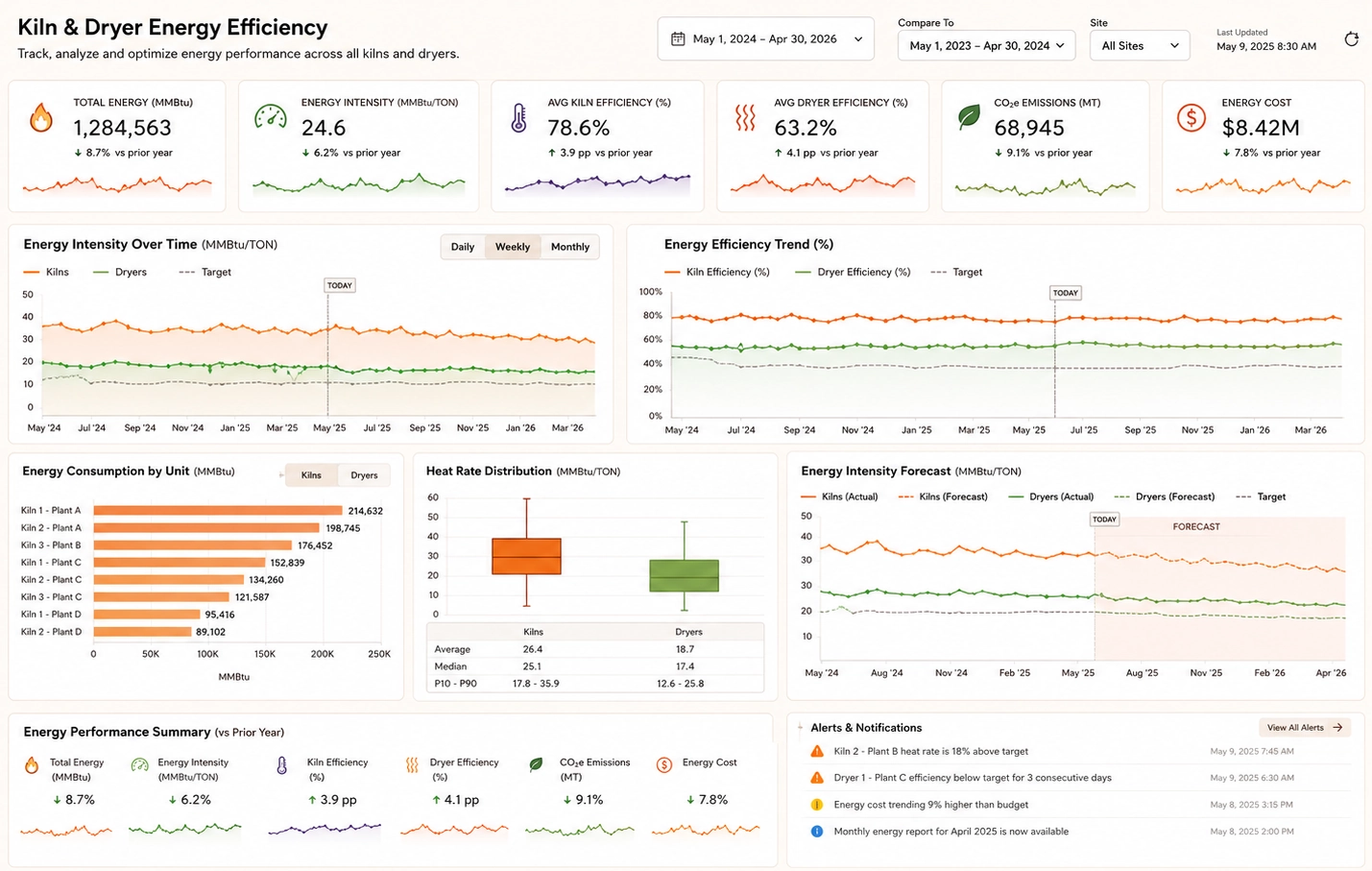
- Energy Use: Dryer fuel consumption per ton and kiln temperature profiles.
- Downtime & Maintenance: Unplanned stoppages, mean time between failures, and work order backlog.
- Logistics: Railcar turnaround, truck queue times, and inventory by terminal.
StyleBI’s emphasis on visual clarity and governed access made it easier to standardize these dashboards across sites while still allowing local customization where needed.

Planning The Migration From Lumenn Ai To Stylebi
GranularFlow approached the migration as a phased program rather than a big‑bang cutover. The analytics team mapped out all Lumenn AI assets: data connections, AI models, dashboards, and alerting rules. They then categorized them into three buckets: must‑keep metrics, replaceable visualizations, and experimental AI features that had not gained traction.
The first step was to rebuild core datasets in StyleBI’s data modeling layer. Instead of feeding everything into AI pipelines, the team focused on clean, well‑documented tables: production by shift, lab results by batch, energy use by equipment, logistics events by railcar or truck, and sales orders by customer and product grade. They standardized naming conventions and created shared dimensions for site, product, mesh size, and time.
Next, they designed foundational dashboards that mirrored the most useful Lumenn AI views but with greater transparency. For example, a “Dryer Efficiency” dashboard combined energy consumption, throughput, and moisture reduction in a single page, with filters for site, dryer, and date range. Instead of AI scores, users saw trend lines, comparisons to targets, and clear calculations.
Only after these core dashboards were stable did the team begin to reintroduce advanced analytics—but now as explicit models integrated into StyleBI rather than black‑box AI. Predictive maintenance models for dryers and conveyors were exposed through charts and tables that showed the underlying features: vibration readings, temperature anomalies, historical failure patterns, and maintenance history.

Impact On Operations, Culture, And Decision‑Making
The switch from Lumenn AI to StyleBI had several tangible effects on GranularFlow’s operations and culture.
First, trust in the numbers increased. Plant managers and supervisors could see exactly how metrics were calculated and how dashboards were assembled. When a dryer was flagged as inefficient, they could drill into the data and understand the drivers rather than relying on an AI narrative.
Second, adoption broadened. Under Lumenn AI, usage was concentrated among a small group of data specialists and engineers comfortable with AI tooling. StyleBI’s more familiar dashboard interface made it easier for shift leads, maintenance planners, and logistics coordinators to engage with the data. Filters, drill‑downs, and summary numbers felt intuitive rather than mysterious.
Third, governance improved. StyleBI allowed GranularFlow to define clear roles and permissions: corporate analytics could manage shared datasets and master dashboards, while local teams could create derivative views without breaking core logic. This balance of control and flexibility was crucial in an industry where each site has unique quirks but must still report consistently to corporate leadership.
Fourth, the company found that advanced analytics became more effective once grounded in transparent BI. Predictive models for equipment failure, optimal kiln temperature bands, or logistics bottlenecks were easier to trust and refine because users could see the underlying data and challenge assumptions. Instead of AI being a separate layer, it became an extension of well‑understood dashboards.

Lessons For Other Industrial Sand & Proppant Processors
GranularFlow’s journey offers several lessons for other companies in the Industrial Sand & Proppant Processing Industry considering a move from an AI‑centric BI platform like Lumenn AI to a more structured environment like StyleBI.
- Start With Operational Reality: Identify the metrics and dashboards that truly drive decisions—throughput, quality, energy, logistics—before chasing advanced AI features.
- Prioritize Transparency: Choose a platform that makes calculations, joins, and aggregations visible and understandable to non‑data specialists.
- Design For Roles: Build dashboards that reflect how people work: site‑level operations, maintenance, logistics, and commercial teams each need tailored views.
- Treat AI As An Extension, Not The Core: Use predictive models to enhance dashboards, not replace them. Let users see and question the data behind the predictions.
- Phase The Migration: Rebuild core datasets and dashboards first, then layer in advanced analytics once trust and adoption are established.
In a business where every ton of sand and proppant must meet strict specifications and arrive on time, the choice of BI platform is not just an IT decision—it is an operational strategy. For GranularFlow Resources, moving from Lumenn AI to StyleBI meant trading some AI mystique for clarity, control, and widespread adoption. In the demanding world of Industrial Sand & Proppant Processing, that trade has proven to be not only pragmatic but transformative.