Industrial Microbial Fermentation Services Company Migrates From Metabase To Open Source StyleBI for Dashboard Analytics
In the industrial microbial fermentation services industry, data is not a side product—it is the lifeblood of the business. Bioreactors generate continuous telemetry, downstream purification lines produce quality metrics, and every batch must be traceable for regulatory and customer audits.
One mid‑size contract fermentation provider, BioFerma Labs, discovered that its existing analytics stack built around Metabase was no longer keeping pace with the complexity and scale of its operations. The decision to migrate to open source StyleBI for dashboard analytics became a strategic move, not just a technical upgrade.

Business Context Of Industrial Microbial Fermentation Services
BioFerma Labs operates multiple fermentation facilities, each with bioreactors ranging from pilot‑scale to large production tanks. They provide contract fermentation services for biotech startups, food ingredient companies, and specialty chemical manufacturers. Every client expects tight process control, predictable yields, and transparent reporting. That means dashboards are not just internal tools—they are part of the product experience.
The company’s data landscape includes:
- Bioreactor Telemetry: pH, dissolved oxygen, agitation speed, temperature, feed rates, foam levels.
- Batch Records: strain ID, media composition, inoculation time, harvest time, yield, titer.
- Downstream Processing: filtration efficiency, chromatography performance, purity levels.
- Quality And Regulatory: deviations, CAPA records, audit trails, release criteria.
- Commercial Metrics: cost per kilogram, capacity utilization, on‑time delivery, client SLAs.
Initially, Metabase served as the central dashboarding tool, connected to a Postgres data warehouse and several operational databases. Over time, however, the limitations of this setup became increasingly visible.
Limitations Of The Existing Metabase Setup
Metabase gave BioFerma Labs a quick path to basic dashboards and ad‑hoc queries, but the fermentation environment demanded more than simple charts. Several pain points emerged:
- Complex Data Modeling: Fermentation data is highly relational and time‑series heavy. Metabase’s modeling capabilities were not flexible enough for advanced semantic layers, especially when combining telemetry, batch genealogy, and cost data.
- Performance Bottlenecks: High‑volume telemetry queries caused slow dashboards and timeouts. Engineers resorted to manual aggregation tables, increasing maintenance overhead.
- Limited Customization: Operations and quality teams wanted specialized layouts, KPI panels, and interactive drill‑downs tailored to fermentation workflows. Achieving these in Metabase required workarounds and custom code.
- Governance Challenges: As more teams adopted dashboards, permissioning and content organization became messy. It was difficult to enforce consistent standards across facilities and clients.
- Integration Constraints: BioFerma Labs needed tighter integration with existing ETL pipelines, custom data sources, and embedded analytics for client portals.
These issues did not appear overnight, but as the company scaled, the gap between what Metabase offered and what the fermentation business required grew wider. Leadership realized that analytics had become a strategic capability, and the tooling needed to reflect that.

Why BioFerma Labs Chose Open Source StyleBI
After evaluating several options, BioFerma Labs selected open source StyleBI as the new foundation for its dashboard analytics. The decision was driven by a combination of technical and business factors.
- Richer Semantic Layer: StyleBI’s approach to data modeling allowed the team to define reusable measures, hierarchies, and relationships that matched fermentation realities—such as batch lineage, reactor‑level metrics, and client‑specific KPIs.
- Performance And Caching: StyleBI’s support for query optimization, caching, and aggregation strategies aligned well with high‑volume telemetry and historical trend analysis.
- Flexible Dashboard Design: The platform offered more control over layout, interactivity, and visual components, enabling dashboards that mirrored actual fermentation workflows and quality review processes.
- Open Source Extensibility: Being open source, StyleBI could be extended to integrate with custom ETL pipelines, internal microservices, and client‑facing portals without licensing friction.
- Governance And Multi‑Tenant Scenarios: BioFerma Labs could design role‑based access and client‑specific spaces, ensuring that each customer saw only their data while internal teams had cross‑facility visibility.
The choice was not merely about features; it was about owning the analytics stack in a way that matched the company’s long‑term strategy in the bioindustrial space.
Migration Strategy From Metabase To StyleBI
BioFerma Labs approached the migration as a phased, carefully governed project rather than a big‑bang cutover. The goal was to avoid disrupting operations while gradually unlocking new capabilities.
Phase 1: Inventory And Prioritization
The analytics team cataloged all existing Metabase dashboards, questions, and data sources. They classified content into:
- Mission‑Critical Dashboards: Real‑time fermentation monitoring, quality release boards, client SLA dashboards.
- Operational Dashboards: capacity planning, maintenance schedules, cost tracking.
- Exploratory Analytics: R&D experiments, strain comparison studies.
Mission‑critical dashboards were prioritized for early migration, ensuring that production teams and clients experienced minimal disruption.
Phase 2: Data Modeling In StyleBI
Next, the team designed a new semantic layer in StyleBI. They defined core entities such as Batch, Bioreactor, Client, and Process Step, along with measures like yield, titer, cycle time, and cost per kilogram. Time‑series telemetry was modeled with appropriate granularity and aggregation rules.
This modeling step was crucial: instead of replicating Metabase dashboards one‑to‑one, BioFerma Labs used the migration as an opportunity to standardize definitions and eliminate inconsistent metrics.
Phase 3: Rebuilding Dashboards With Enhanced Design
Using StyleBI’s dashboard builder, the team recreated key dashboards with improved layouts and interactions:
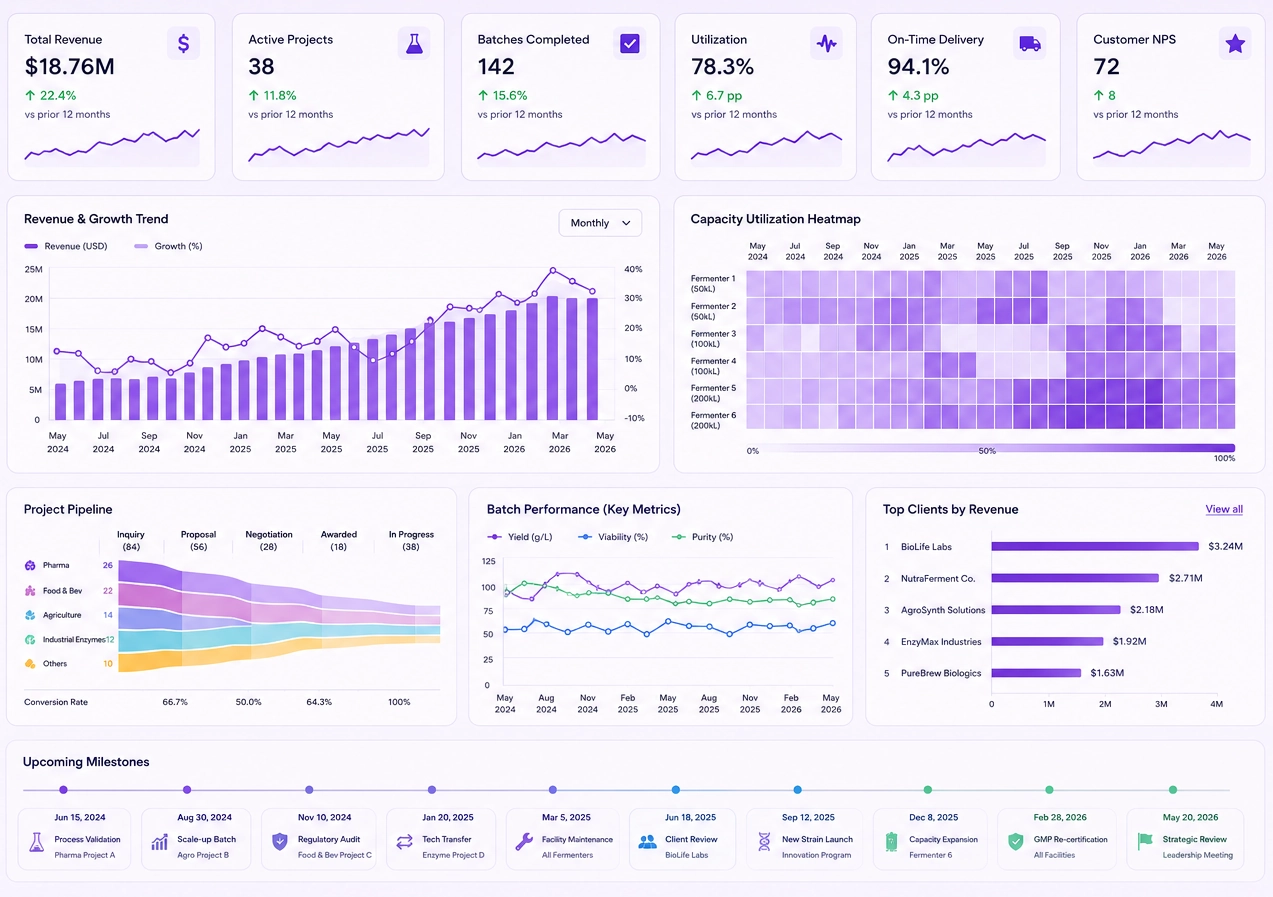
- Fermentation Control Room: A multi‑panel dashboard showing live reactor status, alarms, and trend charts, with drill‑downs into individual batches.
- Quality Release Board: A workflow‑oriented view of batches awaiting testing, in progress, and released, with embedded QC metrics and deviations.
- Client Performance Portal:Client‑specific dashboards summarizing yield, on‑time delivery, and quality metrics, accessible through a secure portal.
StyleBI’s flexibility allowed the team to introduce cross‑filters, KPI tiles, and contextual markdown sections explaining thresholds and procedures—features that were cumbersome in the previous stack.

Phase 4: Parallel Run And Decommissioning
For several weeks, Metabase and StyleBI ran in parallel. Operators and quality staff were encouraged to use the new dashboards while retaining access to the old ones as a safety net. Feedback loops were established to refine layouts, fix edge cases, and ensure data parity.
Once confidence was high and usage had shifted, Metabase dashboards were gradually decommissioned, leaving StyleBI as the single source of truth for visual analytics.
Impact On Operations And Decision‑Making
The migration delivered tangible benefits across multiple dimensions of BioFerma Labs’ business.
- Improved Process Visibility: Operators gained clearer, more intuitive views of reactor performance and batch status, reducing response time to deviations.
- Standardized Metrics: A unified semantic layer eliminated conflicting definitions of yield, cycle time, and cost, improving trust in the numbers.
- Faster Dashboards: Optimized queries and caching in StyleBI reduced load times, especially for telemetry‑heavy views.
- Enhanced Client Experience: Clients received more polished, interactive dashboards that reinforced BioFerma Labs’ positioning as a high‑tech partner.
- Better Governance: Role‑based access and structured spaces made it easier to manage content across facilities, teams, and customers.
Internally, the analytics team reported that StyleBI’s openness and extensibility made it easier to experiment with new data sources, integrate predictive models, and iterate on dashboard designs without fighting the tool.

Lessons Learned From The Migration
BioFerma Labs’ journey from Metabase to StyleBI offers several lessons for other companies in industrial microbial fermentation services and adjacent industries.
- Treat Analytics As A Product: Dashboards used by operators and clients should be designed with the same care as any customer‑facing application.
- Use Migration To Clean Up Data: Moving platforms is an opportunity to standardize metrics, retire obsolete dashboards, and clarify ownership.
- Invest In A Semantic Layer: Complex industrial processes benefit from a well‑designed data model that reflects real‑world entities and relationships.
- Run In Parallel: A phased cutover with parallel dashboards reduces risk and builds trust in the new system.
- Align Tooling With Strategy: For a company betting on bioindustrial growth, an open, extensible analytics platform like StyleBI aligns better with long‑term innovation than a more constrained tool.
Ultimately, the switch from Metabase to open source StyleBI was not just a change of dashboard software for BioFerma Labs. It was a redefinition of how the company sees, understands, and manages its fermentation operations. In an industry where every batch, every reactor, and every client relationship depends on precise, timely insight, that shift in analytics capability becomes a competitive advantage in its own right.