From ThoughtSpot To StyleBI: Transforming Online Reporting In Vapor-Phase Emissions Control
In the Vapor-Phase Emissions Control Industry, data is not a luxury; it is the backbone of regulatory compliance, community relations, and operational safety. Scrubber towers, biofilters, chemical dosing systems, and airflow networks generate continuous streams of readings that must be monitored, interpreted, and reported. One mid-market environmental engineering firm—let’s call it VaporGuard Systems—had built its online reporting stack around ThoughtSpot, attracted by its search-driven analytics and AI-assisted insights. Over time, however, the company realized that its stakeholders needed something different: stable, governed, and highly structured online reporting dashboards that mirrored regulatory frameworks and operational workflows. That realization led VaporGuard to migrate from ThoughtSpot to StyleBI for its online reporting.
This transition was more than a change of tools. It represented a shift in philosophy—from ad hoc, search-centric exploration to curated, role-based reporting tailored to emissions engineers, plant operators, compliance officers, and municipal clients. The story of VaporGuard’s move to StyleBI illustrates why a specialized emissions control provider might trade a modern search analytics platform for a more traditional, yet deeply powerful, dashboard-centric environment.

Why ThoughtSpot Began To Fall Short For Emissions Reporting
VaporGuard initially adopted ThoughtSpot because it promised to democratize analytics through natural language search. Engineers and managers could type questions like “average H2S concentration last month” or “VOC trends by site” and receive instant charts. For a company managing dozens of odor and vapor-phase control installations, this sounded ideal.
In practice, several limitations emerged. First, the search paradigm did not align with regulatory reporting. Compliance officers needed fixed, auditable reports that matched permit conditions, not ad hoc queries. Air quality regulators expected consistent formats, thresholds, and time windows. ThoughtSpot’s flexible search made it easy to explore data, but harder to lock down standardized online reporting views that could be shared with external stakeholders.
Second, the complexity of VaporGuard’s data model strained the simplicity of search-based analytics. Each installation had multiple sensors, scrubber stages, chemical dosing points, and airflow zones. Metrics like removal efficiency, chemical consumption per cubic meter, and pressure differential across media beds required carefully defined calculations. While ThoughtSpot could handle these, the logic often lived in scattered worksheets and search expressions rather than a centralized, governed model.
Third, the online reporting experience for clients was not as polished as VaporGuard wanted. Municipal customers and industrial plant operators accessed ThoughtSpot through shared links and embedded views, but the navigation felt more like a search tool than a purpose-built reporting portal. Clients wanted clearly labeled pages: “Compliance Summary,” “Scrubber Performance,” “Chemical Dosing,” “Alarm History,” and “Maintenance Forecasts,” not a blank search bar.

Why Stylebi Was A Better Fit For Online Reporting
StyleBI entered the picture when VaporGuard’s leadership decided that online reporting needed to be more structured, predictable, and aligned with how regulators and clients consume information. The company was not abandoning modern analytics; it was reframing them inside a more traditional, dashboard-driven architecture.
StyleBI’s strength lay in its ability to build governed data models that captured the complexity of vapor-phase emissions control. Emissions engineers could define shared dimensions for site, scrubber stage, pollutant type, and time, along with standardized measures: inlet concentration, outlet concentration, removal efficiency, chemical dosing rate, airflow, pressure differential, and alarm counts. These definitions lived in a central model, not scattered across user-created searches.
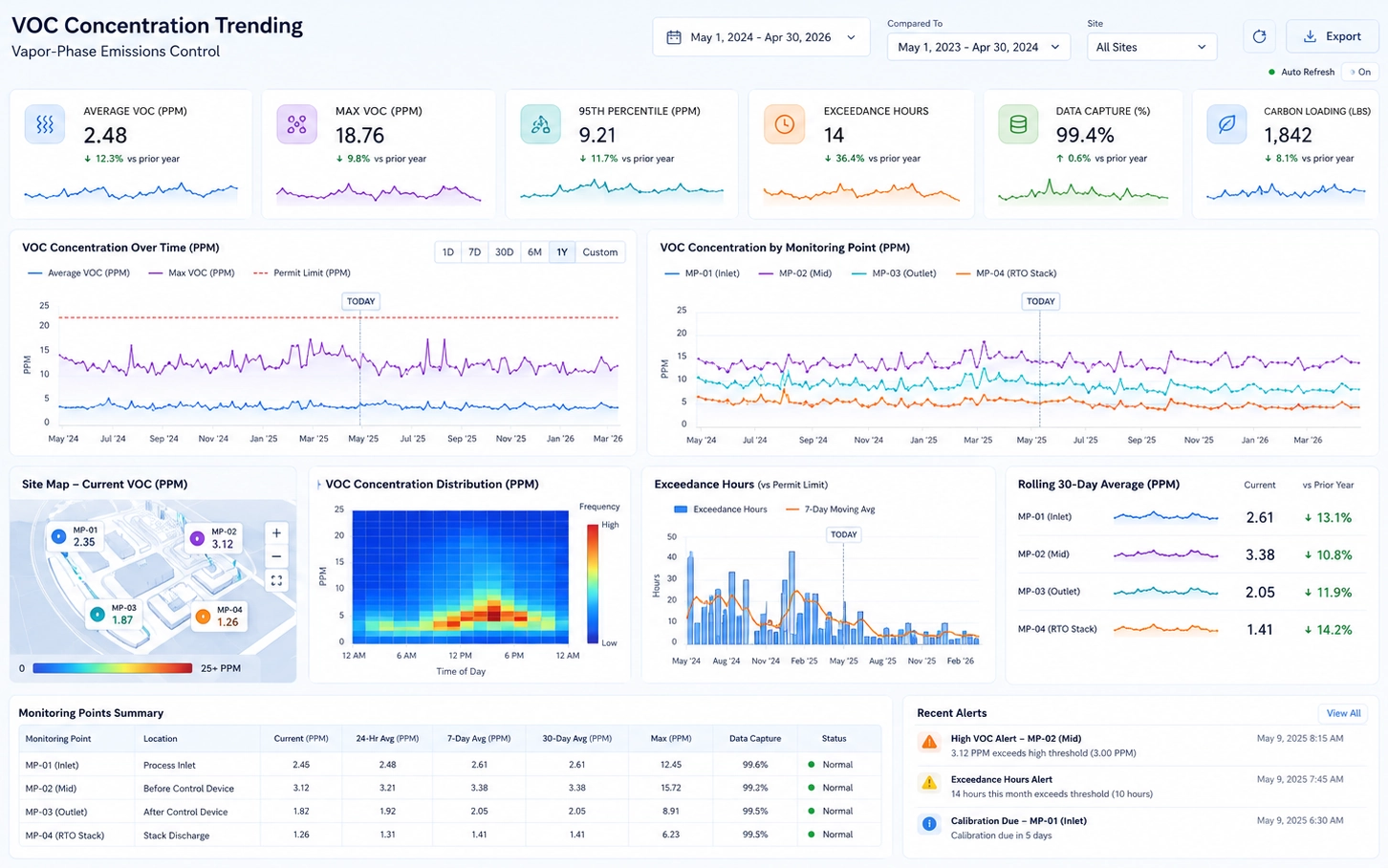
Equally important, StyleBI’s dashboard design capabilities allowed VaporGuard to create a true online reporting portal. Pages could be organized by audience and purpose: “Regulatory Compliance,” “Operations Monitoring,” “Chemical Optimization,” “Maintenance & Reliability,” and “Client Summary Reports.” Each page contained carefully arranged charts, tables, and summary numbers that told a coherent story.
For example, a municipal client logging into VaporGuard’s StyleBI-powered portal might see:
- Compliance Summary: Daily and monthly averages for key pollutants, compared to permit limits.
- Scrubber Performance: Inlet vs outlet concentrations, removal efficiency trends, and alarm events.
- Chemical Usage: Dosing rates, consumption per unit of treated air, and cost estimates.
- Operational Conditions: Airflow, temperature, humidity, and pressure differentials across media.
- Maintenance Overview: Upcoming service windows, historical downtime, and work order status.
StyleBI’s emphasis on visual clarity and role-based access made it easier to deliver these views consistently across clients and installations, while still allowing internal teams to drill deeper when needed.

Planning The Migration From ThoughtSpot To StyleBI
VaporGuard approached the migration as a structured program, recognizing that emissions data and reporting obligations could not be disrupted. The analytics team began by cataloging all ThoughtSpot assets: data connections, worksheets, search expressions, pinboards, and embedded views. They then grouped them into categories: regulatory-critical reports, operational dashboards, and exploratory analytics.
The first priority was to rebuild the core data model in StyleBI. Instead of relying on user-driven search logic, the team defined canonical tables for sensor readings, alarm events, chemical dosing logs, maintenance records, and site metadata. They standardized naming conventions and ensured that every pollutant, scrubber stage, and sensor type had a clear, documented representation.
Next, they designed online reporting dashboards that mirrored the most important ThoughtSpot pinboards but with greater structure. A “Regulatory Compliance” dashboard, for instance, displayed pollutant concentrations over time, highlighted exceedances, and summarized performance against permit limits. A “Scrubber Performance” dashboard showed inlet and outlet trends, removal efficiency, and alarm history, with filters for site and date range.
Only after these foundational dashboards were stable did VaporGuard begin to reintroduce advanced analytics. Predictive models for chemical dosing optimization and media replacement timing were integrated into StyleBI as explicit charts and tables, showing both the predictions and the underlying drivers. Instead of being hidden behind search expressions, these models became part of the governed reporting environment.
Impact On Clients, Regulators, And Internal Teams
The switch from ThoughtSpot to StyleBI had significant effects on how VaporGuard interacted with clients, regulators, and its own staff.
For clients, online reporting became more intuitive and trustworthy. Instead of navigating a search interface, they accessed clearly labeled dashboards with consistent layouts and terminology. Permit limits, thresholds, and compliance status were front and center, reducing confusion and support requests. Municipal stakeholders appreciated that reports looked and felt like formal compliance documents, even though they were delivered through a web portal.

For regulators, data transparency improved. StyleBI’s dashboards made it easy to export structured reports, share specific views, and demonstrate how metrics were calculated. When questions arose about a spike in VOC levels or a series of alarms, VaporGuard could quickly show the underlying data and context, building confidence in its monitoring systems.
Internally, collaboration between emissions engineers and IT strengthened. With StyleBI’s governed model, engineers could define metrics and relationships while IT ensured performance, security, and integration. The platform’s dashboard-centric approach encouraged cross-functional design sessions where operations, compliance, and customer success teams jointly shaped the online reporting experience.
The migration also changed how advanced analytics were perceived. Under ThoughtSpot, AI-assisted search sometimes felt like a black box to non-technical users. In StyleBI, predictive insights were embedded in familiar dashboards, with clear visualizations and explanations. This made it easier for plant operators and maintenance planners to trust recommendations about chemical dosing adjustments or media replacement schedules.
Lessons For The Vapor-Phase Emissions Control Industry
VaporGuard’s journey offers several lessons for other companies in the Vapor-Phase Emissions Control Industry considering a move from search-driven analytics platforms like ThoughtSpot to structured, dashboard-focused environments like StyleBI.
- Align Reporting With Regulatory Reality: Compliance requires stable, auditable views. Choose a platform that excels at building consistent dashboards and reports, not just ad hoc exploration.
- Centralize Complex Calculations: Emissions metrics are intricate. Define them in a governed data model rather than scattering logic across user-created searches.
- Design Portals For Clients, Not Analysts: Municipal and industrial clients need clear navigation and labeled pages. Build online reporting as a portal, not a search box.
- Expose Advanced Analytics Transparently: Integrate predictive models into dashboards with visible inputs and outputs so operators can understand and challenge recommendations.
- Phase The Migration Carefully: Start with critical compliance dashboards, then expand to operational and exploratory analytics once the foundation is solid.
In an industry where every data point can influence regulatory status, community impact, and safety, the choice of online reporting platform is strategic. For VaporGuard Systems, moving from ThoughtSpot to StyleBI meant trading search-centric flexibility for structured clarity, governance, and client-ready reporting. In the demanding world of Vapor-Phase Emissions Control, that trade has proven to be a decisive advantage—turning data from a reactive tool into a proactive, trusted foundation for long-term environmental performance.