How an Industrial Hydroblasting Company Boosted Productivity by Moving From SAS Viya to StyleBI
Industrial hydroblasting is a business where every hour of uptime matters. Crews, vacuum trucks, pumps, and high-pressure rigs must be orchestrated with precision across refineries, chemical plants, and power stations. In this environment, analytics is not a luxury; it is the control tower for safety, utilization, and profitability.
This case study follows a mid-sized industrial hydroblasting company, HydroForce Services, as it transitions from a SAS Viya–centric analytics stack to StyleBI from InetSoft.
The move was driven by a simple but pressing goal: increase business productivity by putting timely, actionable insight into the hands of operations, safety, and sales teams without requiring a data science background.

Industry Context and Company Background
HydroForce Services operates across three regions, serving clients in oil and gas, food processing, and heavy manufacturing. Its work includes tank cleaning, line flushing, exchanger cleaning, and surface preparation using ultra-high-pressure water jets. Jobs are often performed during plant shutdowns or turnarounds, where delays can cost clients millions per day.
The company’s success depends on:
- Asset utilization: Keeping hydroblasting units, vacuum trucks, and support equipment in productive use.
- Crew productivity: Matching the right certified technicians to the right jobs and minimizing idle time.
- Safety and compliance: Tracking incidents, permits, and training in real time.
- Job profitability: Understanding margin by job, customer, and service line.
HydroForce had invested heavily in SAS Viya to centralize data and build advanced models. Over time, however, the operations and field leadership teams felt that the analytics environment was not keeping pace with the speed and variability of their work.
Limitations of the Legacy SAS Viya Environment
SAS Viya provided a powerful platform for data management and advanced analytics, but several practical issues emerged for HydroForce:
- Heavy reliance on specialists: Most dashboards and reports required intervention from a small analytics team. Operations managers could not easily build or adjust their own views.
- Slow iteration cycles: Simple changes, such as adding a new KPI for nozzle wear or job setup time, often took weeks to prioritize, develop, test, and deploy.
- Fragmented user experience: Field supervisors, safety coordinators, and sales reps found the interface complex and tended to fall back on spreadsheets and email.
- Underused advanced models: Predictive models for job duration and equipment failure existed, but they were not embedded into daily decision-making dashboards.
The net effect was that the company had strong analytical horsepower but weak day-to-day adoption. Productivity suffered because decisions were still being made with stale data, manual exports, and ad hoc reports.
Why HydroForce Chose StyleBI
HydroForce’s leadership team set out to find a platform that would:
- Empower non-technical users to build and modify dashboards.
- Unify operational, safety, and financial data into a single, governed semantic layer.
- Embed analytics into daily workflows for dispatch, maintenance, and account management.
- Reduce time-to-insight from weeks to hours or days.
After evaluating several BI tools, the company selected StyleBI for its combination of:
- Web-based, self-service dashboarding that operations managers could learn quickly.
- Flexible data mashup capabilities to blend job tickets, telematics, maintenance logs, and safety records.
- Interactive, parameter-driven dashboards that could be tailored to each role without custom coding.
- Lightweight deployment footprint that fit the company’s existing infrastructure and budget.
Crucially, StyleBI promised to make analytics feel less like a separate “system” and more like an integrated part of how HydroForce ran its business day to day.

Implementation: From SAS-Centric to StyleBI-Centric Analytics
The transition was not a rip-and-replace overnight. HydroForce adopted a phased approach that preserved value from existing SAS assets while shifting the center of gravity toward StyleBI.
Phase 1: Establishing a Unified Data Model
The first step was to define a clear, business-friendly data model for hydroblasting operations:
- Jobs: Job ID, customer, site, service type, start and end times, quoted hours, actual hours, revenue, and cost.
- Assets: Equipment ID, type (pump, vacuum truck, support trailer), location, utilization, maintenance status.
- Crew: Technician certifications, shift assignments, overtime, and safety training status.
- Safety: Incidents, near misses, permits, and job hazard analyses.
Existing SAS data pipelines were reused where appropriate, but the semantic layer and business definitions were rebuilt in a way that StyleBI could expose cleanly to end users.
Phase 2: Designing Role-Based Dashboards
Next, HydroForce worked with InetSoft consultants to design a set of role-based dashboards:
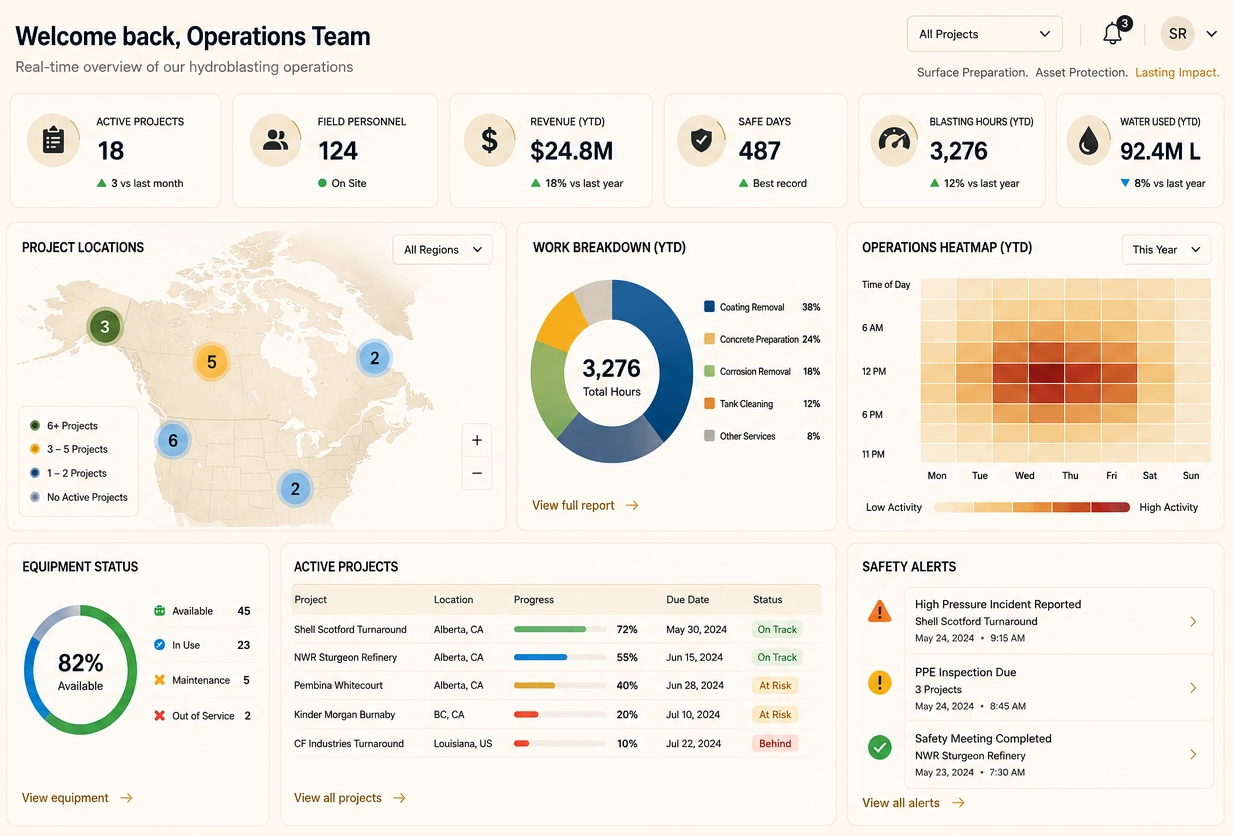
- Operations control dashboard: Real-time view of active jobs, crew assignments, and equipment status.
- Asset utilization dashboard: Daily and weekly utilization by asset type, region, and customer.
- Job profitability dashboard: Margin by job, with drill-down to labor, equipment, and consumables.
- Safety performance dashboard: TRIR, near-miss trends, and training compliance by crew and region.
These dashboards were built directly in StyleBI, with operations managers participating in design sessions and learning how to adjust filters, parameters, and visual layouts themselves.

Phase 3: Embedding Analytics into Workflows
Finally, HydroForce integrated StyleBI views into the tools that teams already used:
- Links to StyleBI dashboards from the job scheduling system.
- Embedded KPI tiles in the maintenance work order application.
- Mobile-friendly views for field supervisors to check job status and safety metrics on tablets.
SAS Viya remained in use for certain advanced modeling tasks, but StyleBI became the primary interface through which the business consumed and acted on data.
Business Productivity Gains After the Switch
Within six months of going live with StyleBI, HydroForce observed measurable improvements in productivity across several dimensions.
Faster Decision-Making in Operations
Previously, operations managers waited for weekly reports to understand utilization and job overruns. With StyleBI:
- Same-day visibility: Managers could see, by midday, which jobs were trending over budgeted hours and reassign crews or equipment accordingly.
- Dynamic what-if analysis: Dispatchers could adjust schedules in StyleBI and immediately see the impact on utilization and overtime.
This reduced the number of jobs that ran significantly over budgeted hours and improved on-time completion rates during critical shutdown windows.

Higher Utilization of Expensive Assets
Hydroblasting pumps and vacuum trucks are capital-intensive. Underutilization directly erodes profitability. StyleBI’s asset utilization dashboard:
- Highlighted underused units by region and shift.
- Exposed patterns where certain customers consistently booked premium equipment but used only a fraction of the reserved time.
Armed with this insight, the company adjusted scheduling practices and customer agreements, increasing average utilization of key assets without adding new equipment.
Reduced Analytics Bottlenecks
One of the most significant productivity gains came from reducing the backlog of report and dashboard requests:
- Operations and safety managers learned to clone and modify existing dashboards in StyleBI without waiting for the analytics team.
- Common requests, such as “show me nozzle wear by job type” or “add a filter for confined-space jobs,” could be implemented in minutes.
The central BI analytics team shifted from being a report factory to focusing on data quality, governance, and more advanced analysis, multiplying their impact.

Improved Safety Oversight
Safety leaders used StyleBI to monitor leading indicators, not just lagging ones:
- Near-miss reports and job hazard analyses were visualized by crew, site, and service type.
- Training gaps were surfaced before crews were assigned to high-risk jobs.
This proactive visibility helped reduce incident rates and reinforced a culture where safety data was reviewed as frequently as financial data.
New Analytics Use Cases Unlocked by StyleBI
As adoption grew, HydroForce discovered that StyleBI enabled use cases that had been impractical in the previous environment:
- Customer-facing performance portals: Key accounts received secure access to dashboards showing job history, safety performance, and turnaround support metrics.
- Sales opportunity dashboards: Sales reps could see which customers were underutilizing certain services, enabling targeted cross-sell campaigns.
- Shutdown readiness scorecards: Before major turnarounds, planners reviewed readiness dashboards covering crew availability, equipment maintenance status, and historical overruns.
These use cases directly supported revenue growth and deeper customer relationships, extending the value of the analytics investment beyond internal productivity.

Lessons Learned from the Transition
HydroForce’s move from a SAS Viya–centric environment to a StyleBI-centric one offers several lessons for other industrial service companies:
- Self-service matters as much as raw power: A platform that only specialists can use will struggle to drive day-to-day productivity.
- Start with the operational questions: The most valuable dashboards answered simple but critical questions: “Where are my crews?” “Which jobs are at risk?” “Which assets are idle?”
- Keep advanced analytics, but surface it simply: Predictive models built in SAS can still be valuable, but their outputs should be delivered through intuitive StyleBI dashboards.
- Design for roles, not departments: Role-based dashboards for dispatchers, supervisors, safety coordinators, and executives ensured that each user saw only what they needed to act quickly.
In the end, HydroForce did not abandon advanced analytics; it made analytics usable. By shifting to StyleBI as the primary lens on its data, the company turned hydroblasting operations from a black box into a transparent, measurable, and continuously improvable system—unlocking significant gains in business productivity across the board.