Top Business Intelligence Software: InetSoft
Are you evaluating the top business intelligence software providers? There are over 100 to chose from, but user review sites like Software Advice make narrowing down a short list easier. Filtering on similarly priced on-premise solutions with the highest average rating, InetSoft is tied among the top 4 for the highest rank, along with Sisense, Board and Dundas. Click the chart below to go to the filter at softwareadvice.com. View a demo and read reviews.
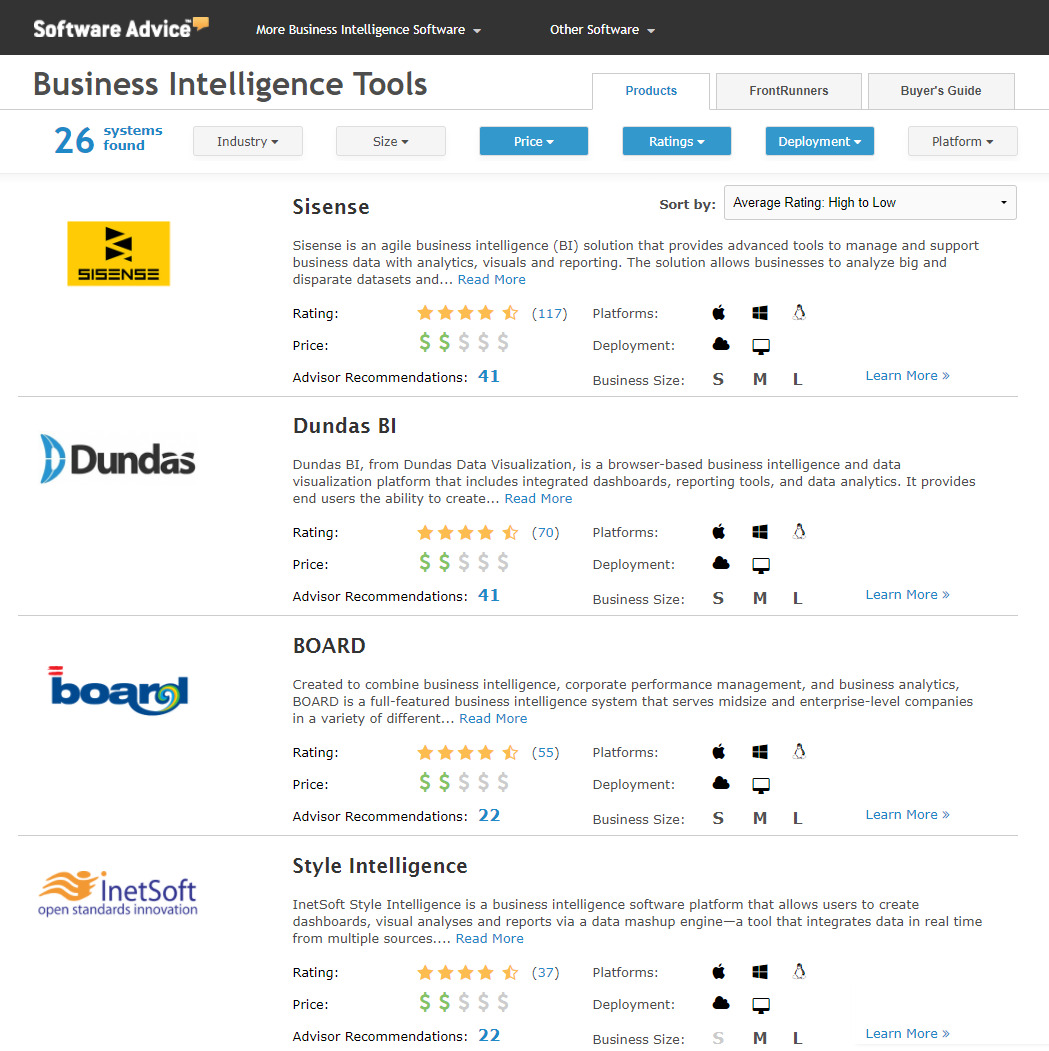
InetSoft vs Board vs Sisense vs insightsoftware (Dundas)
The BI and analytics market is crowded with platforms that sound similar on the surface but differ significantly in architecture, governance, and ideal use cases. InetSoft, Board, Sisense, and insightsoftware (which acquired Dundas) all target organizations that need interactive dashboards and visual analytics, yet they approach data modeling, extensibility, and planning in distinct ways. Understanding these differences is crucial when you are choosing a long-term analytics foundation rather than just a reporting tool.
At a high level, InetSoft emphasizes flexible data mashup and embeddable visual analytics; Board blends BI with integrated planning and CPM; Sisense focuses on a modern, API-first analytics stack with strong embedding and cloud-native options; and insightsoftware, through Dundas, offers a highly customizable, developer-friendly dashboarding and reporting environment. The right choice depends on whether your priority is governed self-service, financial planning, embedded analytics, or deep customization.
InetSoft: Flexible data mashup and operational analytics
InetSoft’s core identity is as a visual analytics and dashboarding platform with strong data mashup capabilities. It is well suited for organizations that need to combine disparate operational data sources—transactional systems, telemetry, spreadsheets, and external feeds—without forcing everything into a single rigid warehouse model first. Its data worksheet paradigm lets analysts and power users create reusable data flows that can be governed and shared across dashboards.
InetSoft is particularly strong in operational and embedded scenarios. Organizations can build highly interactive dashboards with drill-down, parameterization, and complex calculations, then embed them into portals or SaaS applications. Governance is handled through a combination of centralized metadata and controlled self-service, which works well when you want business users to explore data but still rely on certified metrics. Compared to the others, InetSoft tends to be more lightweight and flexible than full CPM suites, while offering more modeling control than pure “plug-and-play” dashboard tools.
Board: BI fused with planning and performance management
Board positions itself as an all-in-one platform that unifies business intelligence, planning, and corporate performance management. Rather than treating reporting and planning as separate systems, Board provides a single environment where users can analyze historical data, create budgets and forecasts, and run what-if simulations. This makes it especially attractive to finance and FP&A teams that want to move beyond spreadsheet-based planning.
The platform includes built-in capabilities for budgeting, forecasting, financial consolidation, and strategic planning. Dashboards and reports are tightly integrated with these planning models, so users can move from viewing KPIs to adjusting drivers and assumptions in the same interface. Compared to InetSoft and Sisense, Board is less focused on being a generic embeddable analytics engine and more focused on delivering a unified CPM and analytics experience. For organizations whose primary need is financial and operational planning with strong governance, Board can be a better fit than a pure-play BI tool.

Sisense: API-first, embeddable, and cloud-native
Sisense is known for its modern, developer-friendly approach to analytics. It offers a highly extensible, API-first architecture that makes it appealing to product teams and SaaS vendors who want to embed analytics deeply into their applications. Sisense’s architecture supports cloud and hybrid deployments, often leveraging containerization and microservices for scalability.
A key strength of Sisense is its focus on embedding and customization through plugins, JavaScript APIs, and extensive theming. Product teams can build tailored analytic experiences that feel native to their applications, including multi-tenant environments where each customer sees their own data and branding. Compared to InetSoft, Sisense leans more heavily into cloud-native scale and developer tooling, while InetSoft often appeals to organizations that want strong mashup and governed self-service without committing fully to a developer-centric model.
For internal BI, Sisense can still serve as a robust dashboarding platform, but its real differentiation emerges when analytics is part of a product strategy. If your primary goal is to monetize data or deliver analytics as a feature, Sisense’s embedding capabilities and APIs can be a decisive advantage.
insightsoftware (Dundas): Deep customization and developer control
Dundas, now part of insightsoftware, has long been recognized for its highly customizable dashboarding and reporting capabilities. It offers a rich design surface where developers and advanced users can build pixel-perfect dashboards, custom visualizations, and tailored workflows. The platform is often deployed on-premises or in private cloud environments, aligning with organizations that have strong IT ownership and specific security or integration requirements.
Compared to InetSoft and Sisense, Dundas tends to be more developer-centric and less focused on out-of-the-box self-service for casual users. Its strength lies in building bespoke analytic applications that match exact line-of-business needs, including complex layouts and specialized visual components. For organizations that want a toolkit-like environment where IT or development teams craft highly tailored experiences, Dundas can be a strong option, especially when integrated into broader insightsoftware financial and operational reporting offerings.

Key comparison dimensions
When comparing these four platforms, several dimensions stand out: data modeling and mashup, planning and CPM, embedding and extensibility, and governance and self-service.
InetSoft excels in data mashup and operational dashboards. It is a good fit when you need to blend many sources, support governed self-service, and potentially embed analytics into portals or applications without committing to a fully developer-driven stack. Board stands out when planning, budgeting, and performance management are central; it is less about being a generic analytics engine and more about providing an integrated CPM environment with strong analytics built in.
Sisense is strongest where embedding, APIs, and cloud-native scale are critical. If your analytics strategy is tied to a SaaS product or you need multi-tenant, white-labeled analytics, Sisense’s architecture and ecosystem are very compelling. insightsoftware’s Dundas offering is best when deep customization and pixel-perfect control matter more than rapid self-service—particularly in IT-led environments that want to build tailored analytic applications and reports.
Choosing the right platform
The “best” platform among InetSoft, Board, Sisense, and insightsoftware (Dundas) depends less on feature checklists and more on your primary use cases and organizational structure. If your priority is operational analytics with strong data blending and governed self-service, InetSoft is a strong contender. If finance and planning are at the center of your analytics strategy, Board’s integrated CPM capabilities may outweigh the benefits of more generic BI tools.
For organizations building data-driven products or embedding analytics into customer-facing applications, Sisense’s API-first design and cloud-native architecture can be decisive. And if your environment is heavily IT-led, with a need for highly customized dashboards and reports that match specific business processes, insightsoftware’s Dundas platform can provide the level of control you need.
Ultimately, many enterprises end up with a combination: a planning-focused platform like Board for finance, a flexible BI tool like InetSoft or Sisense for operational analytics and embedding, and specialized reporting or dashboarding from tools like Dundas where deep customization is required. Clarifying which teams you are serving, how much you value self-service versus developer control, and whether analytics is internal or product-facing will guide you to the right mix among these four platforms.