From Redash to StyleBI: How a Specialty Gas Distributor Upgraded Its Dashboarding Software
Specialty gas distributors operate in a world where precision, safety, and reliability are non-negotiable. They supply ultra-high-purity gases and complex gas mixtures to semiconductor fabs, pharmaceutical labs, environmental testing facilities, aerospace programs, and advanced manufacturing plants. Every cylinder, dewar, and microbulk tank carries not just product, but risk, regulatory obligations, and customer expectations. Behind each delivery is a web of data: purity certifications, batch numbers, pressure readings, telemetry from on-site tanks, route histories, and usage patterns.
One regional specialty gas distributor had invested heavily in telemetry systems, ERP integration, and digital order management. However, its analytics and dashboarding layer lagged behind. The company initially adopted Redash as a flexible, SQL-centric way to query databases and build simple dashboards. It worked well for analysts and technically inclined staff, but as the business grew, the limitations of Redash became more apparent. Operations managers, sales teams, and executives needed richer, more governed, and more user-friendly dashboards than Redash was designed to provide. This realization led them to StyleBI.
Life with Redash: Great for Queries, Weak for the Business
Redash entered the organization through the back door, so to speak. A data-savvy engineer introduced it as a way to quickly query the company’s PostgreSQL and MySQL databases and visualize results. Analysts appreciated the ability to write SQL, create charts, and share links. For ad hoc analysis and one-off questions, Redash was a big step up from raw database access.
Over time, Redash dashboards began to appear in operations meetings and sales reviews. They showed cylinder inventory levels, delivery counts, and basic customer usage trends. However, the more the company tried to use Redash as its primary dashboarding software, the more friction it encountered. Most business users were not comfortable writing SQL or editing queries. They relied on a small group of power users to build and maintain dashboards, creating bottlenecks and delays.
Redash also lacked a robust semantic layer. Each query defined its own logic for metrics like “on-time delivery rate,” “cylinder turn rate,” and “telemetry coverage.” Small differences in joins, filters, or date logic led to inconsistent numbers across dashboards. In meetings, teams sometimes spent more time debating whose Redash query was correct than discussing what to do about the results. For a company operating in a safety-critical, regulated industry, this inconsistency was more than an annoyance—it was a risk.

Why StyleBI Came into the Picture
The turning point came when the company’s leadership decided to formalize its analytics strategy. They wanted dashboards that could serve as a single source of truth for operations, sales, safety, and finance. They needed a platform that could support governed metrics, interactive dashboards, and non-technical users, while still giving analysts the flexibility they needed. StyleBI emerged as a strong candidate.
Several capabilities stood out. First, StyleBI’s data modeling layer allowed the company to define reusable measures and dimensions—such as cylinder utilization, route efficiency, on-time delivery, and telemetry uptime—once and then use them consistently across all dashboards. Second, StyleBI could connect to multiple data sources: ERP, CRM, telemetry platforms, route optimization tools, and laboratory information systems. This meant the company could build integrated views of its operations without forcing everything into a single database.
Third, StyleBI offered a richer, more polished dashboarding experience than Redash. Instead of static charts and simple filters, the company could build interactive dashboards with drill-down paths, parameter controls, and advanced visualizations tailored to logistics, safety, and commercial performance. This promised to move dashboards from the realm of “technical reports” into everyday decision tools for the entire organization.
Planning the Migration: From SQL Dashboards to Decision Dashboards
The company approached the migration from Redash to StyleBI as more than a tool swap. They saw it as a chance to redesign their dashboards around decisions rather than queries. They began by interviewing key stakeholders to understand their core questions:
- Operations managers: Are we delivering on time, minimizing emergency runs, and using our fleet efficiently?
- Safety and compliance teams: Are cylinders, tanks, and pipelines operating within safe limits, and are inspections up to date?
- Sales and account managers: How are customers consuming gases, and where are there opportunities for growth or risk of churn?
- Warehouse and inventory teams: Do we have the right mix of cylinders and gases in each location?
- Executives: How do operational metrics translate into revenue, margin, and capital efficiency?
These questions became the organizing principle for the new StyleBI dashboards. Instead of porting Redash queries one by one, the team defined standard KPIs and encoded them into StyleBI’s semantic layer. They mapped out which dashboards would be operational (refreshed frequently, used daily), which would be analytical (used for deeper investigations), and which would be executive (focused on trends and strategic indicators).

Rebuilding Dashboards for Specialty Gas Operations
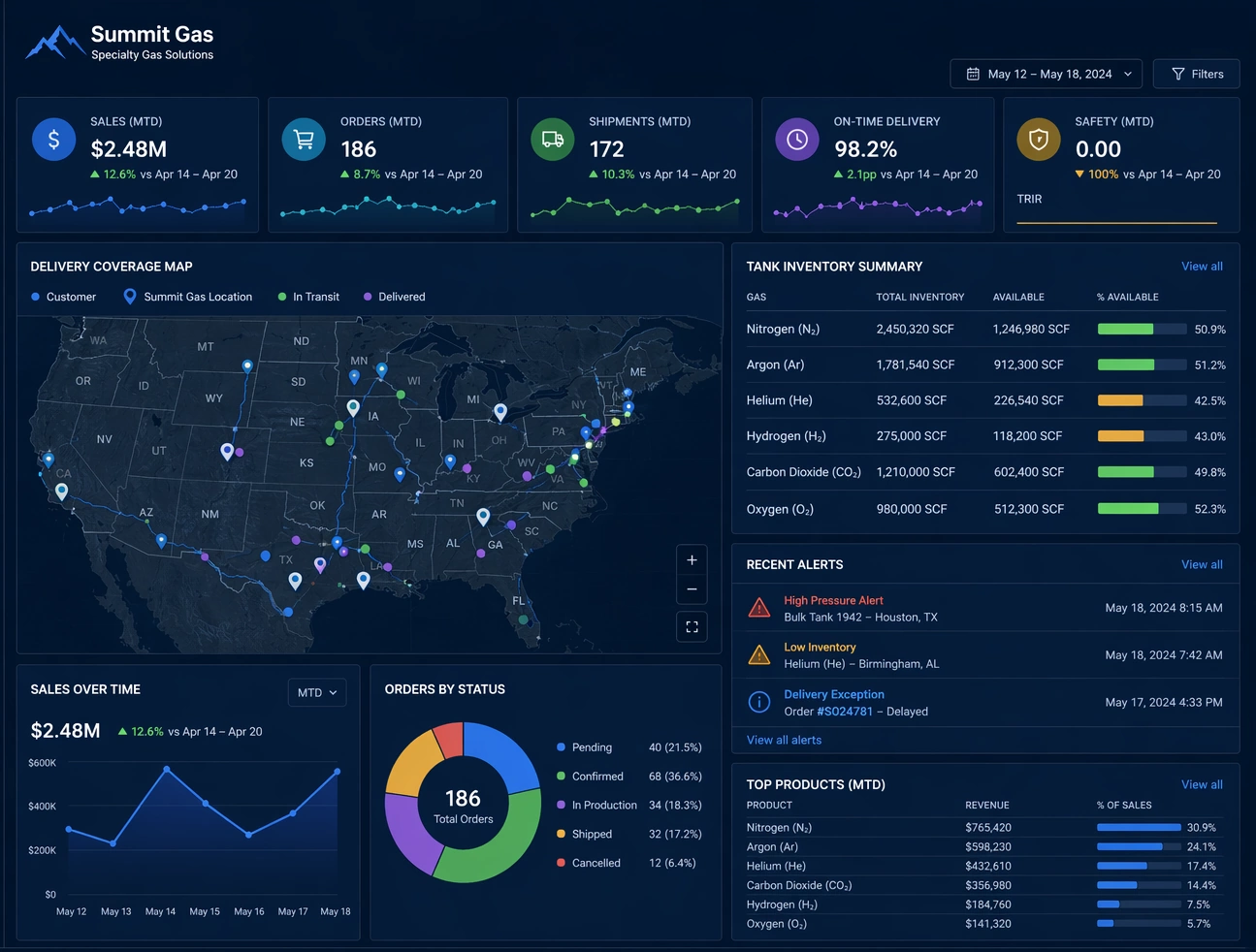
With StyleBI in place, the company designed dashboards that reflected the unique realities of specialty gas distribution. For operations managers, they built dashboards that combined route maps, delivery counts, and on-time performance metrics. Interactive filters allowed managers to drill down by depot, driver, route, or customer segment. Heatmaps highlighted regions with frequent emergency deliveries or recurring delays, helping managers identify where to adjust schedules or add capacity.
For safety and compliance teams, they created dashboards that tracked inspection schedules, cylinder test dates, and telemetry alerts. Time-series charts showed pressure and flow trends for on-site tanks, with thresholds clearly marked. Dashboards flagged assets approaching regulatory deadlines or exhibiting abnormal behavior. StyleBI’s ability to integrate data from telemetry systems and asset management tools made it easier to maintain a real-time view of risk.
Sales and account managers received dashboards focused on customer usage patterns and contract performance. They could see consumption trends by gas type, cylinder size, and delivery frequency. Alerts highlighted customers whose usage was declining or whose emergency orders were increasing—both potential signals of dissatisfaction or operational issues. These dashboards helped account managers have more informed conversations with customers and identify opportunities for upselling telemetry, microbulk solutions, or new gas lines.
Inventory and warehouse teams gained dashboards that visualized cylinder circulation and stock levels across depots. They could track how long cylinders stayed at customer sites, how quickly they returned, and where bottlenecks occurred. This helped optimize cylinder pools, reduce capital tied up in underutilized assets, and ensure that high-demand gases were available where needed.

Executive Dashboards: Connecting Operations to Financial Outcomes
Executives had previously relied on a mix of Redash dashboards and static reports. The Redash views showed some operational metrics, but they were fragmented and often lacked financial context. With StyleBI, the company built executive dashboards that connected operational performance to revenue, margin, and capital efficiency.
New executive dashboards showed revenue and margin by segment, overlaid with operational KPIs such as on-time delivery rate, emergency delivery frequency, and cylinder utilization. Executives could see how operational improvements translated into financial gains, such as reduced overtime, lower fuel costs, or better asset utilization. Scenario views allowed them to explore how changes in delivery patterns or telemetry adoption could impact profitability.
These dashboards also supported strategic decisions, such as where to invest in new depots, telemetry infrastructure, or microbulk installations. By combining geographic, operational, and financial data in a single view, StyleBI dashboards gave leadership a clearer picture of where the business was strong and where it needed attention.
Governance and Consistency: Solving the “Whose Query Is Right?” Problem
One of the most important outcomes of the move from Redash to StyleBI was the establishment of a governed analytics layer. In the Redash era, each dashboard was essentially a custom SQL script. Small differences in logic led to conflicting numbers and eroded trust. With StyleBI, the company defined core metrics centrally and exposed them as reusable measures.
A cross-functional data governance group was formed to own these definitions. They documented how each KPI was calculated, which data sources it used, and how it should be interpreted. StyleBI enforced these definitions across dashboards, ensuring that “on-time delivery rate” or “cylinder turn rate” meant the same thing in operations, sales, and executive views. This consistency reduced confusion and made it easier to align discussions around shared facts.

Performance, Scale, and Real-Time Needs
As the company expanded its telemetry footprint and added more customers, data volumes grew significantly. Redash could handle many of the queries, but complex joins and large time windows sometimes led to slow dashboards. StyleBI’s query optimization and caching capabilities delivered faster, more predictable performance.
For near real-time monitoring, the company configured StyleBI to refresh key dashboards at frequent intervals, pulling from telemetry and operational systems. Operations teams could trust that what they saw on screen reflected current conditions. For historical analysis, StyleBI handled large datasets without forcing users to wait through long load times, making it practical to analyze trends over months or years.
Cultural Shift: From Analyst-Driven to Self-Service Dashboards
The transition from Redash to StyleBI also changed how people interacted with data. Under Redash, most dashboards were created and maintained by a small group of analysts who wrote SQL. Business users were largely consumers of whatever those analysts produced. With StyleBI, more users could participate in dashboard creation and customization without writing code.
Training sessions introduced teams to StyleBI’s interactive features: filters, drill-downs, saved views, and parameter controls. Users learned how to adjust dashboards to their needs without breaking underlying logic. Analysts still played a crucial role in modeling data and designing core dashboards, but they were no longer the only ones capable of shaping the analytics environment. This shift increased engagement and helped embed data-driven thinking more deeply into daily operations.

Lessons Learned from the Migration
Looking back, the specialty gas distributor identified several key lessons from its move from Redash to StyleBI. First, a tool that is excellent for analysts is not always sufficient for the broader business. Redash excelled at ad hoc querying but struggled as a company-wide dashboarding platform. Second, consistent metric definitions are essential in a complex, regulated industry; without governance, dashboards can undermine trust instead of building it.
Third, the most valuable dashboards are those designed around decisions, not just data access. By starting with the questions that operations, sales, safety, and executives needed to answer, the company ensured that each StyleBI dashboard had a clear purpose. Finally, they learned that upgrading dashboarding software can catalyze a broader cultural shift—from reactive reporting to proactive, data-informed management. In their case, moving from Redash to StyleBI turned dashboards from technical artifacts into strategic instruments for running a high-stakes, high-precision specialty gas business.