From Geckoboard to StyleBI: How a Precision Fermentation Company Rebuilt Its Dashboards for Serious Analytics
Precision fermentation companies live and breathe data. They engineer microbes, run bioreactors, optimize feed strategies, and refine downstream purification processes to produce high-value proteins, enzymes, and specialty ingredients. Every batch generates a torrent of information: growth curves, dissolved oxygen levels, pH profiles, feed rates, yields, purity metrics, energy consumption, and cost-per-gram calculations. To stay competitive, these companies must turn that data into decisions quickly.
One mid-sized precision fermentation company had invested heavily in bioreactors, sensors, and lab information systems, but its dashboarding layer lagged behind. They initially adopted Geckoboard as a lightweight way to visualize KPIs on big screens across the facility. It worked well for simple, high-level metrics, but as the company scaled, they ran into limitations. Scientists, process engineers, and executives needed deeper, more flexible analytics than Geckoboard was designed to provide. That realization set the stage for a move to StyleBI.

Life with Geckoboard: Great for TV Screens, Weak for Process Insight
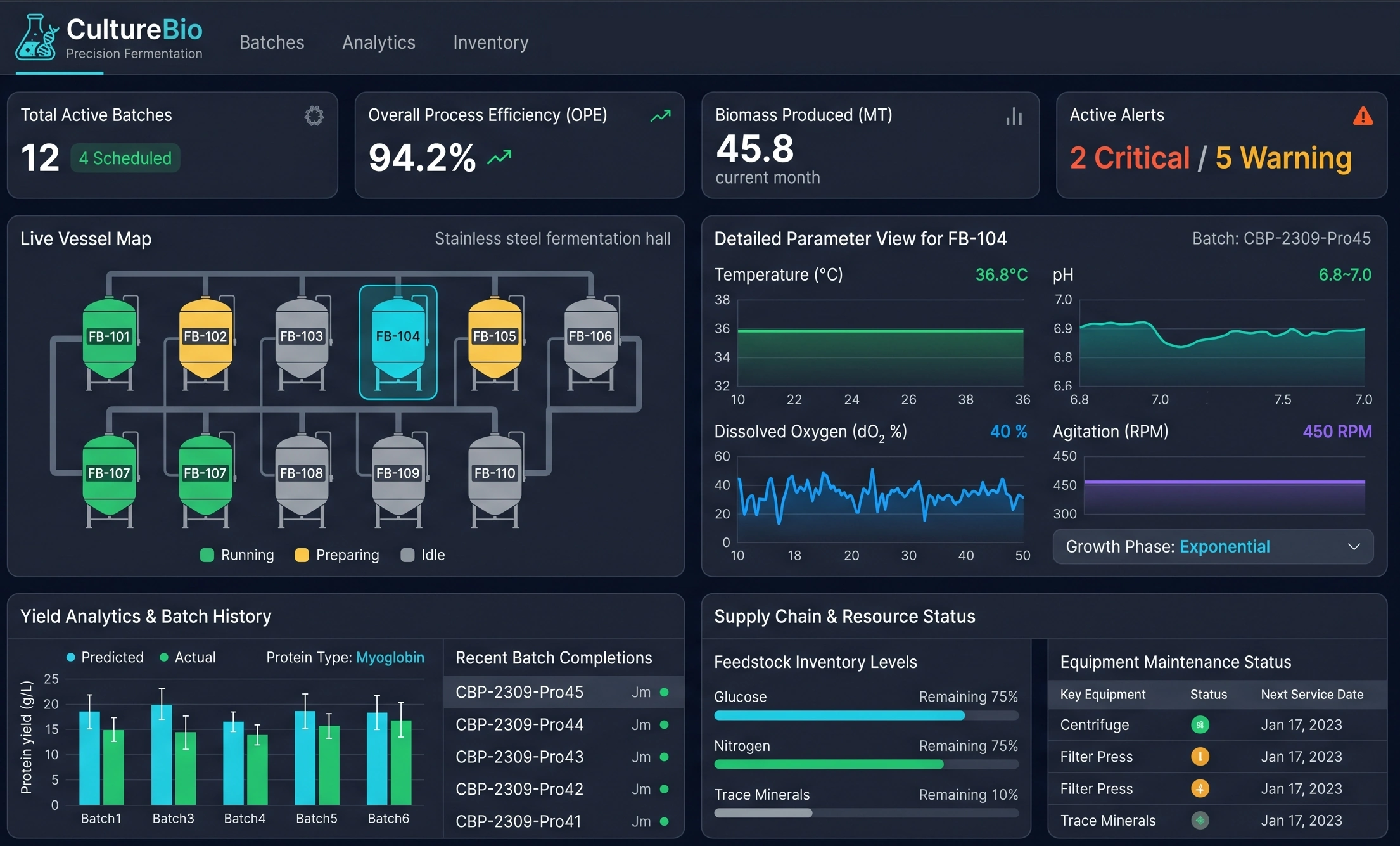
Geckoboard entered the company as a quick win. It was easy to connect to a few data sources, build simple KPI tiles, and display them on wall-mounted monitors in the production area and offices. Operators could see basic metrics like current batch status, number of active fermentations, and daily production volume. Executives liked the visual simplicity and the sense of transparency it created.
However, as the company’s operations matured, the cracks began to show. Geckoboard’s strength—simple, high-level dashboards—became a weakness when teams needed to dig into the details. Process engineers wanted to overlay multiple sensor streams, compare batches, and analyze deviations. Scientists wanted to correlate strain variants with yield and robustness. Finance wanted to tie production metrics to cost models and margin analysis. Geckoboard’s limited data modeling and interactivity made these tasks cumbersome or impossible.
Another challenge was governance. Different teams created their own Geckoboard dashboards with slightly different definitions of key metrics like “batch success rate,” “on-spec yield,” and “overall equipment effectiveness.” Without a central semantic layer, the same question could produce different answers depending on which dashboard someone looked at. For a company operating in a regulated, quality-sensitive environment, this inconsistency was risky.
Why StyleBI Came into Focus
The company’s head of digital operations initiated a review of more robust BI platforms. The goal was not just prettier dashboards, but a foundation for serious analytics: consistent metrics, deeper drill-downs, and the ability to support both scientists and executives from the same data backbone. StyleBI quickly emerged as a strong candidate.
Several capabilities stood out. First, StyleBI’s data modeling layer allowed the company to define reusable measures and dimensions—such as yield, productivity, batch duration, and cost-per-gram—once and then use them consistently across all dashboards. Second, StyleBI could connect to a wide range of data sources: historian databases, LIMS, ERP, MES, and even flat files from lab instruments. This meant the company could build a unified view of the fermentation lifecycle without forcing everything into a single system.
Third, StyleBI offered far more flexible visualizations and interactivity than Geckoboard. Instead of static tiles and simple charts, the company could build dashboards with drill-down paths, filters, parameter controls, and advanced charts tailored to process analysis. This promised to bridge the gap between high-level monitoring and deep technical insight.
Planning the Migration: From TV Dashboards to Decision Tools
The company treated the migration from Geckoboard to StyleBI as an opportunity to rethink its entire dashboard strategy. Rather than simply recreating existing screens, they started by asking a fundamental question: “What decisions should each dashboard support?” They identified key audiences and their core questions:
- Bioprocess scientists: Which strains and conditions deliver the best yields and robustness?
- Process engineers: Are bioreactors running within control limits, and where are deviations occurring?
- Production managers: Are batches on schedule, and is capacity being used effectively?
- Quality and regulatory teams: Are we maintaining compliance and traceability across batches?
- Executives and finance: How do production metrics translate into cost, margin, and growth?
These questions became the backbone of the new StyleBI dashboards. The team defined standard KPIs and encoded them into StyleBI’s semantic layer, ensuring that “batch success rate” or “on-spec yield” meant the same thing everywhere. They also mapped out which dashboards would be primarily monitoring tools (for wall displays) and which would be interactive analysis tools (for desktop use).
Rebuilding Dashboards for Precision Fermentation Reality
With StyleBI in place, the company designed a suite of dashboards that reflected the complexity of precision fermentation rather than hiding it behind simplistic tiles. For bioprocess scientists, they built dashboards that combined scatter plots, line charts, and box plots to explore relationships between strain variants, feed strategies, and yields. Scientists could filter by strain, media composition, temperature profile, or bioreactor type and instantly see how performance shifted.
For process engineers, they created real-time and historical views of bioreactor performance. Time-series charts showed dissolved oxygen, pH, agitation speed, and feed rates over the course of each batch. Control charts highlighted when parameters drifted outside predefined limits. Engineers could compare multiple batches side by side, identify recurring patterns in deviations, and link those patterns to specific equipment or operating conditions.
Production managers received dashboards focused on throughput, capacity utilization, and schedule adherence. Gantt-style views showed batch timelines across bioreactors, while KPI tiles summarized active batches, completed batches, and upcoming changeovers. Drill-downs allowed managers to move from a high-level view of the week to the details of a single batch with a few clicks.
Quality and regulatory teams gained dashboards that emphasized traceability and compliance. They could track batch genealogy, see which raw materials and strains were used, and verify that critical process parameters stayed within validated ranges. StyleBI’s ability to integrate data from multiple systems made it easier to demonstrate compliance during audits.

Executive Dashboards: From Vanity Metrics to Operational Insight
Executives had previously relied on Geckoboard dashboards that showed simple metrics like total batches, total volume produced, and a few trend lines. These were useful for a quick pulse check but did not provide much context. With StyleBI, the company redesigned executive dashboards to connect operational metrics to financial outcomes.
New executive dashboards showed production volume by product line, overlaid with cost-per-gram and margin trends. They highlighted which products and clients were driving the most profitable growth and which ones were consuming disproportionate capacity. Scenario views allowed executives to see how changes in yield or batch success rate would impact revenue and cost structure. Instead of just seeing that “things are up or down,” leadership could see why—and what levers they could pull.
Governance and Consistency: Fixing the “Multiple Truths” Problem
One of the most significant benefits of moving to StyleBI was the ability to enforce consistent definitions across the organization. In the Geckoboard era, each team had its own version of key metrics, leading to debates over whose numbers were correct. With StyleBI’s semantic layer, the company defined core measures centrally and exposed them as reusable building blocks.
Data stewards were assigned to maintain these definitions, ensuring that changes were deliberate and documented. Dashboards built by different teams all pulled from the same metric definitions, eliminating the “multiple truths” problem. This not only improved internal alignment but also increased confidence when sharing dashboards with external partners and investors.
Performance, Scale, and Real-Time Needs
As the company scaled up production and added more bioreactors, data volumes grew rapidly. Geckoboard had struggled with some of the more complex views, especially when pulling from multiple sources or large time windows. StyleBI’s query engine and caching strategies delivered faster, more reliable performance.
For near real-time monitoring, the company configured StyleBI to refresh key dashboards at frequent intervals, pulling from historian and MES systems. Operators could trust that what they saw on the screen reflected current conditions, not stale data. For historical analysis, StyleBI handled large datasets without forcing users to wait through long load times, making exploratory analysis more practical.

Cultural Shift: From Passive Displays to Active Analysis
The move from Geckoboard to StyleBI also triggered a cultural shift. Previously, dashboards were treated as passive displays—something you glanced at while walking through the facility. With StyleBI, dashboards became active tools for investigation and decision-making. Scientists used them to plan experiments. Engineers used them to troubleshoot issues. Managers used them to prioritize resources.
Training sessions helped teams understand not just how to use the new dashboards, but how to ask better questions of the data. StyleBI’s interactive features—filters, drill-downs, saved views—encouraged users to explore rather than just observe. Over time, the company saw an increase in data-driven discussions in meetings, with dashboards serving as the shared reference point.
Lessons Learned from the Transition
Looking back, the precision fermentation company identified several key lessons from its journey from Geckoboard to StyleBI. First, a dashboarding tool must match the complexity of the business. Geckoboard was great for simple, high-level displays, but it could not keep up with the analytical demands of a growing biomanufacturing operation. Second, consistent metric definitions are just as important as visual design; without governance, dashboards can create confusion instead of clarity.
Third, the most successful dashboards are built around decisions, not data sources. By starting with the questions each audience needed to answer, the company ensured that every StyleBI dashboard had a clear purpose. Finally, they learned that upgrading the tool is only part of the story; the real transformation happens when people change how they use data. In their case, moving from Geckoboard to StyleBI turned dashboards from digital posters into strategic instruments for optimizing precision fermentation.