Why Choose InetSoft as an Alternative to Kyvos
When you are evaluating modern analytics platforms, it is easy to get lost in buzzwords like “semantic layer,” “AI-powered analytics,” and “cloud-scale OLAP.” Kyvos positions itself as a semantic layer for AI and BI, focused on delivering a unified view of enterprise data and fast analytics at scale.
InetSoft, by contrast, is a mature, full-stack business intelligence and reporting platform that combines visual analytics, interactive dashboards, and pixel-perfect reporting in a single, cohesive solution. InetSoft If you are looking for a practical, flexible, and cost-effective alternative to Kyvos, InetSoft deserves serious consideration.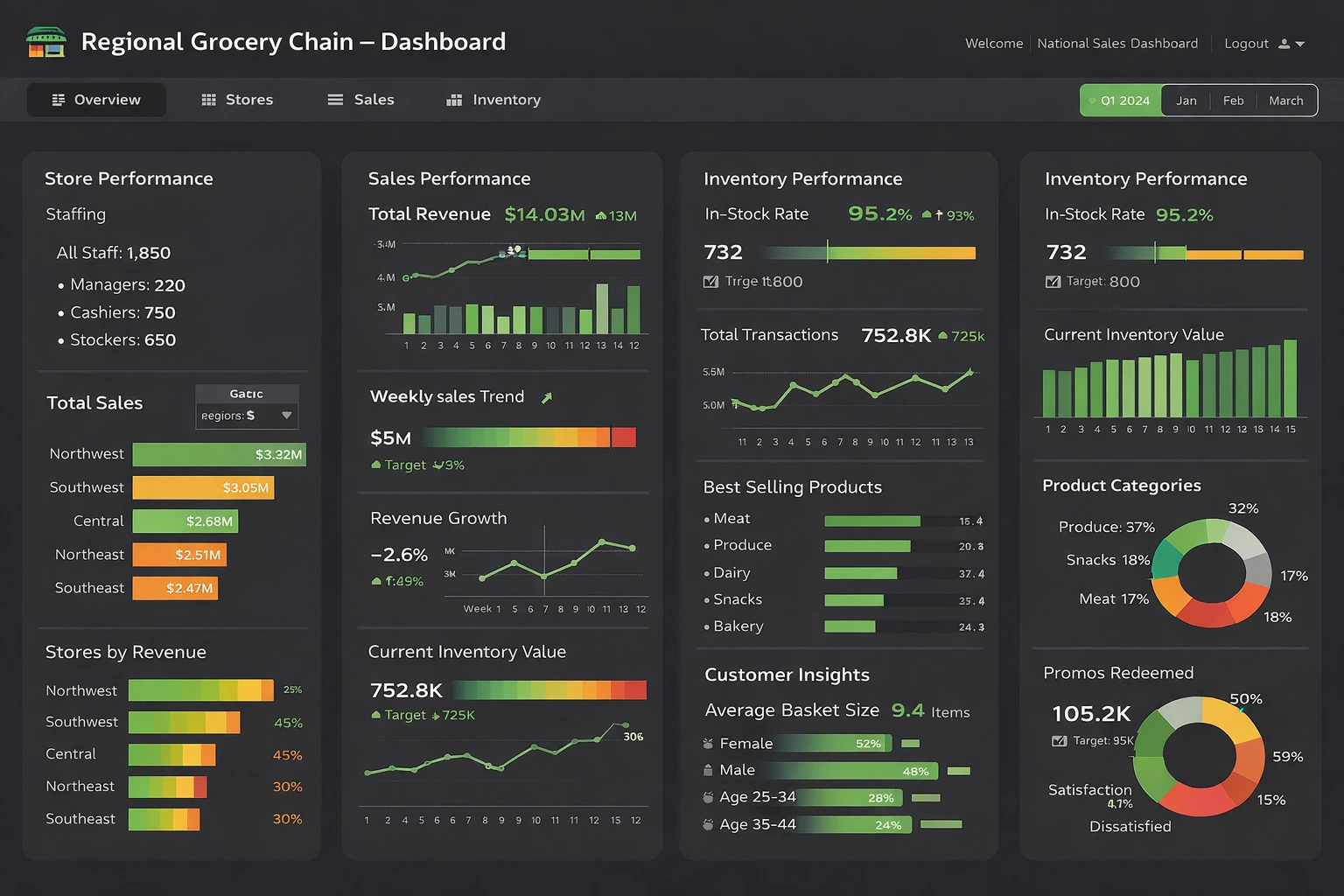

1. Complete BI Platform, Not Just a Semantic Layer
Kyvos is excellent at being a semantic layer: it standardizes metrics, definitions, and business logic so that multiple BI tools can consume governed data consistently. However, that also means you still need separate tools for dashboarding, reporting, and visualization, plus the integration work to connect them all.
InetSoft takes a different approach. It provides:
- Visual analytics for interactive dashboards and data exploration
- Traditional, pixel-perfect reporting for operational and regulatory needs
- Embedded analytics for integrating insights directly into your applications
- Data mashup and transformation built into the platform
Instead of stitching together a semantic layer, a separate dashboard tool, and a reporting engine, InetSoft gives you an end-to-end BI environment in one product. This reduces architectural complexity, integration overhead, and vendor management effort.
2. Visual Analytics and Pixel-Perfect Reporting in One Product
One of InetSoft’s biggest differentiators is its ability to deliver both modern, interactive dashboards and highly formatted, paginated reports from the same platform. Many visualization-first tools focus on dashboards but fall short when you need production-grade reports with precise layout, complex tables, and regulatory formatting. InetSoft explicitly highlights this dual strength: dashboards plus pixel-perfect reporting.
Kyvos, on the other hand, is not a reporting tool. It accelerates queries and standardizes metrics, but you still rely on external BI tools to design and render dashboards and reports. If your organization needs everything from executive scorecards to detailed operational reports, InetSoft offers a more direct, consolidated path.

3. Strong User Satisfaction and Proven Adoption
Independent review platforms are a useful way to gauge real-world satisfaction. On Gartner Peer Insights, InetSoft is rated highly by users in the Analytics and Business Intelligence Platforms market, with strong overall scores and willingness to recommend. Kyvos, by contrast, has far fewer reviews in that specific context, making it harder to benchmark user experience and adoption in a like-for-like BI platform category.
For organizations that value a track record of successful deployments, InetSoft’s long-standing presence in the BI space and positive user feedback provide additional confidence. You are not just adopting a new semantic layer; you are choosing a mature BI platform that has been refined through years of customer use across industries.
4. Flexible Data Mashup Without Heavy ETL
InetSoft’s sweet spot is organizations that want a flexible, web-based BI and reporting platform with a built-in data mashup engine. It can connect to many disparate sources, perform transformations inside the product, and produce interactive dashboards and reports without requiring elaborate ETL pipelines.
Kyvos is optimized for large-scale analytics on cloud data platforms and data warehouses. While it excels at accelerating queries on massive datasets, you typically still rely on upstream data engineering and modeling work to prepare data. If your team wants more agility—quickly combining spreadsheets, databases, cloud apps, and legacy systems—InetSoft’s built-in mashup capabilities can shorten the path from raw data to insight.

5. Better Fit for Embedded and Custom Analytics Experiences
Many organizations today want to embed analytics directly into their products, portals, or internal applications. InetSoft is particularly attractive when you need embedded analytics or custom report delivery, rather than marketing-centric automation or search-first analytics.
Because InetSoft controls the full stack from data access to visualization and reporting, it can be embedded as a cohesive component, with consistent styling, security, and behavior. Kyvos, by design, is a semantic and acceleration layer that sits behind other tools. You can certainly embed the front-end BI tools that consume Kyvos, but that adds more moving parts and vendors to coordinate.
6. Cost-Effective Architecture and Simpler Licensing Story
While exact pricing depends on your specific deal and deployment model, the architectural differences between InetSoft and Kyvos have clear cost implications. With Kyvos, you typically pay for:
- The Kyvos semantic/acceleration layer itself
- One or more BI tools on top (Tableau, Power BI, etc.)
- Cloud data warehouse or data lake infrastructure
- Integration and maintenance across all of the above
InetSoft consolidates much of this stack. You still need data sources, of course, but the BI, dashboarding, reporting, and data mashup capabilities are all in one platform. That can translate into:
- Fewer vendors and contracts to manage
- Lower integration and maintenance overhead
- More predictable total cost of ownership over time
For many mid-sized organizations or larger enterprises looking to rationalize their toolset, this simplicity is a major advantage.
7. Empowering Both Technical and Non-Technical Users
InetSoft is designed to balance flexibility with ease of use. Business users can build and interact with dashboards, run ad hoc analysis, and consume reports without needing deep technical skills. Meanwhile, power users and developers can leverage advanced data mashup, custom calculations, and embedding options.
Kyvos is powerful, but its value is often realized most fully in environments with strong data engineering and BI teams that can design semantic models, manage cloud infrastructure, and integrate multiple front-end tools. If your goal is to democratize analytics and put more capability directly into the hands of business stakeholders, InetSoft’s all-in-one design can be a better cultural and operational fit.
8. Practical Scalability for Real-World Workloads
Kyvos emphasizes sub-second query performance at massive scale and high concurrency, especially on cloud data platforms. That is ideal for organizations with extremely large datasets and thousands of concurrent users performing complex slice-and-dice analysis.
InetSoft, while not marketed as a specialized semantic layer, is built to handle demanding reporting and dashboarding workloads across many data sources. For most organizations—where data volumes are large but not at hyperscale, and concurrency is significant but not internet-scale—InetSoft’s performance profile is more than sufficient. You get robust scalability without the complexity of introducing a separate semantic acceleration layer.

9. Versatile Use Cases Across Departments and Industries
Because InetSoft combines dashboards, ad hoc analysis, and pixel-perfect reporting, it can serve a wide range of use cases from a single platform:
- Executive scorecards and KPIs
- Operational and financial reporting
- Customer and product analytics
- Compliance and regulatory reports
- Embedded analytics for customer-facing portals
Kyvos is strongest when you already have multiple BI tools and want to standardize metrics and accelerate queries across them. If your priority is to give business units a single, versatile environment for building and consuming analytics, InetSoft aligns more directly with that goal.
10. A Pragmatic Path to Modern Analytics
Choosing between InetSoft and Kyvos is not just a feature checklist exercise; it is a strategic decision about how you want your analytics stack to look and operate. Kyvos shines as a semantic layer and query accelerator for organizations that already have a complex BI ecosystem and very large data estates.
InetSoft offers a more pragmatic, consolidated path: a single platform for visual analytics, interactive dashboards, pixel-perfect reporting, data mashup, and embedded analytics. For many organizations, that means:
- Faster time to value, because there are fewer components to integrate
- Lower total cost of ownership, thanks to a simpler architecture
- Broader adoption, since both technical and non-technical users can thrive in one environment
- Less risk, because you are not dependent on multiple vendors to deliver a coherent experience

Why InetSoft Is a Compelling Kyvos Alternative
If your primary challenge is governing metrics across many BI tools at hyperscale, Kyvos is a strong candidate. But if you are looking for a powerful, flexible, and cost-effective alternative that delivers end-to-end BI capabilities in one platform, InetSoft stands out.
By choosing InetSoft as an alternative to Kyvos, you gain:
- A complete BI stack instead of just a semantic layer
- Unified visual analytics and pixel-perfect reporting
- Built-in data mashup and transformation
- Strong user satisfaction and proven adoption
- Embedded analytics and custom reporting options
- Simpler architecture and potentially lower total cost of ownership
For organizations that want modern analytics without unnecessary complexity, InetSoft offers a balanced, future-ready alternative to Kyvos—one that can support everything from executive dashboards to operational reporting and embedded analytics, all from a single, cohesive platform.