How a Medical Clinic Adopted InetSoft to Build Advanced, Multi-Source Analytics
Modern medical clinics generate enormous volumes of data across scheduling, billing, clinical documentation, patient engagement, and quality reporting systems. Yet many clinics still struggle to turn that data into timely insight. One multi-specialty outpatient clinic recently faced this challenge head-on by adopting InetSoft’s dashboard and analytics platform to unify and analyze information from multiple practice management and electronic health record (EHR) systems, including athenahealth, DrChrono, NextGen, Tebra, and Cliniko. The result was a dramatic improvement in reporting speed, operational visibility, and strategic decision-making.
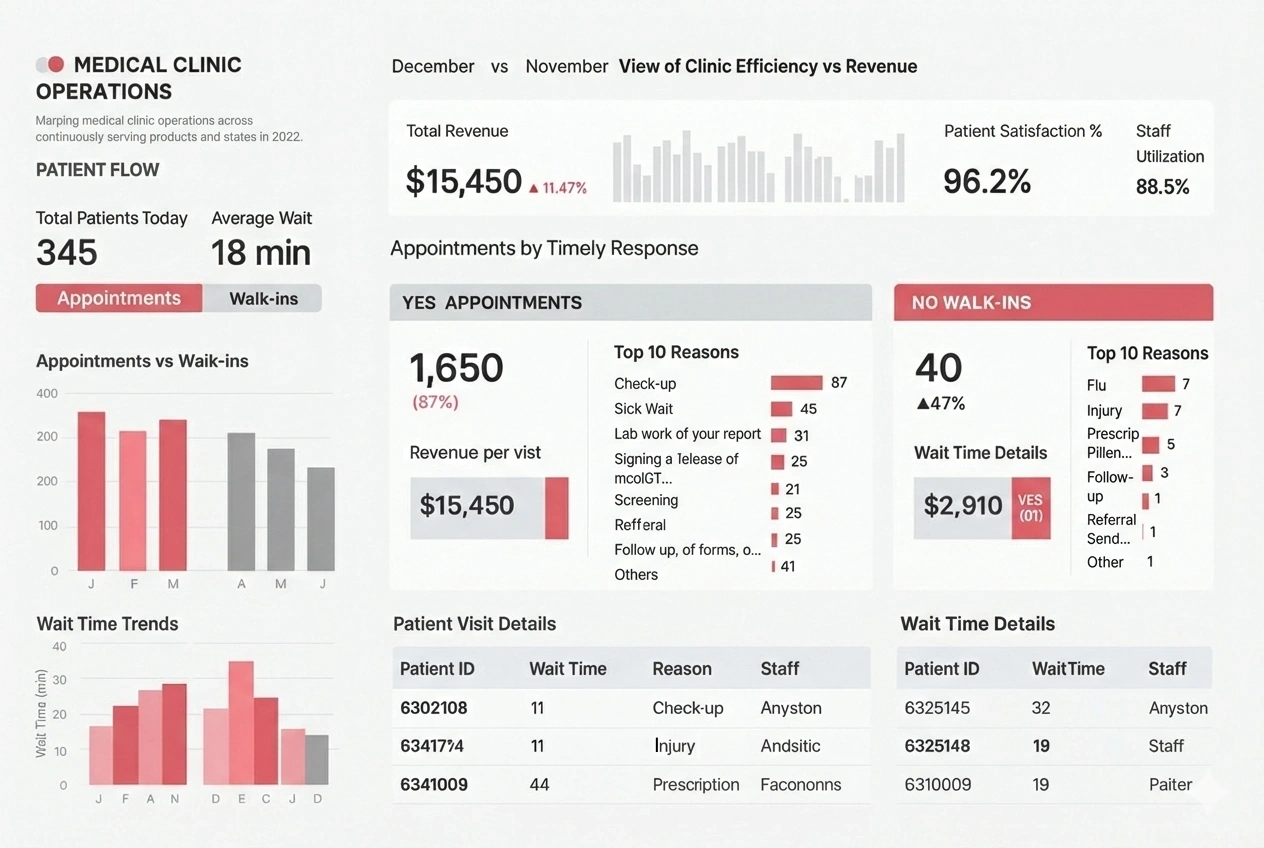

The Challenge: Data Locked in Silos
Like many growing clinics, this organization had adopted different systems over time to support distinct needs. Some departments relied on athenahealth for clinical documentation and claims submission. Specialty providers preferred DrChrono for mobile charting. A legacy group used NextGen for historical records and billing workflows. Marketing and patient engagement data flowed through Tebra, while allied health teams tracked scheduling and treatment outcomes in Cliniko.
Individually, each platform served its function well. Collectively, they created an analytics nightmare. Reports were generated separately in each system, often exported into spreadsheets and manually reconciled. Leadership could not easily answer questions such as:
- Which providers had the highest revenue per visit when adjusted for case complexity?
- How did patient no-show rates differ by location and appointment type?
- What was the relationship between marketing spend and new patient acquisition?
- Which diagnoses were driving the largest share of denied claims?
Because the data lived in different formats and schemas, it was difficult to compare or combine it. Analysts spent more time cleaning data than interpreting it. The clinic recognized that without a centralized analytics layer, it would remain reactive instead of proactive.
Why InetSoft Was Selected
The clinic evaluated several business intelligence and healthcare analytics tools. InetSoft stood out for three main reasons:
- Flexible data connectivity. InetSoft could connect to cloud-based EHR platforms, SQL databases, flat files, and APIs without requiring a full data warehouse project upfront.
- Visual data modeling. Analysts could build relationships between tables from different systems using a graphical interface, rather than writing extensive custom code.
- Customizable dashboards. The clinic wanted role-based dashboards for executives, operations managers, and clinicians, all driven from the same underlying data models.
This combination allowed the clinic to create a “virtual data layer” spanning all five systems, while preserving the autonomy of each operational platform.
Integrating athenahealth, DrChrono, and NextGen
The first phase focused on core clinical and financial data. athenahealth and DrChrono were integrated to provide real-time access to encounter records, diagnoses, and procedure codes. NextGen, which housed years of historical patient and billing data, was added as a longitudinal data source.
InetSoft’s data access features enabled the clinic to map patient identifiers across systems, resolving differences in naming conventions and record formats. Once unified, analysts created standardized metrics such as:
- Visits per provider per day
- Average reimbursement by CPT code
- Claim denial rate by payer
- Time from visit to payment
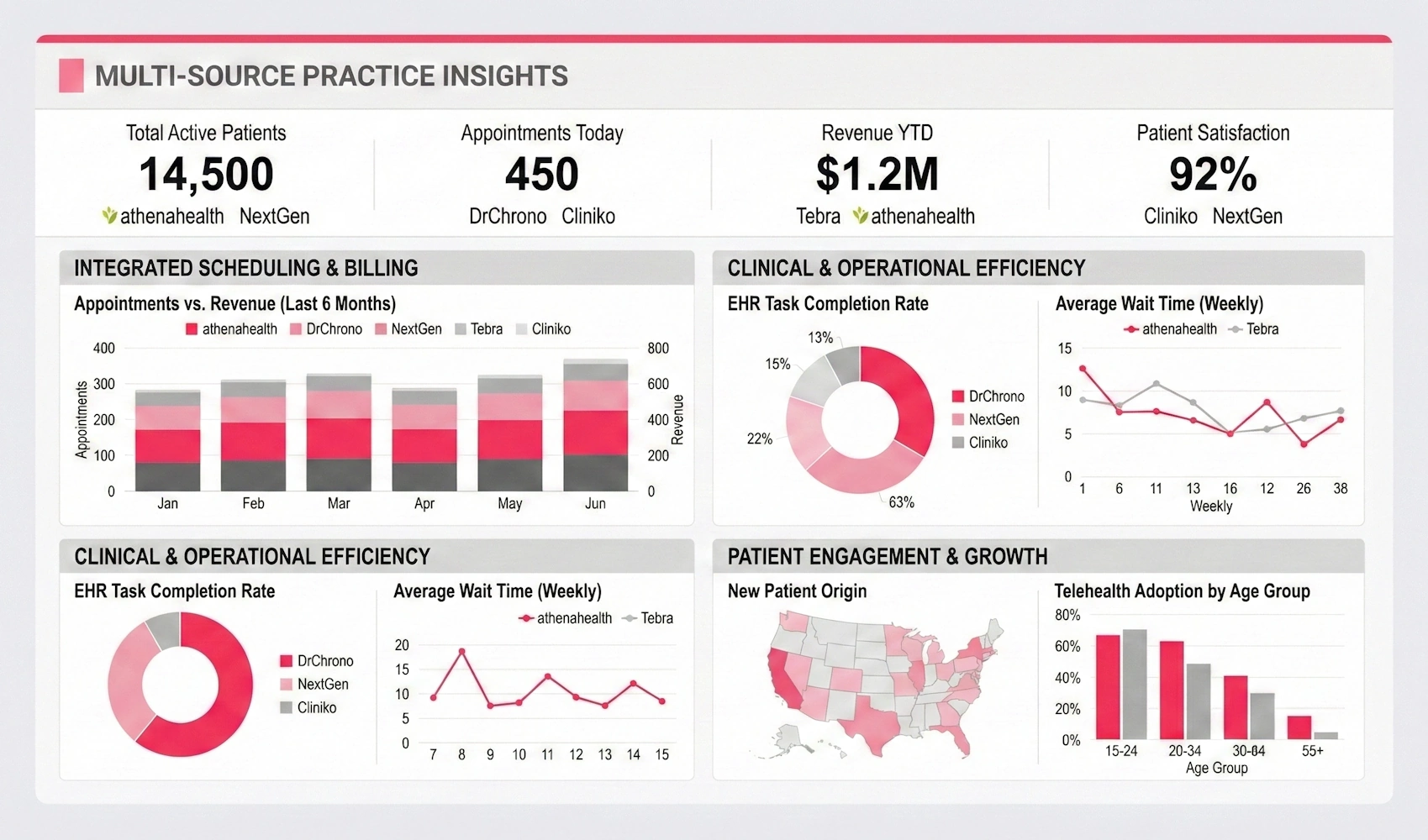
These metrics were visualized in dashboards that refreshed automatically, replacing manual weekly and monthly reporting processes.
Adding Tebra for Marketing and Growth Analytics
The next step expanded analytics beyond clinical and billing operations. Tebra data was integrated to capture website inquiries, appointment requests, and campaign attribution. This allowed the clinic to correlate marketing activity with downstream revenue and utilization.
For example, a new patient acquisition dashboard combined:
- Campaign data from Tebra
- First-visit records from athenahealth
- Revenue data from NextGen
Leadership could see which referral channels produced the highest-value patients over time, not just the highest number of leads. This insight shifted budget allocations away from low-performing campaigns toward channels that drove sustainable growth.
Incorporating Cliniko for Operational Efficiency
Cliniko was primarily used by therapy and allied health teams to manage appointments and treatment plans. By integrating Cliniko data, the clinic gained a more complete picture of capacity utilization and staff productivity.
Dashboards now tracked:
- Utilization rates by therapist and location
- No-show and cancellation patterns
- Average visits per treatment plan
- Revenue per hour of scheduled time
These metrics helped managers identify bottlenecks in scheduling and adjust staffing levels based on demand trends.

Advanced Analytics Across All Systems
Once data from athenahealth, DrChrono, NextGen, Tebra, and Cliniko was unified, the clinic could perform more advanced analytics that were previously impossible. InetSoft’s analytics layer enabled:
- Trend analysis. Multi-year comparisons of patient volume and revenue across specialties.
- Predictive indicators. Early warning dashboards for rising no-show rates or declining reimbursement.
- Comparative benchmarking. Provider performance comparisons adjusted for visit type and patient mix.
Instead of reacting to quarterly financial results, executives could see issues emerging in near real time.
Role-Based Dashboards
One of the most impactful changes was the introduction of role-based dashboards. InetSoft allowed the clinic to design different views of the same data for different users:
- Executives received high-level KPIs such as total revenue, patient growth, and payer mix.
- Operations managers monitored appointment utilization, staffing efficiency, and throughput.
- Clinicians saw personal productivity metrics, documentation turnaround times, and quality indicators.
This ensured that each group focused on metrics relevant to their responsibilities, without being overwhelmed by unnecessary detail.

Improved Data Governance and Trust
Before adopting InetSoft, different departments often reported different numbers for the same metric. Now, standardized definitions were embedded in the data models. A “visit” or “revenue” figure meant the same thing across all dashboards.
This consistency improved trust in analytics. Meetings shifted from debating which number was correct to discussing what actions to take based on shared insight.
Measurable Results
Within the first year of implementation, the clinic reported:
- A significant reduction in manual reporting time for analysts
- Improved claim denial visibility and faster corrective action
- Higher appointment utilization in therapy services
- More effective marketing spend based on ROI analysis
Perhaps most importantly, leaders gained confidence in making data-driven decisions. Whether evaluating a new service line or negotiating payer contracts, they had a unified view of clinical, financial, and operational performance.
A Model for Multi-System Healthcare Analytics
This clinic’s experience illustrates a broader trend in healthcare: organizations no longer rely on a single monolithic system for all operations. Instead, they use specialized platforms like athenahealth, DrChrono, NextGen, Tebra, and Cliniko to meet specific needs. The challenge is not choosing the right operational tools, but connecting them into a coherent analytics strategy.
By adopting InetSoft as an analytics and dashboard layer, the clinic avoided replacing existing systems while still achieving enterprise-level insight. The result was an analytics environment that grew with the organization and adapted as new data sources were added.
Transformed This Medical Clinic’s Approach to Data
The adoption of InetSoft’s dashboard software transformed this medical clinic’s approach to data. What began as disconnected reports across multiple systems evolved into an integrated analytics platform spanning clinical care, finance, marketing, and operations. With unified dashboards built on data from athenahealth, DrChrono, NextGen, Tebra, and Cliniko, the clinic moved from fragmented reporting to strategic intelligence.
This case demonstrates how healthcare organizations can unlock the full value of their existing systems by layering advanced analytics and visualization on top. Instead of drowning in data silos, the clinic created a single source of truth that empowered better decisions, improved efficiency, and supported long-term growth.