What Key Performance Indicators (KPIs) and Metrics Are Tracked in Pension Administration Dashboards?
Pension administration involves managing complex processes, from enrolling new members to ensuring timely payments to retirees. As pension funds grow in size and complexity, administrators increasingly rely on dashboards to monitor and manage their operations. These dashboards track key performance indicators (KPIs) and metrics that provide insights into the health of the pension fund, the efficiency of administrative processes, and the satisfaction of members.
In this analysis, we will explore various KPIs and metrics commonly tracked in pension administration dashboards, define these KPIs, and discuss their significance in performance management.
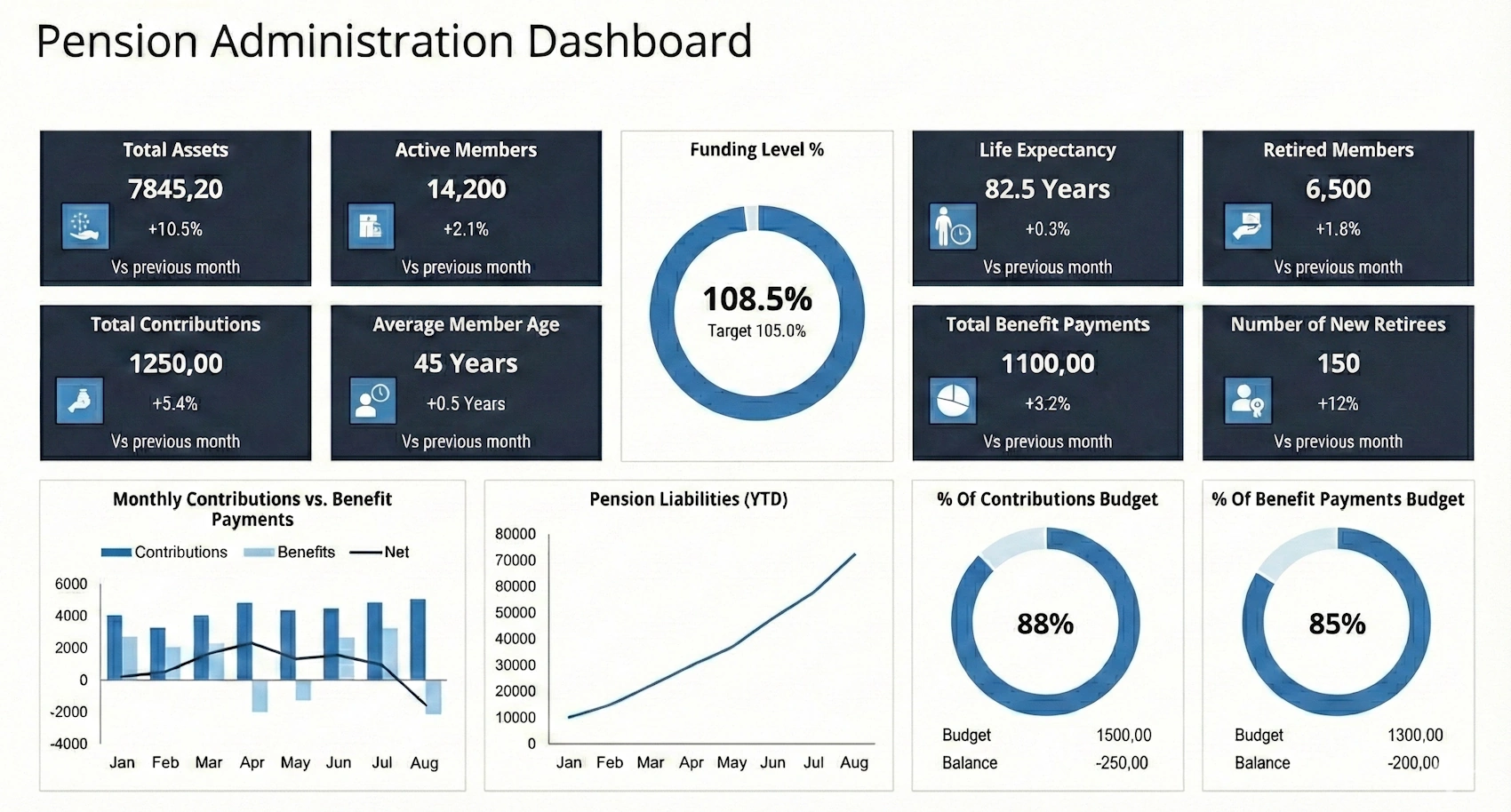

1. Member Enrollment and Demographics
- KPI: Active Membership Count
- Definition: The total number of active members currently enrolled in the pension plan.
- Significance: This KPI helps administrators monitor the growth or decline of the pension fund. A rising active membership count may indicate healthy enrollment and engagement, while a decline could signal issues with member retention or attractiveness of the plan.
- KPI: New Enrollments
- Definition: The number of new members joining the pension plan within a specific period (monthly, quarterly, annually).
- Significance: Tracking new enrollments helps assess the effectiveness of marketing efforts, recruitment strategies, or changes in plan offerings. A steady increase in enrollments could suggest successful outreach and onboarding processes.
- KPI: Average Age of Members
- Definition: The average age of all active members in the pension plan.
- Significance: Understanding the age distribution of the plan's membership is crucial for long-term financial planning. An older average age may suggest that the fund will need to start making more payouts soon, while a younger average age may indicate a longer accumulation phase.
- KPI: Member Retention Rate
- Definition: The percentage of members who remain in the pension plan over a specific period.
- Significance: High retention rates indicate member satisfaction and confidence in the pension plan. Conversely, declining retention rates may require administrators to investigate potential issues such as poor service, unattractive benefits, or communication failures.
2. Contribution and Funding Metrics
- KPI: Contribution Rate
- Definition: The percentage of income that members contribute to the pension plan, typically broken down by employee and employer contributions.
- Significance: Monitoring contribution rates ensures that the pension fund is receiving adequate funding to meet its future obligations. Administrators can use this data to assess the sufficiency of current contribution levels and make adjustments if necessary.
- KPI: Total Contributions Collected
- Definition: The total amount of contributions received from all members and employers within a specific period.
- Significance: This metric is critical for evaluating the financial health of the pension fund. Consistent or increasing contributions indicate a stable inflow of funds, while declining contributions may signal potential cash flow problems.
- KPI: Funded Ratio
- Definition: The ratio of the pension fund's assets to its liabilities, often expressed as a percentage.
- Significance: The funded ratio is one of the most critical indicators of a pension fund's financial health. A funded ratio of 100% or higher means that the fund has enough assets to cover its liabilities, while a lower ratio suggests a funding shortfall that may need to be addressed through increased contributions, adjustments to benefits, or other strategies.
- KPI: Employer Contribution Compliance Rate
- Definition: The percentage of employers who make their required contributions on time and in full.
- Significance: Ensuring that employers meet their contribution obligations is essential for maintaining the pension fund's financial stability. Low compliance rates may necessitate closer monitoring and follow-up with employers to avoid funding gaps.
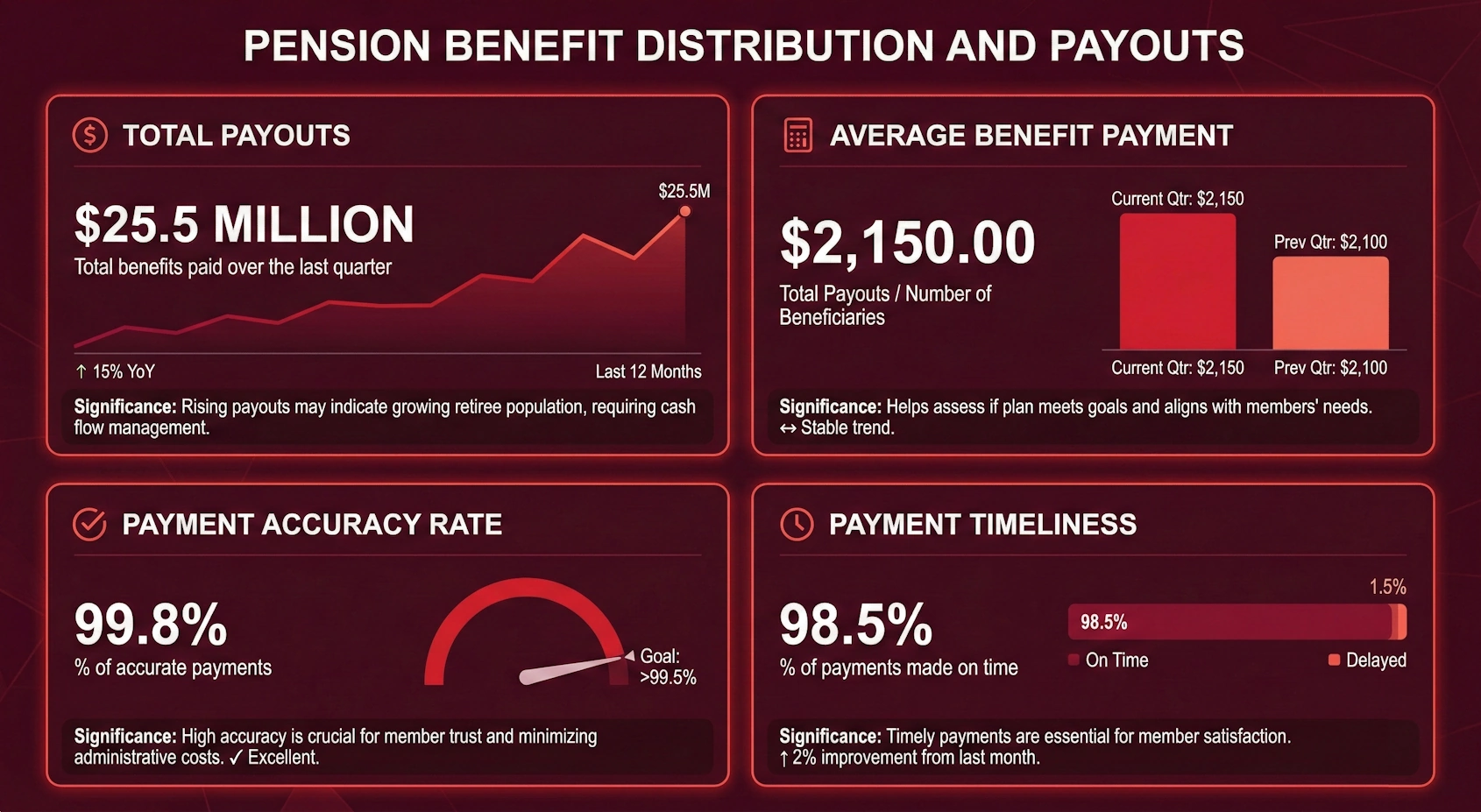
3. Benefit Distribution and Payouts
- KPI: Total Payouts
- Definition: The total amount of benefits paid out to retirees and beneficiaries over a specific period.
- Significance: Tracking total payouts helps administrators manage cash flow and ensure that the fund has enough liquidity to meet its obligations. Rising payouts may indicate a growing retiree population, necessitating adjustments in funding or investment strategies.
- KPI: Average Benefit Payment
- Definition: The average amount paid to retirees in benefits, calculated by dividing total payouts by the number of beneficiaries.
- Significance: Understanding the average benefit payment helps administrators assess whether the pension plan is meeting its intended goals. It can also help in identifying trends in benefit adequacy and ensuring that payouts align with members' retirement needs.
- KPI: Payment Accuracy Rate
- Definition: The percentage of benefit payments that are accurate and free from errors.
- Significance: High payment accuracy rates are crucial for maintaining member trust and minimizing administrative costs associated with correcting errors. Errors in payments can lead to member dissatisfaction and legal challenges, making this KPI vital for performance management.
- KPI: Payment Timeliness
- Definition: The percentage of benefit payments made on time, according to the scheduled payment dates.
- Significance: Timely payments are essential for member satisfaction and financial stability. Delayed payments can lead to member dissatisfaction, reputational damage, and potential penalties, making it crucial to track and maintain high levels of payment timeliness.

4. Member Communication and Satisfaction
- KPI: Member Satisfaction Score
- Definition: A measure of overall member satisfaction, often obtained through surveys or feedback mechanisms.
- Significance: High satisfaction scores indicate that members are happy with the pension plan's services, communication, and benefits. Monitoring this KPI helps administrators identify areas for improvement and address member concerns proactively.
- KPI: Response Time to Member Inquiries
- Definition: The average time taken to respond to member inquiries, whether through phone, email, or other communication channels.
- Significance: Quick response times contribute to member satisfaction and demonstrate the pension plan's commitment to customer service. Long response times can frustrate members and negatively impact their perception of the plan.
- KPI: Communication Effectiveness
- Definition: A measure of how well the pension plan communicates with its members, often based on feedback or engagement metrics (e.g., open rates of emails, participation in webinars).
- Significance: Effective communication ensures that members are informed about their benefits, plan changes, and important deadlines. It also helps build trust and transparency, which are critical for maintaining long-term member engagement.
- KPI: Member Engagement Rate
- Definition: The percentage of members actively engaging with the pension plan, such as by attending seminars, logging into the online portal, or participating in surveys.
- Significance: High engagement rates suggest that members are involved and informed about their retirement plans. This KPI is important for assessing the effectiveness of communication strategies and identifying opportunities to increase member participation.
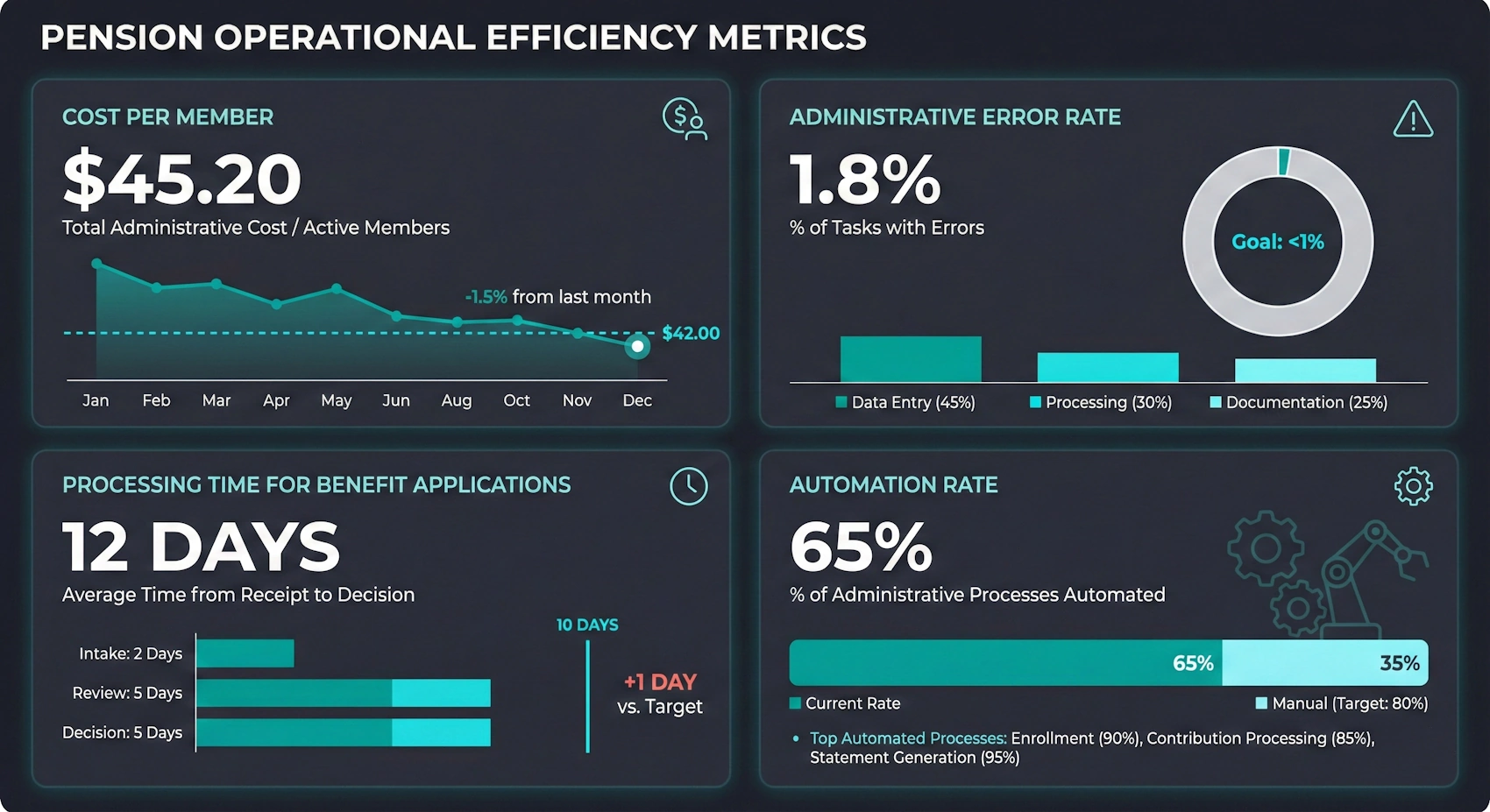
5. Operational Efficiency Metrics
- KPI: Cost per Member
- Definition: The total administrative cost of managing the pension plan, divided by the number of active members.
- Significance: Monitoring cost per member helps administrators assess the efficiency of their operations. A lower cost per member indicates more efficient use of resources, while a higher cost may require a review of administrative processes to identify areas for cost reduction.
- KPI: Administrative Error Rate
- Definition: The percentage of administrative tasks (e.g., data entry, processing of applications) that contain errors.
- Significance: High error rates can lead to inefficiencies, member dissatisfaction, and increased costs associated with correcting mistakes. This KPI is crucial for identifying areas where process improvements or additional training may be needed.
- KPI: Processing Time for Benefit Applications
- Definition: The average time taken to process benefit applications from the time they are received to the time they are approved or denied.
- Significance: Faster processing times improve member satisfaction and reduce the backlog of applications. This KPI is important for assessing the efficiency of the pension plan's administrative processes and identifying bottlenecks that may need to be addressed.
- KPI: Automation Rate
- Definition: The percentage of administrative processes that are automated rather than handled manually.
- Significance: Higher automation rates can lead to greater efficiency, reduced error rates, and lower administrative costs. Tracking this KPI helps administrators identify opportunities to further streamline operations and improve overall performance.
6. Compliance and Risk Management
- KPI: Compliance Rate
- Definition: The percentage of regulatory requirements that the pension plan complies with, often measured through internal audits or external reviews.
- Significance: Ensuring compliance with regulations is essential to avoid legal penalties and maintain the trust of members and stakeholders. A high compliance rate indicates that the pension plan is operating within legal guidelines and minimizing risk.
- KPI: Audit Findings
- Definition: The number and severity of findings from internal or external audits.
- Significance: Tracking audit findings helps administrators identify areas of non-compliance or operational weaknesses. Addressing these findings promptly is crucial for maintaining the integrity of the pension plan and avoiding potential risks.
- KPI: Risk Exposure
- Definition: A measure of the pension plan's exposure to various risks, such as market risk, credit risk, and operational risk.
- Significance: Monitoring risk exposure is essential for maintaining the financial stability of the pension fund. By tracking this KPI, administrators can proactively manage risks and implement strategies to mitigate potential impacts on the fund's performance
Additional Resources for Further Reading
- OECD – Private Pensions and Retirement Savings
- World Bank – Pensions Overview and Resources
- Society of Actuaries – Pension and Retirement Research
- Institute and Faculty of Actuaries – Pensions Practice Area

Additional Industry KPI Articles from InetSoft
Tracking Performance Across Retail Sales KPIs
This article explains how retail organizations monitor essential KPIs to understand sales performance and customer behavior. It highlights the importance of tracking store-level trends, product category movement, and promotional effectiveness. The piece also explores how dashboards help identify underperforming regions and optimize inventory decisions. Readers gain insight into how real-time analytics supports faster decision-making. The article concludes by showing how KPI visibility strengthens forecasting accuracy and operational efficiency.
Improving Outcomes With Healthcare Operational KPIs
This article focuses on the KPIs healthcare providers use to measure patient flow, resource utilization, and care quality. It explains how dashboards reveal bottlenecks in scheduling, admissions, and discharge processes. The content emphasizes the role of data in improving patient satisfaction and reducing operational delays. Administrators learn how KPI monitoring supports compliance and regulatory reporting. The article also demonstrates how analytics helps balance staffing levels with patient demand.
Monitoring Efficiency Through Manufacturing Production KPIs
This article outlines the KPIs manufacturers rely on to track production output, equipment performance, and quality control. It describes how dashboards visualize cycle times, defect rates, and machine utilization. The piece shows how KPI insights help reduce downtime and improve throughput. Leaders learn how real-time monitoring supports lean manufacturing initiatives. The article concludes by highlighting how KPI-driven decisions enhance profitability and operational stability.
Strengthening Oversight With Financial Services Risk KPIs
This article examines the KPIs financial institutions use to track risk exposure, compliance, and portfolio performance. It explains how dashboards consolidate credit, market, and operational risk indicators into a unified view. The content highlights how KPI monitoring supports regulatory reporting and internal governance. Executives learn how early-warning signals help mitigate emerging risks. The article also discusses how analytics improves transparency across business units.
Enhancing Visibility Across Supply Chain Logistics KPIs
This article explores the KPIs logistics teams use to measure delivery performance, transportation costs, and fulfillment accuracy. It shows how dashboards reveal delays, route inefficiencies, and warehouse bottlenecks. The piece emphasizes the importance of monitoring supplier reliability and inventory turnover. Readers learn how KPI insights support cost reduction and service-level improvements. The article concludes by demonstrating how analytics strengthens end-to-end supply chain visibility.