From Static Compliance to Strategic Insight: How a Fire Suppression Foam Manufacturer Transformed Reporting by Moving from Holistics to StyleBI
In the fire suppression foam manufacturing industry, data is more than a back-office concern—it is directly tied to safety, compliance, and the future viability of the business. As regulations tighten around PFAS-containing foams and demand for PFAS-free alternatives accelerates, manufacturers must manage complex R&D pipelines, rigorous performance testing, global supply chains, and evolving environmental standards. One mid-sized fire suppression foam manufacturer, SafeQuell Systems, discovered that its existing analytics stack could no longer keep up. The company’s decision to move from Holistics to StyleBI for its dashboard designer became a turning point in how it managed risk, innovation, and growth.
SafeQuell Systems had grown steadily over two decades, supplying foam concentrates to airports, refineries, chemical plants, and industrial facilities worldwide. The company’s product portfolio included legacy AFFF formulations as well as a new generation of fluorine-free foams designed to meet emerging environmental regulations. With this growth came a surge in data: batch records, performance test results, customer audits, incident reports, regulatory filings, and supply chain metrics. Initially, Holistics provided a way to centralize reporting and build dashboards on top of the company’s data warehouse. Over time, however, the limitations of that setup became increasingly visible.

Why Holistics Started to Hold Them Back
At first, Holistics seemed like a reasonable choice. It allowed the data team to define models, schedule reports, and build dashboards for internal stakeholders. But as the business environment changed, SafeQuell’s needs evolved in ways that Holistics struggled to support.
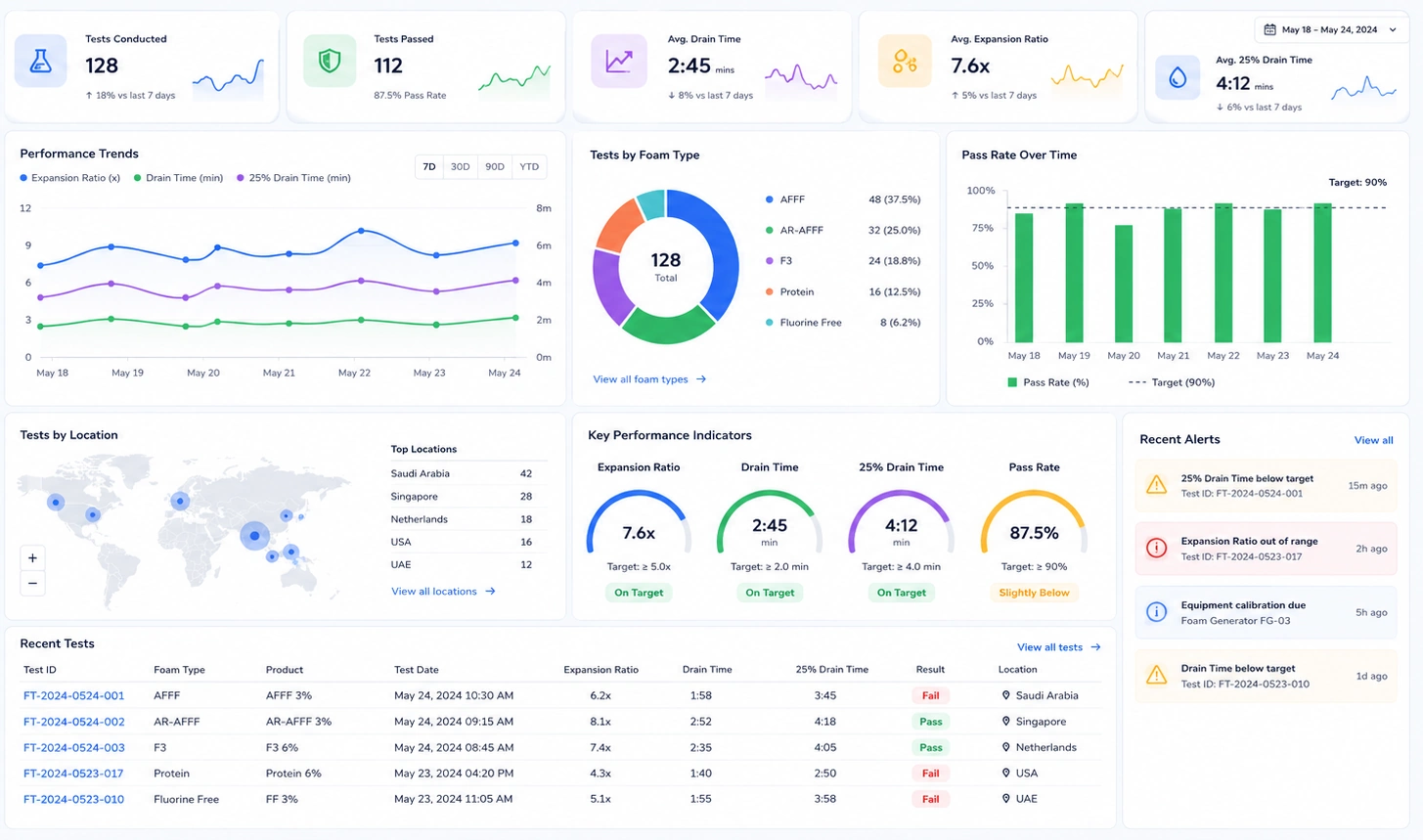
The R&D team needed highly interactive dashboards to compare foam performance across dozens of test conditions—expansion ratios, drainage times, burn-back resistance, temperature ranges, and fuel types. Compliance officers needed near real-time visibility into PFAS phase-out timelines, regional regulatory thresholds, and customer-specific requirements. Operations leaders wanted to track production yields, batch deviations, and raw material variability. Sales and product management needed to see how new PFAS-free formulations were performing in the market compared to legacy products.
In Holistics, many of these dashboards felt rigid. Interactivity was limited, parameter controls were not as flexible as the teams wanted, and embedding dashboards into internal portals required workarounds. The data team found itself spending too much time maintaining brittle reports and not enough time enabling new questions. As more departments requested tailored views, the system became cluttered with variations of similar dashboards, each slightly customized but difficult to manage at scale.
Most critically, SafeQuell wanted to move beyond static reporting toward a more exploratory, self-service model. Engineers, compliance specialists, and product managers wanted to slice and dice data without waiting for the data team to build new views. Holistics could provide some of this, but the experience was not intuitive enough for non-technical users, and the performance of complex dashboards sometimes lagged when dealing with large test datasets.

Why SafeQuell Chose StyleBI
When SafeQuell began evaluating alternatives, the company focused on three priorities: a powerful dashboard designer, strong support for parameterized and embedded analytics, and a platform that could serve both technical and non-technical users. StyleBI emerged as the leading candidate because it combined enterprise-grade data modeling with a highly flexible, visual dashboard designer that could adapt to the company’s unique workflows.
The evaluation team built a proof of concept using StyleBI to replicate and then extend several critical dashboards:
- Foam Performance Analytics: Interactive dashboards that allowed R&D to filter by formulation, test standard, fuel type, temperature, and nozzle configuration, with drill-down into individual test runs.
- Regulatory and PFAS Phase-Out Tracking: Dashboards that mapped products to regional regulations, highlighting where legacy foams needed replacement and where PFAS-free alternatives were approved.
- Batch Quality and Deviation Monitoring: Visualizations that tracked batch consistency, raw material variability, and lab test results, with alerts for out-of-spec parameters.
- Customer and Market Performance: Views that combined sales data, incident reports, and product performance feedback to guide product strategy.
StyleBI’s dashboard designer allowed SafeQuell to create these experiences with a level of interactivity and visual clarity that the team had struggled to achieve in Holistics. Parameter controls were more flexible, enabling users to switch between formulations, customers, regions, and time periods with ease. The ability to design responsive layouts meant that dashboards could be used effectively on large control room displays, standard desktops, and tablets used on the plant floor.

Designing Dashboards Around Real Decisions
One of the most important changes during the migration was a shift in mindset: instead of simply recreating existing reports, SafeQuell used StyleBI to design dashboards around specific decisions and workflows.
For example, the R&D foam performance dashboard was built to answer questions such as:
- Which PFAS-free formulations meet or exceed the performance of our legacy AFFF products under specific test standards?
- How does performance vary by temperature, fuel type, and application method?
- Where are we seeing inconsistent results that may indicate process or formulation issues?
In StyleBI, these questions were translated into interactive filters, drill-down paths, and comparative visualizations. Engineers could select a formulation, overlay its performance against benchmarks, and immediately see where it excelled or fell short. Instead of exporting data to spreadsheets or static PDFs, they could explore patterns directly in the dashboard.
Similarly, the regulatory dashboard was designed around the needs of compliance officers and account managers. They could select a region, customer, or facility type and instantly see which products were approved, which needed replacement, and what deadlines were approaching. This helped SafeQuell proactively engage customers about transitioning to PFAS-free foams, turning a regulatory challenge into a strategic opportunity.

Empowering Non-Technical Users
A key reason for leaving Holistics was the desire to empower non-technical users to work with data more independently. StyleBI’s dashboard designer and self-service capabilities made this possible without sacrificing governance.
The data team created curated data models that exposed clean, business-friendly fields—formulation names, test standards, regions, customer segments, and regulatory categories. On top of these models, they built a library of reusable visual components and templates. Engineers, product managers, and compliance specialists could then create or customize dashboards using drag-and-drop interactions, without writing SQL or worrying about joins.
This shift reduced the backlog of dashboard requests and allowed the data team to focus on more advanced modeling and analytics. It also increased engagement: teams that had previously relied on emailed reports began logging into StyleBI daily to explore data, monitor trends, and prepare for customer and regulatory meetings.
Embedding Dashboards Into Daily Operations
Another advantage of StyleBI was its ability to embed dashboards into existing portals and applications. SafeQuell integrated key dashboards into:
- The R&D Portal: Where formulation teams accessed test plans, lab results, and performance analytics.
- The Quality and Production Portal: Used by plant managers to monitor batch performance, deviations, and equipment status.
- The Customer Success Portal: Where account managers reviewed product performance, incident history, and regulatory status for key customers.
In Holistics, embedding had required workarounds and often felt like an afterthought. With StyleBI, embedded dashboards felt native, with consistent styling and responsive layouts. This integration helped make analytics a natural part of daily work rather than a separate destination.

Measurable Impact of the Migration
Within the first year of moving from Holistics to StyleBI, SafeQuell saw several tangible benefits:
- Faster Decision-Making: R&D teams reported that they could evaluate new formulations and test results significantly faster, reducing the time needed to move promising PFAS-free products toward commercialization.
- Improved Compliance Readiness: The regulatory dashboard helped the company stay ahead of regional phase-out deadlines, reducing the risk of non-compliance and strengthening customer trust.
- Reduced Reporting Backlog: The data team spent less time building one-off reports and more time improving data models and advanced analytics.
- Higher User Adoption: More employees across R&D, quality, operations, and sales began using dashboards regularly, making data a shared language across departments.
Perhaps most importantly, the migration changed how SafeQuell thought about data. Instead of treating dashboards as static deliverables, the company began to see them as living tools that evolve with the business. StyleBI’s dashboard designer made it feasible to iterate quickly, test new layouts, and respond to emerging questions without rebuilding everything from scratch.
Looking Ahead: From Compliance to Competitive Advantage
For a fire suppression foam manufacturer operating in a rapidly changing regulatory and technical landscape, the move from Holistics to StyleBI was more than a software swap—it was a strategic shift. By adopting a more flexible, interactive, and user-friendly dashboard designer, SafeQuell transformed its reporting from a compliance obligation into a source of competitive advantage.
As the company continues to expand its PFAS-free product line, enter new markets, and respond to evolving standards, StyleBI provides the analytical backbone needed to navigate uncertainty with confidence. The story of SafeQuell illustrates a broader truth for specialized industries: when the stakes are high and the environment is complex, the right analytics platform is not just a convenience—it is a critical part of how the business thinks, decides, and grows.