From Mozaïk to StyleBI in Specialty Crop Pollination Analytics
Aurora Pollination Services is a mid-sized specialty crop pollination provider that manages more than 80,000 hives across almonds, blueberries, apples, and seed crops in multiple states. Its business lives at the intersection of biology, logistics, and risk management: hive health, bloom timing, weather volatility, and grower contracts all collide in a short, high-stakes window each season. For years, Aurora relied on Mozaïk as its visual analytics solution to track hive deployments, colony strength, and contract performance. Over time, however, the company discovered that Mozaïk could not keep up with the complexity, speed, and self-service expectations emerging across its operations team, field managers, and executive leadership.
The decision to switch from Mozaïk to StyleBI was not just a technology refresh; it was a strategic move to treat data as a core operational asset. Aurora needed a platform that could unify telemetry from hive sensors, GPS tracking from trucks, weather feeds, and grower ERP data into a single, flexible analytics layer. StyleBI’s combination of data mashup, governed self-service, and highly customizable dashboards aligned closely with the company’s need to support both power users in analytics and non-technical users in the field.

Limitations Aurora Faced with Mozaïk
Initially, Mozaïk gave Aurora a way to move beyond spreadsheets and static reports. Operations could see basic deployment counts, regional hive distribution, and historical colony loss trends. But as the business scaled and the stakes of each pollination season grew, several limitations became impossible to ignore.
First, Mozaïk’s data modeling layer was rigid. Aurora’s data landscape was constantly evolving: new hive telemetry vendors, updated grower contract schemas, and experimental bee health metrics such as brood pattern indices and foraging radius estimates. Each change required heavy IT intervention and long lead times to adjust data models and reports. Field managers often waited weeks for new views or filters, which meant decisions about moving hives, adjusting stocking rates, or renegotiating service levels were made with stale information.
Second, Mozaïk’s dashboard interactivity was limited. Aurora wanted to let regional managers drill from a national view of hive deployments down to specific orchards, then pivot to hive health indicators and weather risk in a few clicks. Instead, they were stuck with rigid dashboards that could not easily support ad hoc exploration. Users frequently exported data to spreadsheets to answer follow-up questions, breaking any sense of a single source of truth.
Third, Mozaïk’s governance model did not match Aurora’s reality. The company needed a balance between centralized data definitions—such as what constitutes a “strong colony” or “on-time deployment”—and local flexibility for regional nuances. In Mozaïk, either IT locked everything down, or users created their own disconnected versions of metrics. Both options created friction and mistrust in the numbers.

Why StyleBI Fit the Specialty Pollination Context
When Aurora evaluated StyleBI, the team focused on how well the platform could reflect the real-world complexity of pollination operations. StyleBI’s data mashup capabilities allowed Aurora to blend hive telemetry, GPS routes, weather forecasts, bloom progression models, and grower contract data without forcing everything into a single, rigid warehouse schema upfront. Analysts could create reusable data blocks that combined, for example, hive health metrics with orchard-level bloom timing and historical yield uplift, then share those blocks as governed building pieces for dashboards.
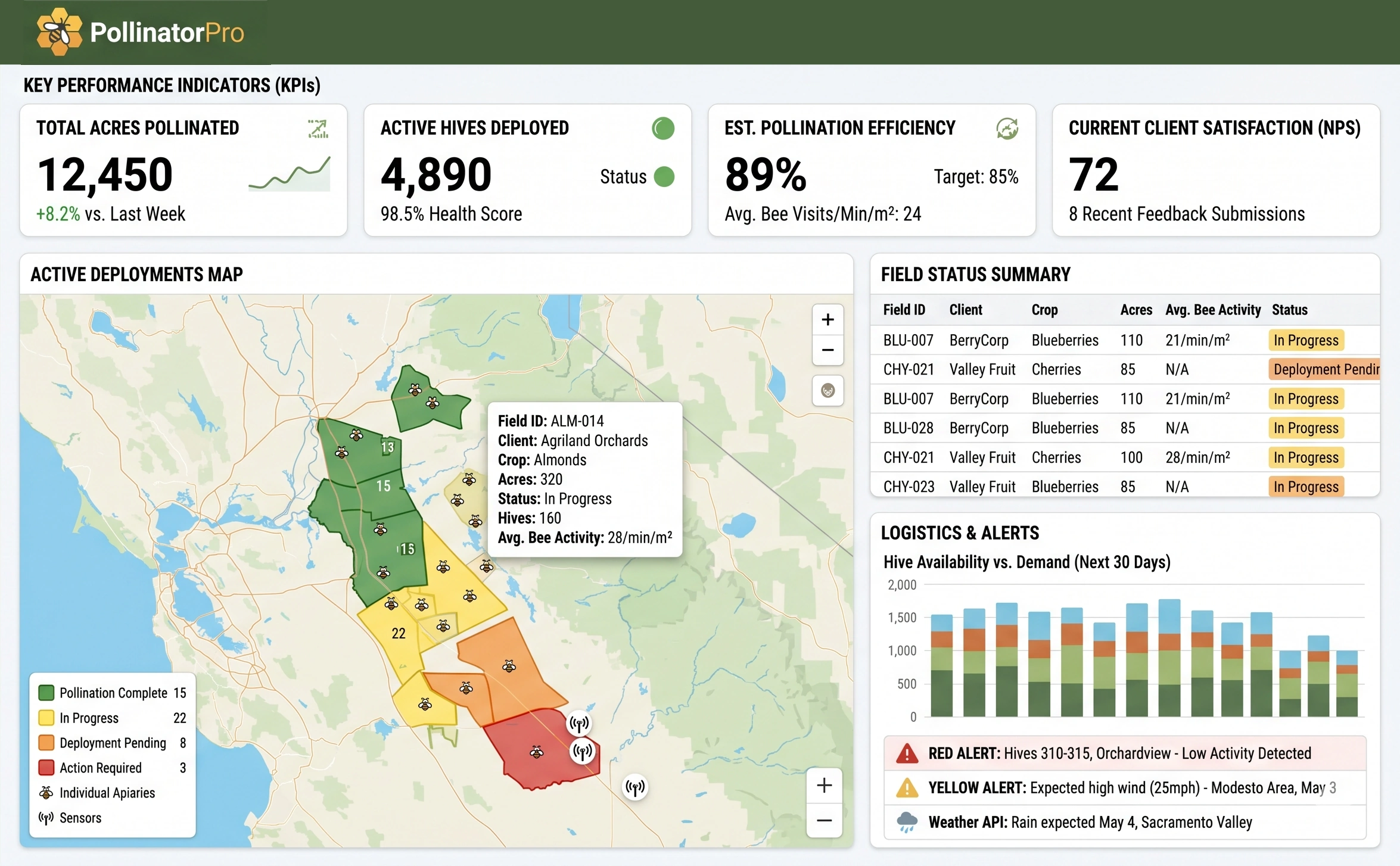
Another key factor was StyleBI’s support for highly interactive, parameter-driven dashboards. Aurora designed a “Pollination Command Center” dashboard where executives start with a national map of active contracts, filtered by crop, region, and risk level. From there, they can drill into a specific state, see hive deployment density versus target stocking rates, and overlay weather risk indicators such as frost probability or high-wind events. A single click can pivot the view from contract status to hive health, showing average colony strength, mite load, and feed consumption for the hives serving that region.
StyleBI also aligned with Aurora’s need for governed self-service. Central data stewards define core metrics—such as “Effective Pollination Days,” “Deployment Compliance,” and “Colony Strength Index”—while regional managers can create their own dashboards and views using those certified definitions. This prevents metric drift while still empowering local teams to answer their own questions without waiting for IT.

The Migration Journey from Mozaïk to StyleBI
Aurora approached the migration in phases to avoid disrupting critical seasonal operations. The first step was to replicate a small set of high-value Mozaïk dashboards in StyleBI, focusing on hive deployment tracking and colony strength monitoring. This allowed the team to validate data connections, performance, and usability with a limited group of power users.
During this phase, Aurora’s data team used StyleBI’s modeling layer to clean up legacy definitions that had grown inconsistent in Mozaïk. For example, different regions had slightly different rules for what counted as “on-time deployment” relative to bloom stage. In StyleBI, they created a unified metric with parameters that could be tuned by crop and region, while still rolling up to a consistent corporate view.
The second phase focused on expanding data sources. Aurora integrated live hive telemetry streams, enabling near real-time dashboards that showed temperature, humidity, and brood patterns at the yard level. They also brought in route optimization data from their logistics system, allowing dispatchers to see which trucks were at risk of missing deployment windows due to traffic, weather, or mechanical issues. StyleBI’s ability to join and filter across these sources without heavy custom coding was a major improvement over Mozaïk.
Training was another critical component of the migration. Instead of treating StyleBI as a tool only for analysts, Aurora designed role-based experiences. Field supervisors received simplified dashboards optimized for tablets, showing only the metrics they needed: hive strength, deployment status, and alerts for at-risk yards. Executives received a strategic view of contract performance, risk exposure, and yield uplift projections. Analysts retained full access to the underlying data mashups and could build exploratory dashboards for R&D questions, such as testing new forage enhancement strategies.

New Dashboards and Use Cases Enabled by StyleBI
Once the core migration was complete, Aurora began to design dashboards that had never been possible in Mozaïk. One flagship example was the “Bloom Alignment and Risk” dashboard. This view combines phenology models, weather forecasts, and hive deployment data to show whether each orchard is likely to have sufficient pollination coverage during peak bloom. Users can simulate scenarios such as moving 10% of hives from one region to another, then see the projected impact on risk scores and contract fulfillment.
Another new use case was colony loss attribution. Previously, Aurora could see overall loss rates by season, but not easily connect those losses to specific environmental or operational factors. In StyleBI, analysts built a model that correlates colony loss with pesticide exposure incidents, forage scarcity indicators, transport duration, and weather extremes. The resulting dashboard helps the company identify high-risk patterns and adjust practices, such as changing transport routes, negotiating spray windows with growers, or increasing supplemental feeding in certain regions.
StyleBI also enabled more transparent reporting to growers. Aurora created shareable, permissioned dashboards that show each grower their hive deployment history, colony strength trends, and pollination coverage relative to contract targets. Instead of sending static PDF reports after the season, Aurora can now provide in-season visibility that builds trust and supports collaborative decision-making, such as adding hives or extending deployment in response to late blooms.

Business Impact of the Switch
The move from Mozaïk to StyleBI produced tangible operational and strategic benefits for Aurora Pollination Services. On the operational side, the company reduced the time required to adjust dashboards or add new data sources from weeks to days, sometimes hours. Regional managers reported that they could answer most of their own questions without exporting data or requesting custom reports, freeing the central analytics team to focus on higher-value modeling work.
Strategically, Aurora gained a clearer view of risk and opportunity across its pollination portfolio. By combining hive health, logistics, weather, and contract data in a single analytics environment, the company could identify under-served orchards, anticipate where additional hives would have the greatest yield impact, and proactively mitigate colony loss risks. This translated into higher contract renewal rates, fewer disputes over perceived under-pollination, and more confident expansion into new regions and crops.
Perhaps most importantly, the switch to StyleBI changed how people at Aurora think about data. Instead of treating analytics as a back-office reporting function, teams across the company now see dashboards as live instruments for steering daily operations. From dispatchers routing trucks to executives planning next season’s capacity, StyleBI has become the shared visual language of the business. Mozaïk helped Aurora take its first steps away from spreadsheets, but StyleBI gave it the agility, depth, and governance needed for the next era of specialty crop pollination services.
Evaluate InetSoft's Visual Analytics Solution
InetSoft's offers a visual analytics solution that is easy to deploy and easy to use for enterprises and mid-sized organizations. View a 2-minute demo or try the solution online for free.
Why InetSoft?
InetSoft's reporting dashboard application is easy enough to be:- Deployed in just weeks
- Learned by end users with minimal training
- Used by any executive without the aid of IT
- Adaptable to changing data and business needs
- Used for data exploration through visualization
- Capable of maximum self-service
- Attract the attention of executives
- Meet the demands of power users
- Scale up for organizations of any size
Evaluate Style Scope from InetSoft. It's Easy. Agile. & Robust.
Register for more info and free software software
About InetSoft
Since 1996 InetSoft has been delivering easy, agile, and robust business intelligence software that makes it possible for organizations and solution providers of all sizes to deploy or embed full-featured business intelligence solutions. Application highlights include visually-compelling and interactive dashboards that ensure greater end-user adoption plus pixel-perfect report generation, scheduling, and bursting. InetSoft's patent pending Data Block™ technology enables productive reuse of queries and a unique capability for end-user defined data mashup.
This capability combined with efficient information access enabled by InetSoft's visual analysis technologies allows maximum self-service that benefits the average business user, the IT administrator, and the developer. InetSoft was rated #1 in Butler Analytics Business Analytics Yearbook, and InetSoft's BI solutions have been deployed at over 5,000 organizations worldwide, including 25% of Fortune 500 companies, spanning all types of industries.
