From Qrvey to StyleBI: How a Biocatalysis Services Company Transformed Its Visual Analysis
Biocatalysis services companies operate at the intersection of biology, chemistry, and industrial manufacturing. They design and optimize enzyme-based processes that power applications in pharmaceuticals, food and beverage, biofuels, and specialty chemicals. Every project generates a complex trail of experimental data, reaction conditions, yields, purity metrics, timelines, and cost models. To stay competitive, these companies must turn that data into insight quickly: which enzyme variants are most promising, which process conditions are robust, and where development bottlenecks are forming.
One mid-sized biocatalysis services company had invested heavily in data collection but struggled to convert that data into clear, actionable visual analysis. They initially adopted Qrvey as their analytics platform, hoping to empower scientists and project managers with self-service dashboards. Over time, however, limitations in flexibility, governance, and advanced visualization began to slow them down. As their client base and project portfolio grew, they realized they needed a more powerful and adaptable solution. That realization led them to StyleBI.

Life with Qrvey: A Good Start, But Not Enough
At first, Qrvey seemed like a reasonable fit. It offered embedded analytics, basic dashboards, and the promise of low-code configuration. The biocatalysis company used it to build simple KPI views for project status, experiment counts, and turnaround times. Scientists could see how many reactions were completed per week, and managers could track high-level pipeline metrics.
However, as the organization matured, their analytical needs became more sophisticated. They wanted to visualize multi-dimensional experiment data: enzyme variant, substrate, temperature, pH, solvent, and yield, all in a single interactive view. They needed to compare process performance across clients, industries, and production scales. They wanted to overlay cost models with technical performance to identify the most commercially viable pathways. Qrvey’s visual and modeling capabilities began to feel constrained, and workarounds multiplied.
Governance also became a concern. Different teams created their own dashboards with inconsistent definitions of “success rate,” “cycle time,” and “on-time delivery.” Without a strong semantic layer and centralized control over metrics, the same question could yield different answers depending on which dashboard a user opened. For a company that needed to present a unified story to demanding pharmaceutical and industrial clients, this inconsistency was unacceptable.

Why StyleBI Entered the Conversation
The company’s head of data strategy initiated a review of alternative platforms, focusing on tools that could handle complex scientific data, support robust governance, and still empower non-technical users. StyleBI emerged as a strong candidate because it combined enterprise-grade data modeling with highly flexible visual analysis and interactive dashboards.
StyleBI’s ability to connect to diverse data sources—LIMS systems, ELNs, ERP, CRM, and custom experiment databases—was particularly attractive. The biocatalysis company had data scattered across multiple systems: reaction results in one database, client contracts in another, and production scale-up metrics in yet another. StyleBI’s data mashup capabilities allowed them to bring these sources together into a unified analytical layer without forcing a disruptive data warehouse project on day one.
Equally important was StyleBI’s support for reusable templates and meta-templates. The company wanted standardized dashboard patterns for enzyme screening, process optimization, and client reporting. With StyleBI, they could define master layouts and KPI definitions once, then reuse them across dozens of client-specific dashboards. This promised a major improvement in consistency and maintainability compared to their fragmented Qrvey environment.

Planning the Migration: From Experiments to Experiences
The transition from Qrvey to StyleBI was not treated as a simple tool swap. The company used the migration as an opportunity to rethink how they presented analytics data to scientists, project managers, and clients. They began by identifying the core decision questions for each audience:
- For scientists: Which enzyme variants and conditions are most promising, and where should we experiment next?
- For project managers: Are projects on time, on budget, and aligned with client expectations?
- For executives: Which clients, industries, and process types are driving the most value?
- For clients: How is the biocatalytic route performing compared to traditional chemistry?
These questions became the backbone of the new StyleBI dashboards. Instead of simply recreating Qrvey views, the team designed dashboards around decisions and workflows. They defined standard KPIs—such as hit rate, average yield, robustness score, and cycle time—and encoded them into StyleBI’s data model. This ensured that every dashboard, regardless of who built it, used the same definitions.

Building Dashboards That Reflect Biocatalysis Reality
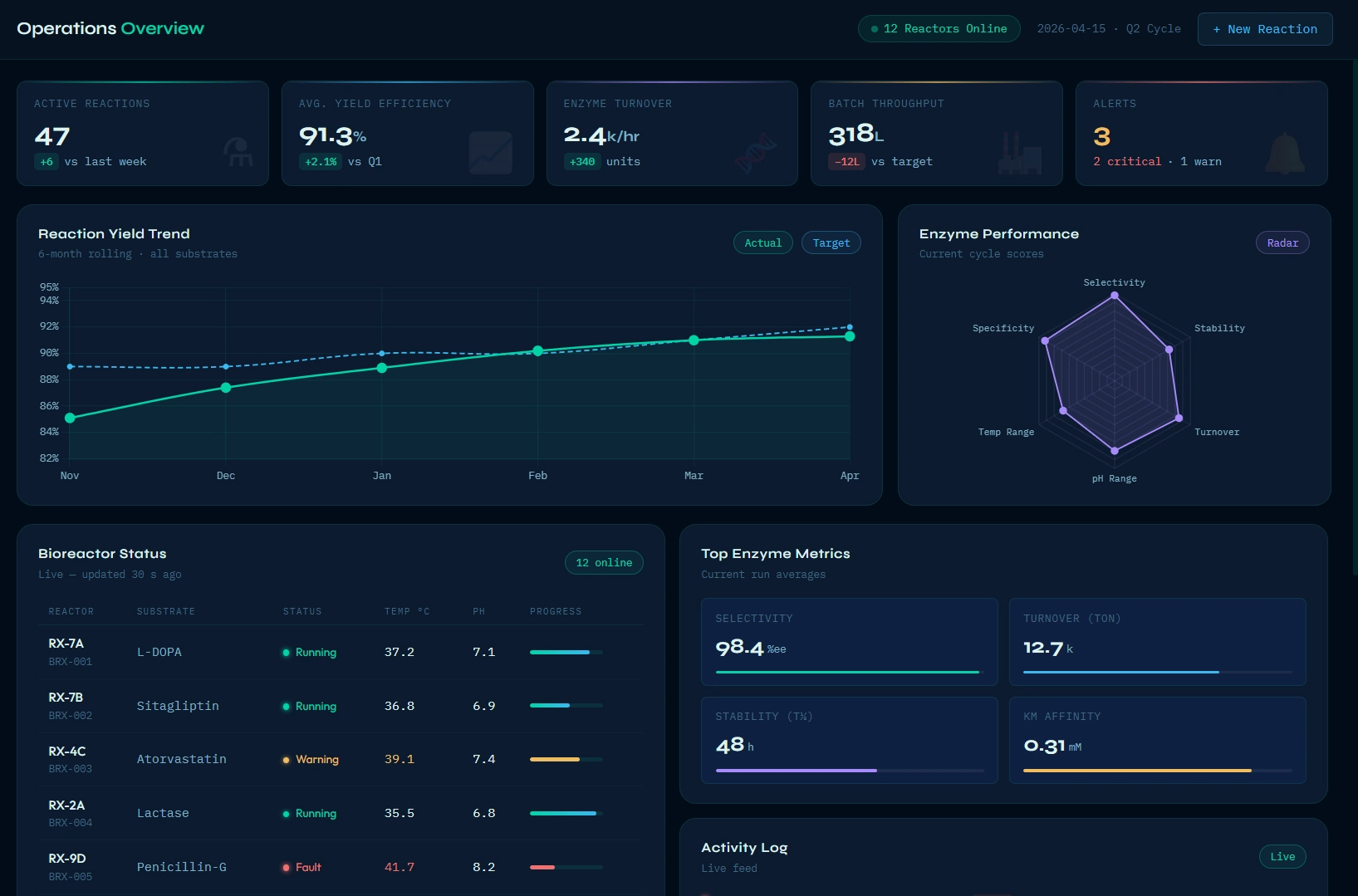
With StyleBI in place, the company created a suite of dashboards tailored to the biocatalysis lifecycle. For early-stage enzyme screening, they built interactive scatter plots and heatmaps that allowed scientists to filter by enzyme family, substrate class, and reaction conditions. Yield, selectivity, and conversion could be visualized simultaneously, with color and size encoding key performance metrics. Scientists could quickly identify promising clusters of conditions and drill down into individual experiments.
For process optimization, they designed dashboards that combined time-series charts, box plots, and control charts. These views helped process engineers understand variability, robustness, and scale-up behavior. They could compare lab-scale and pilot-scale performance, track the impact of parameter changes, and monitor whether processes stayed within predefined control limits. StyleBI’s ability to handle complex filtering and drill-down paths made it easy to move from high-level trends to specific batches or runs.
Client-facing dashboards were built with clarity and storytelling in mind. Instead of sending static PDF reports, the company began offering interactive portals where clients could see progress, performance, and value in real time. Dashboards showed how the biocatalytic route compared to traditional chemistry in terms of yield, waste reduction, energy savings, and timeline. StyleBI’s flexible layout and branding options allowed the company to present these dashboards with a polished, professional look that reinforced their position as a high-tech partner.

Governance, Security, and Collaboration
One of the most significant improvements after switching to StyleBI was the strengthening of governance and security. The company defined a central semantic layer where core metrics, dimensions, and hierarchies were maintained. Only authorized data stewards could modify these definitions, ensuring that KPIs remained consistent across all dashboards. This eliminated the “multiple versions of the truth” problem that had plagued their Qrvey environment.
Role-based access control allowed them to tailor data visibility by user type. Internal scientists could see detailed experiment-level data, while clients saw aggregated, anonymized views that protected proprietary information. Executives had cross-client, cross-project visibility, but sensitive commercial details were restricted to account managers. StyleBI’s security model made it possible to support these nuanced access patterns without building separate, redundant dashboards for each audience.
Collaboration also improved. StyleBI’s interactive features allowed users to annotate dashboards, save filtered views, and share links with colleagues. A scientist could highlight a promising cluster of experiments and send a link to a process engineer, who could then explore the same data with additional filters. Project managers could bookmark specific views for recurring client meetings, ensuring that everyone looked at the same numbers and visuals.

Performance and Scalability Gains
As the company’s data volumes grew, performance became a critical factor. Qrvey had struggled with some of the larger datasets, especially when users applied complex filters or tried to visualize high-density experiment data. StyleBI’s optimized query engine and caching strategies delivered faster response times, even when dashboards pulled from multiple data sources.
This performance boost had a direct impact on adoption. Users were more willing to explore data when dashboards responded quickly. Scientists could iterate through hypotheses in real time, adjusting filters and parameters without waiting for slow reloads. Executives could navigate from high-level summaries to detailed breakdowns during live meetings, making data-driven discussions more fluid and engaging.
Business Impact: From Data to Differentiation
The switch from Qrvey to StyleBI ultimately delivered benefits that went beyond technology. Internally, the company gained a clearer, more consistent view of its operations and scientific performance. They could identify which enzyme platforms were most successful, which industries offered the best margins, and where process development tended to stall. This allowed them to allocate resources more strategically and prioritize high-value opportunities.
Externally, the improved dashboards became a differentiator in client relationships. Prospective clients were impressed by the transparency and sophistication of the visual analysis. Existing clients appreciated being able to see progress and performance in real time, rather than waiting for periodic static reports. In competitive bids, the company could demonstrate not only their scientific expertise but also their ability to communicate results clearly and convincingly.
The migration also changed the culture around data. Instead of treating dashboards as a reporting obligation, teams began to see them as active tools for experimentation, optimization, and decision-making. StyleBI’s flexibility allowed power users to build advanced analyses, while standardized templates ensured that casual users still had access to clean, reliable views. The result was a more data-literate organization that could move faster and with greater confidence.

Lessons Learned from the Transition
Looking back, the biocatalysis services company identified several key lessons from their journey from Qrvey to StyleBI. First, a tool change is most effective when it is tied to a broader rethink of decision workflows and KPI definitions. Simply recreating old dashboards in a new platform would have missed the opportunity to improve clarity and alignment. Second, investing in a strong semantic layer and governance model pays off by reducing confusion and rework. Third, performance and user experience matter as much as features; fast, responsive dashboards drive adoption.
Most importantly, they learned that the right visual analysis platform can amplify scientific and operational excellence. In a field as complex and competitive as biocatalysis, the ability to see clearly—across experiments, projects, clients, and markets—can be the difference between incremental improvement and transformative growth. By moving from Qrvey to StyleBI, this company turned its data from a scattered asset into a strategic advantage.