From Splunk to StyleBI: A Geosynthetics Manufacturer’s Shift to Web-Based Business Intelligence
GeoMatrix Fabrics, a mid-sized geosynthetics manufacturing company, had built its reputation on high-performance geomembranes, geotextiles, and geogrids used in landfills, mining operations, and transportation infrastructure. Its products were mission-critical, buried under highways, lining tailings ponds, and reinforcing embankments where failure was not an option. Over the years, the company invested heavily in process automation, lab testing, and plant-floor instrumentation, but its analytics stack lagged behind the complexity of its operations.
For several years, GeoMatrix relied on Splunk as its primary analytics and monitoring platform. Initially, Splunk was introduced by the IT team to centralize machine logs from extrusion lines, weaving machines, and curing ovens. It quickly became the go-to tool for troubleshooting downtime, monitoring PLC messages, and tracking application logs from the company’s manufacturing execution system (MES). While Splunk excelled at log aggregation and real-time alerting, it was never designed to be the company’s main web-based business intelligence platform.

The Growing Need for True Business Intelligence
As the business matured, new questions emerged that Splunk struggled to answer elegantly. Production managers wanted to correlate tensile strength test results with resin batch data and machine settings. Quality engineers needed to track nonconformance trends by product line, customer, and shift. Supply chain leaders wanted to visualize resin consumption, supplier performance, and inventory turns. Executives asked for margin analysis by product family, region, and project type. These were not log-centric questions; they were classic BI questions that required modeling, governed metrics, and highly consumable dashboards.
The tipping point came when the company launched a strategic initiative to differentiate on quality and traceability. Customers in landfill engineering and mining began demanding richer documentation: roll-level certificates, test histories, and performance dashboards that could be shared with regulators and engineering firms. GeoMatrix realized it needed a web-based BI platform that could serve both internal stakeholders and external partners, with secure, role-based access and interactive dashboards that went far beyond log charts.
After evaluating several options, including extending Splunk with additional modules, GeoMatrix decided to transition to StyleBI as its primary web-based business intelligence platform. The decision was driven by three core needs: a semantic layer that business users could understand, flexible dashboarding for non-technical stakeholders, and a licensing model that made sense for broad deployment across plants, offices, and customer portals.

Limitations of a Log-Centric Platform for Business Intelligence
Splunk had served the IT and operations teams well, but its strengths were also its constraints. The data model was fundamentally event- and log-oriented. While it was possible to ingest structured data from SQL databases and CSV files, building reusable business metrics—such as on-time delivery rate, first-pass yield, or scrap percentage by product—required complex queries that few outside the IT analytics group could maintain.
For example, the quality team wanted a dashboard that showed, for each geotextile product, the distribution of tensile strength, puncture resistance, and permeability over the last 12 months, segmented by plant and resin supplier. In Splunk, this meant stitching together MES logs, lab test records, and ERP data with search processing language queries that were powerful but opaque to non-specialists. Any change in business logic—such as redefining what counted as a “critical defect”—required IT intervention.
Moreover, Splunk’s user experience was optimized for analysts and engineers comfortable with search-driven exploration. Production supervisors, sales managers, and external engineering partners needed something more approachable: curated dashboards, guided filters, and consistent KPIs that could be consumed in a browser without learning a query language. The company began to see that it was forcing a log analytics tool to behave like a full-fledged BI platform, and the friction was growing.

Why StyleBI Fits the Geosynthetics Use Case
StyleBI offered GeoMatrix a web-based BI environment that aligned with how the business actually thought about its data. Instead of starting from raw events, the team could define subject areas such as Production, Quality, Supply Chain, and Sales. Within each area, they modeled entities like resin batch, production order, roll ID, test result, and shipment. This semantic layer allowed business users to drag and drop fields, build ad hoc views, and trust that the underlying joins and calculations were consistent.
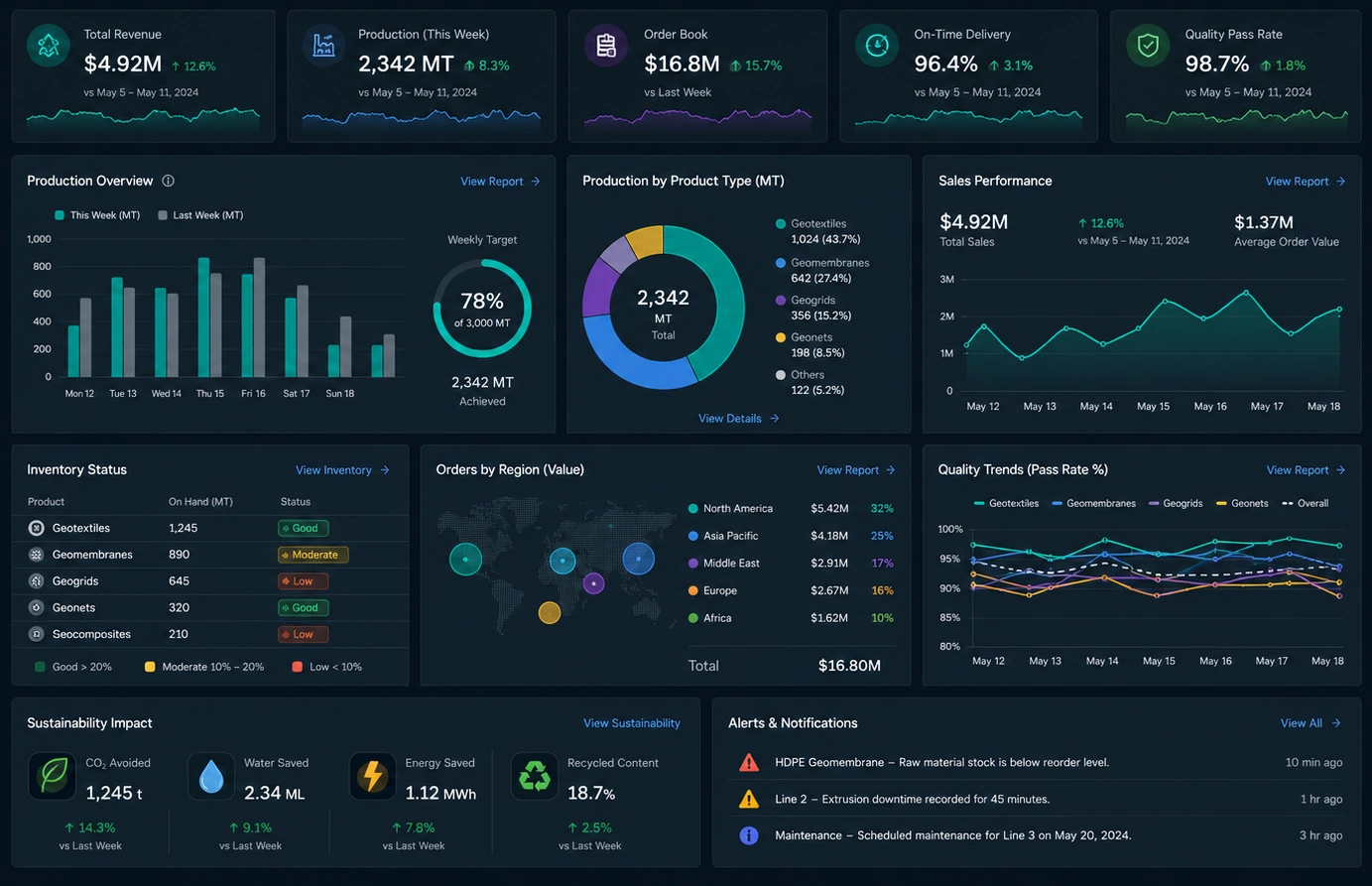
For the manufacturing group, StyleBI enabled dashboards that combined real-time and historical views. A plant manager could open a browser and see, on a single screen, current line speeds, scrap rates, and downtime events alongside weekly trends in yield and energy consumption. Filters allowed them to switch between geomembranes, geotextiles, and geogrids, or drill into a specific product code used in a high-profile landfill project.
The quality team built a “Roll Traceability” dashboard that became a cornerstone of customer conversations. By entering a roll ID, they could instantly see the resin batch, machine settings, operator, shift, and full lab test history. StyleBI’s web-based interface made it easy to share a read-only version of this dashboard with select customers and engineering firms, reinforcing GeoMatrix’s positioning as a transparent, data-driven partner.
On the commercial side, sales and product management used StyleBI to analyze revenue and margin by product family, region, and application segment (landfill, mining, transportation, coastal protection). They could quickly identify which geosynthetic products were gaining traction in specific markets, where price erosion was occurring, and how changes in resin costs were affecting profitability. These were classic BI questions that StyleBI handled naturally through interactive charts, tables, and parameterized reports.

Migration Strategy: From Splunk-Centric to BI-Centric
GeoMatrix did not abandon Splunk overnight. Instead, it reframed the role of each platform. Splunk remained the backbone for log analytics, IT monitoring, and real-time alerting on machine and application events. StyleBI became the system of choice for business intelligence, performance management, and external-facing analytics.
The migration began with a data inventory. The BI team cataloged the key data sources: ERP tables for orders and shipments, MES data for production orders and machine states, LIMS data for lab tests, and supplier data for resin deliveries and certifications. Some of these sources had previously been funneled into Splunk as logs or exports; now they were connected directly to StyleBI through database connections and scheduled ETL processes.
Next, the team identified the “top 10” dashboards and reports that would deliver immediate value. These included a plant performance dashboard, a quality nonconformance dashboard, a roll traceability view, a resin supplier scorecard, and an executive margin overview. By focusing on high-impact use cases, GeoMatrix ensured that stakeholders saw tangible benefits early in the transition, building momentum and buy-in.
Training was another critical component. Instead of teaching business users a query language, the company organized short workshops where participants learned how to navigate StyleBI dashboards, apply filters, drill down into details, and export views for presentations. Power users in each department were given additional training to create and modify dashboards within a governed framework, ensuring consistency in metrics and definitions.

Outcomes and Cultural Shift
Within a year of adopting StyleBI as its web-based BI platform, GeoMatrix saw a noticeable shift in how decisions were made. Plant review meetings moved from static spreadsheets and screenshots to live dashboards where supervisors could explore the data in real time. Quality engineers spent less time manually compiling reports and more time investigating root causes of variation. Sales and product managers came to quarterly reviews armed with interactive views of product performance, not just slide decks.
One of the most significant outcomes was the improvement in customer-facing analytics. For large landfill and mining projects, GeoMatrix began offering project-specific portals where customers could log in and view dashboards on delivery status, test results, and roll traceability. This capability, powered by StyleBI’s web architecture and security model, differentiated GeoMatrix from competitors who still relied on emailed PDFs and static certificates.
Internally, the clear separation of responsibilities between Splunk and StyleBI reduced confusion and tool sprawl. IT continued to use Splunk for what it did best: monitoring logs, detecting anomalies, and supporting incident response. Business users gravitated to StyleBI for performance metrics, trend analysis, and cross-functional insights. The company no longer tried to stretch a log analytics platform into a full BI solution; instead, it allowed each tool to play to its strengths.
For a geosynthetics manufacturer like GeoMatrix, where product performance is tightly linked to process control, material quality, and regulatory scrutiny, the move from Splunk-centric analytics to a StyleBI-centered web BI environment marked a turning point. It aligned the company’s data strategy with its strategic goals: operational excellence, quality leadership, and transparent collaboration with customers and engineering partners.
The story of GeoMatrix illustrates a broader pattern in industrial sectors. As companies mature beyond basic monitoring and troubleshooting, they need platforms that support rich, business-oriented analytics accessible to a wide range of stakeholders. For GeoMatrix, StyleBI became that platform—turning scattered data into a coherent, web-based intelligence layer that now underpins decisions from the plant floor to the boardroom.