Embedding InetSoft Dashboards in Telemedicine Software
Telemedicine has become a critical component of modern healthcare delivery, enabling clinicians to provide care remotely while managing patient data securely. As telemedicine adoption grows, software developers are increasingly tasked with building platforms that not only facilitate virtual visits but also provide meaningful insights into patient engagement, clinical outcomes, and operational efficiency.
For telemedicine software makers, embedding a robust analytics platform like InetSoft offers the ability to deliver interactive dashboards, KPI tracking, and actionable reports directly within the application, enhancing the overall value to both clinicians and administrators.
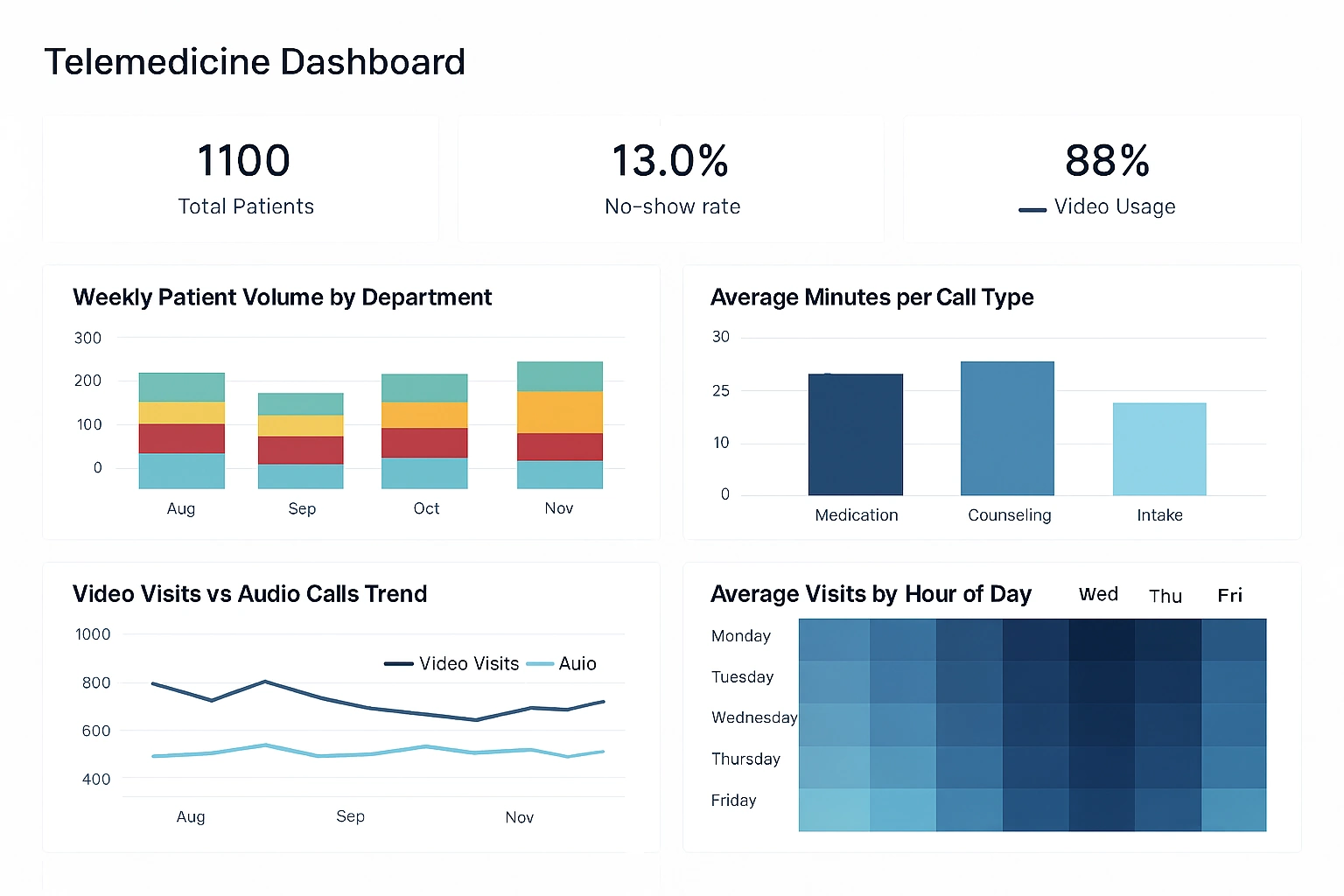

One of the primary motivations for embedding analytics into a telemedicine platform is the need for comprehensive monitoring of key performance indicators (KPIs). Relevant KPIs include patient engagement metrics such as number of virtual visits per provider, average consultation duration, and patient no-show rates. Operational KPIs focus on appointment scheduling efficiency, average wait times, and throughput per clinician. Financial KPIs, including billing accuracy, reimbursement rate, and revenue per visit, are also critical for evaluating the economic health of the telemedicine service. By embedding InetSoft, the software can automatically pull real-time data from electronic health records (EHRs), scheduling systems, and billing modules to calculate and visualize these KPIs without leaving the platform.
Charts are central to communicating these KPIs effectively. Bar charts can compare provider performance or patient engagement across multiple clinics or departments. Line charts and area charts are suitable for tracking trends over time, such as weekly visit volume or monthly revenue growth. Pie charts or donut charts are ideal for visualizing proportional data, for instance, the distribution of visit types, insurance coverage, or patient age groups. Heatmaps can be used to identify peak hours for consultations or geographic regions with higher patient demand. By offering multiple visualization types, InetSoft enables developers to provide intuitive insights that can be customized based on user roles, such as administrators, physicians, or billing teams.
Interactive dashboards enhance the utility of these visualizations by allowing users to drill down into the underlying data. For example, an administrator might begin with a high-level dashboard showing clinic-wide no-show rates. By clicking on a specific provider or location, the dashboard can reveal patient-level details, appointment histories, or demographic insights. Filters enable clinicians to examine specific time ranges, visit types, or patient segments, providing contextual insights that inform operational decisions. InetSoft’s dashboard tools support dynamic linking between charts, meaning that selecting a data point in one chart can automatically update related charts and tables on the same dashboard. This interactivity transforms static data into actionable intelligence, allowing telemedicine teams to respond quickly to trends or anomalies.
Reports complement dashboards by providing detailed, structured views of the data. Scheduled reports can summarize daily, weekly, or monthly activity, such as appointment adherence rates, clinical documentation completion, or billing summaries. For compliance purposes, reports can detail audit trails for patient interactions, ensuring the platform meets regulatory requirements. Custom reports enable healthcare administrators to export specific datasets for internal review or integration with other reporting systems. InetSoft supports both tabular and graphical reporting formats, allowing developers to provide printable, exportable, and shareable insights alongside interactive dashboards.

Implementation Benefits and Technical Considerations
Security and role-based access are critical in a healthcare context, and embedded analytics must adhere to stringent compliance standards. InetSoft allows developers to define access controls so that providers can see only their patients’ metrics, administrators can access organization-wide KPIs, and billing staff can view financial data without exposing clinical details. Row-level security ensures sensitive patient information remains protected, while encryption and secure API integration maintain compliance with healthcare regulations. Embedding analytics directly into the telemedicine application reduces the need for users to log into separate platforms, streamlining workflows while maintaining strict access control.
A practical example of embedded analytics in telemedicine could involve monitoring patient engagement and clinical outcomes simultaneously. A dashboard might show KPIs such as average patient satisfaction score, follow-up adherence rate, and post-visit survey completion rate. Line charts could display trends in patient engagement over time, while scatterplots correlate engagement metrics with clinical outcomes like blood pressure control or diabetes management. Heatmaps might reveal regions with low engagement, guiding marketing or outreach initiatives. Administrators can generate reports summarizing performance across multiple clinics, identifying top-performing providers, and pinpointing areas requiring intervention.
Another application is resource utilization and workflow efficiency. Dashboards can visualize appointment scheduling patterns, clinician availability, and patient wait times. Bar charts might compare provider caseloads, while stacked area charts highlight how resource allocation changes throughout the day or week. KPI alerts can be embedded to notify staff when utilization thresholds are exceeded or when wait times surpass acceptable limits. InetSoft’s analytic components allow developers to implement conditional formatting, such as coloring cells red when KPIs fall below target levels, giving users immediate visual cues. These insights help healthcare operations managers optimize scheduling, balance workloads, and improve patient satisfaction.
Real-Time Monitoring and Alert Systems
Financial oversight is equally important in telemedicine, where reimbursement and billing accuracy directly impact sustainability. Embedded dashboards can track billing metrics such as claims submitted, claims denied, average reimbursement time, and revenue per visit. Line charts and trend analyses can highlight discrepancies or bottlenecks, allowing billing teams to take corrective actions. Pie charts can display the breakdown of claims by insurance provider or visit type. Scheduled reports can automate the delivery of these financial summaries to finance departments or executive teams, ensuring transparency and timely decision-making. By embedding these analytics, developers equip telemedicine platforms with tools for both operational and financial governance.
From a technical perspective, embedding InetSoft into a telemedicine platform involves leveraging APIs, iFrames, or SDK components. Developers can integrate dashboards seamlessly into the application’s interface, maintaining a consistent look and feel. The platform’s data mashup capabilities allow combining disparate sources such as EHRs, scheduling systems, and payment processors to create unified KPIs. Dynamic filtering, drill-downs, and responsive design ensure that dashboards function across desktop and mobile devices, which is essential for clinicians who may be accessing data remotely. Additionally, InetSoft supports multitenancy, enabling healthcare providers or large hospital networks to implement dashboards across multiple sites without duplicating infrastructure.
Customization is another benefit of embedding analytics. Developers can tailor dashboard layouts, chart styles, and KPI calculations to match the needs of different user roles. For instance, clinicians may require metrics focused on patient engagement and outcomes, while administrators prioritize operational efficiency and compliance. Billing teams need financial KPIs visualized differently than clinical metrics. InetSoft’s flexible component model allows embedding interactive charts, tables, and filters that adapt to each role. Users can also personalize dashboards, saving preferred layouts or filters for faster access to frequently used insights.
Embedded analytics in telemedicine software also drives proactive decision-making. By surfacing anomalies such as high no-show rates, low patient satisfaction scores, or reimbursement delays, dashboards allow staff to act before minor issues escalate. Historical data and trend analyses help anticipate seasonal patterns or predict resource demands. Predictive KPIs, such as forecasted patient volume or projected revenue, can be integrated into the dashboards using InetSoft’s calculation and modeling features. These insights support evidence-based management and continuous performance improvement, turning raw operational data into actionable healthcare intelligence.