Choosing InetSoft StyleBI over QlikView
Selecting Business Intelligence (BI) solutions for an organization is hard, risky, and inherently biased. But the process is made easier by the G2 Crowd review platform with its real-time, transparent and unbiased user reviews. This helps an organization to objectively assess what is best by leveraging the wisdom of the crowd, limiting the risk, and finding out what works. The reviews are validated by G2 Crowd thereby helping organizations make better buying decisions.
G2 Crowd recently compared InetSoft StyleBI and QlikView over 6 categories. InetSoft won the majority of ratings in 4 out of 6 categories, averaging with a 4.4 out of 5 in detail categories while QlikView ended up with 4.1 out of 5. Those winning categories are Ratings, Reports, Self Service, and Advanced Analytics. Each category had various individual parameters which will be detailed below.
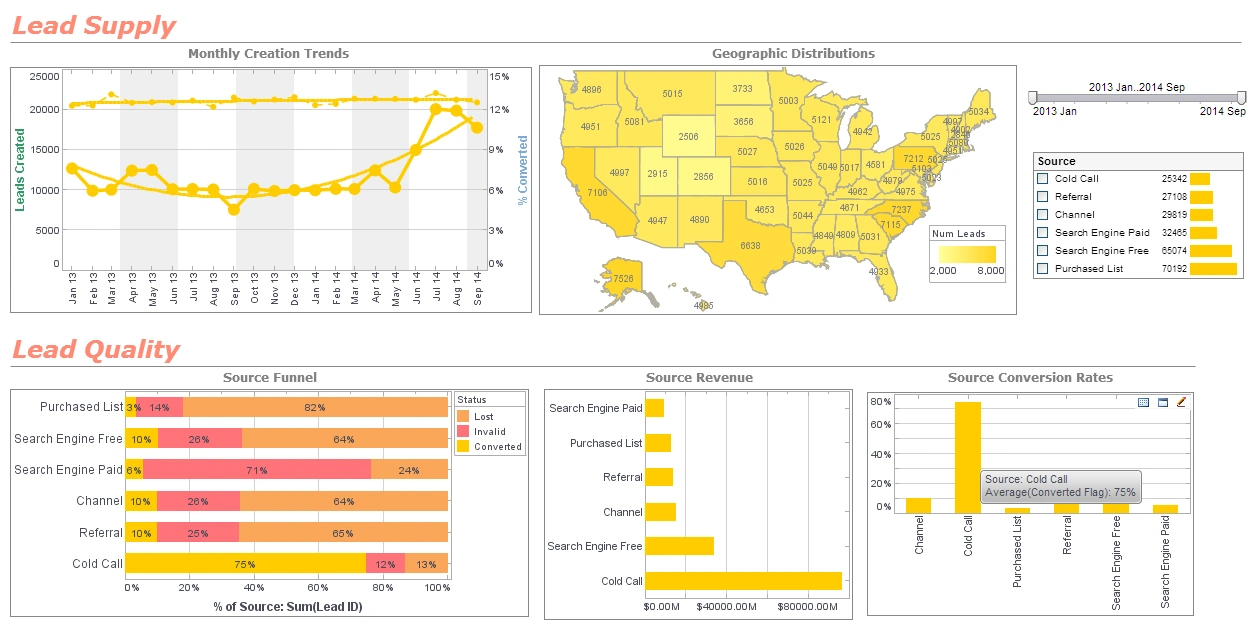

A QlikView Alternative with Enhanced Self Service
InetSoft has done extremely well in general usage ratings - Meeting Requirements, Ease of Use, Ease of Setup, Ease of Admin, Quality of Support, Ease of Doing Business With, and Product Direction. The speed with which dashboards and reports can be churned out has been a great reason for reviewers to recommend Style Intelligence. InetSoft also scored big under Quality of Support with its very responsive support staff and quick resolution to customer queries. The Product Direction parameter was also ranked favorably with the extensive "how to" reference videos on numerous topics and the mentoring service from InetSoft to kick-start an organization's efforts in the BI space.
Reports Interface, Steps to Answer, Dashboards, Scorecards, and Steps to Answer were the parameters where StyleBI was lauded for its robustness and described as a complete and powerful go-to tool for visual data analysis. These parameters were evaluated under the Reports Category aimed to strengthen an organization's reporting by balancing the visual images and the reports in the right proportions to gain valuable insights into critical decisions making.
StyleBI uses the same metadata layer for its reports and dashboards. The advantage of this is that the users can put formulas in one place and the dashboards and reports will show the same results providing a single version of truth. This was evident in the Self Service category where the parameters Calculated Fields, Data Column Filtering, Data Discovery, Collaboration / Workflow, Automodeling were won by InetSoft. Self-service reporting is the natural and prudent evolution of information management. The benefits of decreased time to information and the broadening of information access are key drivers for competitive success of any organization.
List of Areas Where InetSoft Ranked Higher than QlikView
The detailed list of categories & parameters of how InetSoft StyleBI scored over QlikView is presented below. Please click here or the G2 logo to go over the individual reviews.

- Meets Requirements
- Ease of Use
- Ease of Setup
- Ease of Admin
- Quality of Support
- Ease of Doing Business With
- Product Direction (% Positive)
- Data Visualization
- Big Data Service
- Reports Interface
- Steps to Answer
- Score Cards
- Dashboards
- WYSIWYG Report Design
- Integration APIs
- Calculated Fields
- Data Column Filtering
- Data Discovery
- Collaboration / Workflow
- Automodeling
- User, Role, and Access Management
Make Better Decisions with Data Visualization
Another major category win against QlikView is in Data Visualization and Big Data Services under Advanced Analytics. StyleBI's data caching technology enables the management of large volumes of data. The tool also offers various data displays like tabbed interfaces, sliders, calendars etc. StyleBI's capability to provide a balanced BI Platform was well served by these two Advanced Analytics parameters. Prediction (proactive) rather than reporting (reactive), will be the focus of any organization in the current times where analytics of customers' spending behavior are of vital importance.
The Building Reports category saw InetSoft's StyleBI win over Microsoft's QlikView in WYSIWYG Report Design, and Integration APIs, clearly exhibiting InetSoft's capability to mash up disparate data sources and schedule reports automatically. Why is this category of reporting critical? This will help any organization to change reports on the fly. The benefits and flexibility of the StyleBI platform result in enabling an incredibly powerful and distributed development environment that allows all levels of the organization visibility and access to data.
InetSoft helps Organizations with Fact Based Decision Making
G2 Crowd also revealed that InetSoft offered better value in the Customization parameter due to InetSoft's extensible and open architecture that lends itself to superb customization through Java and Javascript.
StyleBI helps any organization to become better at fact based decision making without too much reliance on IT to access critical information. InetSoft helps to eliminate costly delays in decision-making and thereby the unnecessary strain on the IT department.
StyleBI offers a business environment in which business users no longer need to rely on IT, but instead can access and manipulate data on their own. With InetSoft's connectors, the users have the flexibility to tie up with any new data on the run and the ability to do business user level data mashups. This solution allows users to rapidly add new sources from disparate data locations and analyze data side-by-side through both dashboards and reports.
Nopal Cactus Processing Company Migrates From Qlik To StyleBI For Dashboards And Analytics
A mid-sized nopal cactus processing company recently transitioned its analytics and dashboarding platform from Qlik to StyleBI to enhance operational visibility, reduce infrastructure complexity, and provide embedded reporting for production and quality management. The company specializes in converting harvested nopal pads into value-added products, including edible goods, dietary supplements, and natural extracts for cosmetics. Their operations involve multiple stages—harvesting, washing, chopping, drying, extraction, and packaging—each of which generates a steady stream of data requiring real-time monitoring and analytics. The switch to StyleBI was motivated by the need for a lightweight, embeddable platform that could deliver interactive dashboards to both production teams and management without requiring a separate desktop client or complex licensing scheme.
Business drivers for the transition
Operational efficiency and product quality are critical in the nopal cactus processing industry because moisture content, nutrient preservation, and contaminant levels directly impact yield and market value. The company previously relied on Qlik for data visualization and reporting, but it faced challenges in embedding dashboards into the plant floor management systems and mobile devices. License costs were also rising as the number of operational users expanded. StyleBI was selected because it offered a web-first, zero-client architecture with REST APIs and embeddable dashboards that could be integrated directly into the company’s production and ERP systems. This allowed floor operators, quality assurance staff, and managers to access actionable insights in context without additional software overhead.
Key KPIs and visualizations
The new analytics environment was designed around core operational and quality metrics for the nopal processing workflow. Key performance indicators include:
- Moisture content percentage in raw and processed nopal pads
- Extraction yield per batch (kg or liters of extract per kg of raw pads)
- Batch-to-batch nutrient retention levels
- Contaminant and microbial test pass rates
- Production throughput per stage (kg/hour)
- Energy consumption per batch and per unit of extract
- Raw material utilization efficiency
- Packaging defect rate and product quality scoring
StyleBI dashboards include real-time line charts for moisture and nutrient trends, heatmaps tracking contamination hotspots, bar charts comparing batch yields across different suppliers, and scatter plots correlating drying times with extract quality. Mini-dashboards were embedded into operator consoles and mobile tablets to provide immediate visibility into critical production parameters, allowing operators to react quickly to deviations.
Technical advantages realized
StyleBI’s architecture delivered immediate technical benefits for the nopal processing operation. Server-side data mashups allowed combining data from ERP systems, laboratory quality tests, IoT sensors, and production logs without extensive ETL pipelines. This approach minimized data duplication and allowed dashboards to provide up-to-the-minute insights. REST APIs and scripting capabilities enabled programmatic dashboard updates, filter application, and alert triggers based on real-time thresholds for moisture content, extraction yield, or microbial counts. Embeddable dashboards allowed analytics to live directly in production management interfaces, improving decision-making speed and reducing the need to switch between multiple software tools.
Query performance was improved through SQL pushdown and optimized data model design. StyleBI’s ability to inspect emitted SQL queries and fine-tune table definitions ensured that large batch-level datasets could be retrieved efficiently without overloading production databases. This capability allowed the company to provide near-real-time analytics even during peak processing periods.

Operational and cultural improvements
The migration to StyleBI improved both operational workflows and company culture around analytics. Operators gained immediate access to dashboards embedded in the production interface, reducing response times to deviations in drying or extraction processes. Production managers were able to monitor multiple stages of the process simultaneously, identify bottlenecks, and make informed scheduling decisions. Quality assurance teams could track compliance with microbial and nutrient standards across batches and suppliers, enabling faster corrective actions and better traceability.
Culture-wise, analytics became more integrated into daily operations. Staff began suggesting enhancements to dashboard layouts, alert thresholds, and filter logic, which could be implemented quickly due to StyleBI’s flexible architecture. This fostered a sense of ownership and accountability, encouraging continuous process improvement and data-driven decision-making at every level.
Migration approach and risk management
The migration followed a structured, phased approach. First, all Qlik dashboards were inventoried and prioritized based on operational impact. Data definitions, transformation logic, and ETL pipelines were documented to ensure semantic consistency. High-priority dashboards, such as real-time moisture monitoring, batch extraction yield, and quality inspection reports, were rebuilt first in StyleBI and validated against historical outputs. Parallel operation of Qlik and StyleBI dashboards allowed users to verify accuracy and build confidence before fully retiring the legacy platform.
Risks included potential gaps in advanced visualization features and complex calculations. These were addressed by translating Qlik expressions into StyleBI formulas or SQL-based queries. Governance controls were replicated through StyleBI’s role-based access system, ensuring that operators, QA staff, and management had appropriate permissions while maintaining audit compliance. Data lineage and traceability were carefully validated to satisfy internal quality standards and regulatory requirements.

Trade-offs and ongoing considerations
While Qlik offered a mature analytics ecosystem, StyleBI provided agility, lightweight deployment, and embedded capabilities that better matched operational needs. Some legacy dashboards required redevelopment rather than direct migration, which represented a short-term workload increase. The company focused on creating reusable dashboard components and scripting templates to accelerate future development. Continuous monitoring of query performance, dashboard load times, and data quality remains a priority to maintain responsiveness and ensure operational KPIs remain accurate. Plans include expanding embedded dashboards to additional production lines and integrating predictive alerts for early detection of quality deviations.
Business outcomes
Within six months of full deployment, the company reported faster insights into production performance, higher dashboard adoption rates among floor operators, and reduced infrastructure and licensing costs. Real-time monitoring of moisture content, extraction yield, and nutrient retention allowed operators to make immediate adjustments, improving yield and product consistency. Energy and raw material utilization became more transparent, enabling proactive scheduling and cost optimization. Managers gained better visibility into batch quality and supplier performance, facilitating informed procurement and production planning decisions. Overall, the migration to StyleBI provided a lighter, more flexible, and embedded analytics environment, enabling the company to optimize operations, improve product quality, and enhance overall decision-making across the nopal cactus processing workflow.