Switching from DataDog to InetSoft for a Business Intelligence Tool
For a document management and records digitization service company, data is woven into every step of the operation.
From intake and scanning to indexing, storage, and retrieval, each process generates timestamps, volumes, error rates, and service-level metrics that determine profitability and client satisfaction.
For years, the company relied on DataDog to monitor infrastructure, application performance, and some operational metrics.
DataDog excelled at observability: logs, traces, and alerts kept the engineering team ahead of outages and performance issues.
But as the business matured, leadership realized they needed something different for strategic decision-making—a true business intelligence platform.
That realization led them to InetSoft.
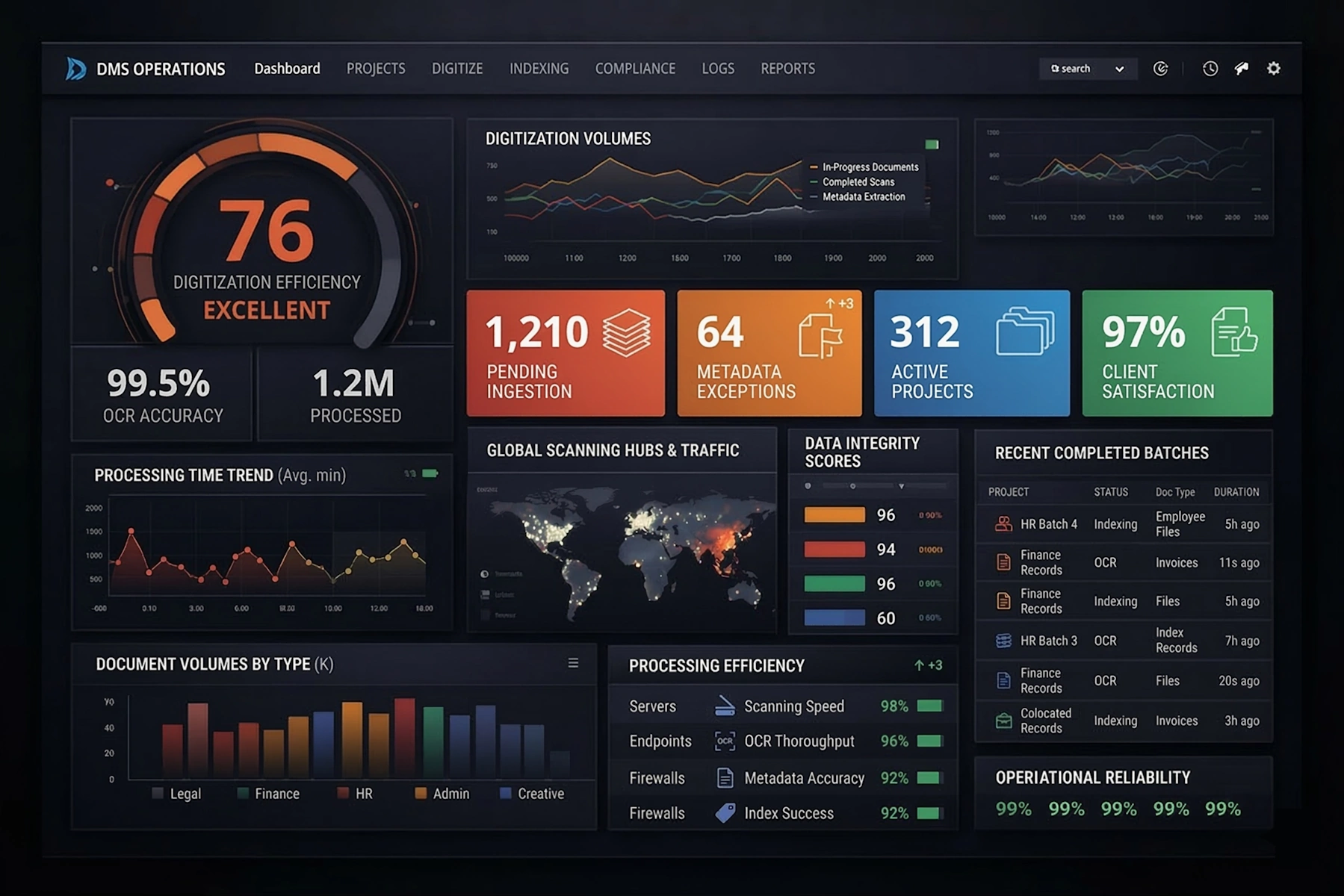

The first major driver of the switch was the gap between technical monitoring and business insight. DataDog was outstanding at telling the company whether systems were healthy, but it was less suited to answering questions like: Which clients are most profitable? Which document types cause the most rework? How do turnaround times vary by site, shift, or client segment? These questions required blending operational data with financials, staffing, and contract terms. InetSoft, as a business intelligence and visual analytics platform, was designed to connect these dots and present them in dashboards that business leaders could actually use.
Another key factor was data modeling and transformation. The company’s data lived in multiple systems: a production scanning platform, a ticketing system, a time-tracking tool, a CRM, and an accounting system. With DataDog, the focus was on ingesting metrics and logs, not on building a semantic layer that business users could understand. InetSoft offered a robust data transformation layer that allowed the analytics team to join, cleanse, and reshape data into business-friendly models. They could define concepts like “job,” “batch,” “client SLA,” and “rework rate” once, then reuse them across dashboards and reports.
This semantic layer became crucial for standardizing KPIs. Previously, different teams calculated metrics in different ways—operations might define “on-time completion” differently than finance or sales. With InetSoft, the company created a governed set of metrics: turnaround time, error rate, rework percentage, revenue per batch, and cost per page. These definitions were embedded in the platform, so every dashboard and report pulled from the same logic. This reduced confusion, shortened meetings, and allowed leadership to focus on decisions instead of debating numbers.
Visualization and storytelling were also significantly improved. DataDog’s dashboards were powerful for engineers, but they were not ideal for executives, account managers, or operations leaders who needed a narrative view of performance. InetSoft allowed the company to design layered dashboards: high-level scorecards for executives, operational views for site managers, and detailed drill-downs for analysts. For example, an executive could see overall SLA compliance across all clients, then drill into a specific client, then into a particular site or document type that was driving delays.

Client-Facing Reporting
The company also needed better support for client-facing reporting. Many of their customers—hospitals, law firms, and government agencies—required regular performance reports showing volumes processed, turnaround times, and error rates. With DataDog, generating these reports meant exporting data and manually building slide decks or spreadsheets. InetSoft’s embedded analytics capabilities allowed the company to create secure, branded portals where clients could log in and view their own dashboards. This not only reduced manual reporting work but also strengthened the company’s value proposition as a transparent, data-driven partner.
Cost structure and value alignment played a role as well. As the company expanded its use of DataDog beyond core infrastructure monitoring, licensing and usage costs grew. Yet many of the business stakeholders still felt underserved because the tool was not optimized for their needs. By shifting business intelligence workloads to InetSoft, the company could keep DataDog focused on what it does best—observability—while using InetSoft for cross-functional analytics and reporting. This division of labor made spending more rational and aligned each tool with its strengths.
The migration process required careful planning and change management. The analytics team began by cataloging the metrics and dashboards that business users relied on, regardless of whether they came from DataDog, spreadsheets, or ad hoc SQL queries. They then designed a new data model in InetSoft, connecting to the company’s databases, cloud storage, and line-of-business applications. Rather than simply replicating old views, they used the opportunity to streamline and improve: consolidating redundant reports, clarifying metric definitions, and designing dashboards around specific decisions and workflows.
Training was essential to adoption. Many managers were used to static reports or basic monitoring dashboards and were initially skeptical of yet another tool. The analytics team created role-based training sessions and starter dashboards tailored to operations, finance, sales, and client services. They emphasized practical use cases: identifying bottlenecks in scanning, tracking SLA risk in real time, and spotting clients whose volumes were trending up or down. As users saw how InetSoft could answer their questions in a few clicks, resistance faded and curiosity grew.
One of the most impactful outcomes was improved operational control. With InetSoft, site managers could monitor throughput by shift, machine, and operator, and correlate that with error rates and rework. They could see when a particular scanner was consistently underperforming or when a specific document type caused indexing delays. This allowed them to adjust staffing, retrain employees, or reconfigure workflows before issues escalated into missed SLAs or client complaints. The same data also fed into continuous improvement initiatives, helping the company refine standard operating procedures.
Strategic Impact
From a strategic perspective, the switch to InetSoft elevated analytics from a reactive, IT-centric function to a core business capability. DataDog remained a critical tool for keeping systems healthy, but InetSoft became the lens through which leadership viewed the business. Quarterly reviews, pricing decisions, capacity planning, and even sales pitches began to rely on InetSoft dashboards and reports. The company could demonstrate, with data, how it met or exceeded SLAs, where it was investing in efficiency, and how clients were benefiting from process improvements.
In the end, the move from DataDog to InetSoft for business intelligence was not about replacing one tool with another, but about recognizing that observability and business analytics serve different purposes. For a document management and records digitization service company, both are essential. DataDog keeps the technical backbone reliable; InetSoft turns the flood of operational and financial data into insight, narrative, and action. Together, they support a more resilient, transparent, and data-driven organization that can scale its services while maintaining the trust of highly regulated clients.

More Articles on Business Intelligence
Drivers of Self-service BI - What are some more drivers of self-service BI? When it comes to business reporting requirements, most of the time business users spend a lot of time explaining what they need to do to the IT teams. After they get the report they spend more time realizing they needed to filter it a certain way, and have to go back and modify the request. The reason for this inefficient cycle is the wrong choice in information management technologies. It must have limitations in terms of the data structure in the data warehouse and in terms of the front end, limitations in formatting capabilities, due to the lack of availability of standard formatted reports and the difficulty of creating ad hoc reports. Business users are heavily dependent on IT in this traditional scenario. With all this difficulty in the daily access of information in the existing BI environment, business users have tended to avoid using the BI tools. The absence of self-service BI, therefore, results in business people make fewer decisions based on fact, or they miss key facts that could be found in the data. This, in turn, results in riskier business performance, if not poorer results in the bottom line...
Easy Business Intelligence - By reducing complexity we have made our BI application easy for IT professionals to implement and easy for business users to learn. The zero-client solution minimizes deployment costs and support overhead. Details: * Minimum specialized IT expertise is required to deploy our software. * No expensive BI experts or consultants are needed. * An IT staffer with basic database admin skills can install and set up the software in weeks, not months..
Easy Reporting Tool - InetSoft's easy reporting tool also features a data grid cache, which automatically updates itself from data sources at a regularly scheduled time. The report wizard also allows users to create their own ad hoc reports to answer specific needs, without help from IT...
Easy to Use BI Tools - Are you searching for a Business Intelligence tool to help you make sense of your copious amounts of data? StyleBI, InetSoft's flagship BI application, can handle large amounts of data to help you identify and develop new opportunities. StyleBI is an all-in-one tool for data mining, data mashup, reporting, and more. Through Style Intelligence, you can analyze your data from different perspectives, turning it from simple numbers to actionable information. The data mining process will help you focus on the most important information that queries and reports can sometimes miss...
Effective Use of Business Intelligence and Information Management Applications - We did see that in the employee size, that did have an impact on how much, how innovative organizations were with respect to the effective use of business intelligence and information management applications. And the logical explanation of that is that in a larger organization they probably have more need to deal with structured information and have more resources also to specialize and dedicate potentially to automating some of the processing of that unstructured information. There are four aspects of maturity. One is technology, so to the extent that an organization could be very mature at looking at unstructured information. They may have people trained in evaluating it. They may have processes in place that are repeatable and shared and documented throughout the organization but they might be doing a lot of it manually. So they would get a very high score on several of the categories but they wouldn’t get as high a score in the technology category and we look at all four of those things together to determine the overall maturity...
Embedded BI - Are you looking to enhance your existing software offering with customizable dashboards and reports? Many enterprise software providers, while being experts in their specific industry areas, do not have the time or expertise to include truly robust visual analytics in their applications. One option for these providers is to embed or OEM an already marketed BI application into their own software. However, providers who do this will want to use a dashboard tool that can blend into their own product seamlessly, absorbing the look and feel of the parent application. Enter InetSoft’s StyleBI, a white-label friendly business intelligence platform featuring...
Emergency Reporting Tools -The answer for emergency reporting is adapting a reporting software that can meet all informational needs through dashboards and reports, without having to rely on a professional analyst or spending copious amount of money on IT setup...

Engine for Business Intelligence - Looking for a flexible and powerful business intelligence engine? InetSoft is a pioneer in dashboard reporting, and our platform includes a data mashup engine for generating complete views of corporate performance. View a demo and try interactive examples...
Enterprise Business Intelligence - An analyst report on the convergence of production and operational reporting and enterprise business intelligence suites and the benefits they offer over "big" BI vendors. There are two significant trends in reporting technology and markets: convergence and emergence. Production reporting has converged with enterprise business intelligence suites to form a next-generation business intelligence software application. Concurrently, new "lightweight" BI and reporting software has been emerging. Years ago, robust enterprise (production and operational) reporting and enterprise business intelligence suites were technologically distinct. Robust reporting supported the need for complex, high-volume, precisely formatted operational reports run offline in scheduled batch mode for distribution to large audiences — push model. The reporting offered in the enterprise business intelligence suite was focused on simple online reporting, graphical presentations, ad hoc reporting and user interaction with the data and featured a metadata layer to simplify end-user querying and reporting — pull model...
Enterprise Business Intelligence Portal Solution - Looking for a good enterprise business intelligence portal solution? InetSoft is a pioneer in self-service BI with a very integratable platform. View a demo and try interactive examples...
Enterprise Business Intelligence Software - BI without the Bloat. Don't want to be saddled with a massive BI software deployment that hogs resources and demands a major hardware investment? Don't want to have to figure out which BI application in the solution is the right one to use for particular dashboard, report, or analysis...

Enterprise Business Intelligence Solutions - Looking for an enterprise business intelligence solution? Try BI without the Bloat. InetSoft offers a small footprint, single application for all dashboard and reporting needs. View a demo...
Enterprise Grade Business Intelligence Solutions - And then on the robust side, the business intelligence solution has been designed to be enterprise grade scalable in terms of having clustering and load balancing and all kinds of security and permission levels that are perfect for either an enterprise deployment or even SaaS based ones operating with a multi-tenancy model. Performance is obviously a big issue, especially with the big data needs out there nowadays. And we have our own proprietary technology that aims to deliver high performance. It’s called Data Grid Cache. It’s the technology that we use for pre-caching the data when you want to fine tune performance in a dashboard or report. By default the product works in live data access mode, but we also have this other capability for caching when performance enhancement is needed. Okay, let’s move on. This next slide is meant to give you an overview of our product offering. The flagship product of InetSoft’s is called StyleBI, and it's in all inclusive BI platform. In its foundation, you have got a strong data access engine and Data Block is one of the technologies that powers it. It's what lets you pick and choose different data fields from data sources and create complex queries and recombine data selections for reuse and sharing among the multiple and dashboard and reports...
Enterprise Intelligence Challenges - Add to all these enterprise intelligence challenges, financial services companies face, all the internal functions and requirements. These things that must be done must be done well to meet regulatory and stockholder demands and to serve customers well. As you can see, we have created a lot of data. And in some cases, this data is the same data from one system to the next, but it's described in a different way. And if you describe data in a different way, you have actually created a new data element and that compounds the problem and makes more complex the ability to use data effectively within the institution. So we are faced with this problem. It's pretty easy to see that the person at the bottom of the screen is a customer using an ATM machine. It's also somewhat easy to ascertain that the person in the middle of the screen is a branch employee helping customers within the branch setting. What's not so clear in the top is whether the two people working remotely are employees or customers. And of course, today, they could be either, and they could be located anywhere in the world...
Enterprise Mashup - A discussion of what an enterprise mashup is, why it is useful, how it is becoming popular, and what makes InetSoft's enterprise mashup capabilities unique. We have been called the first company to try this concept in the business intelligence market, or in the data management field, which was a little surprising to learn. That was recently at a business intelligence conference we participated in. To define enterprise mashup is not very hard. Mashup typically means you are combining a couple of things together that were not really designed to be used together. One of the most famous examples is the mashup of the Google map with something else. Somebody plotted city crime rates on a Google map. Those two things, before had no connection at all, but someone just put it together. An enterprise mashup is when two or more data sources are combined that were not originally modeled in an enterprise BI system or information management system. So our mashup is pretty much the same concept here, only we enable maximum self-service, meaning the average business end user can do a mashup with a simple drag and drop interface...
Entrepreneurial Business Intelligence Tools - Are you looking for the best business intelligence tool for startups? InetSoft partners with entrepreneurs to embed its flexible dashboard BI application, including options for no up-front license investment costs. Solution providers get great-looking web-based dashboards with an easy-to-use drag-and-drop designer. Companies wanting internal BI get personalized handholding for a successful roll-out. Get cloud-flexibility for your deployment. Minimize costs with a small-footprint solution. Maximize self-service for all types of users. No dedicated BI developer required. View a demo and try interactive examples...
ERP Lawson Business Intelligence Alternative - Looking for a good alternative business intelligence solution for Lawson? InetSoft's pioneering BI application produces great-looking cloud-based dashboards with an easy-to-use drag-and-drop designer. Mash up ERP, HCM, general leddger, and other enterprise data for a complete view of performance. Maximize self-service for business and technical staff. View a demo and try interactive examples...