Why A Carbon Capture & Sequestration Services Company Switched From Smashing To StyleBI For Visual Analysis Software
As the carbon capture and sequestration (CCS) industry expands, organizations are managing increasingly complex operations that generate enormous amounts of data. Carbon capture facilities, transportation networks, geological storage sites, environmental monitoring systems, and regulatory compliance programs all produce valuable information that must be analyzed quickly and accurately. For many companies, the ability to transform this data into actionable insights has become a competitive advantage.
One carbon capture and sequestration services company found itself facing this exact challenge. The organization had relied on Smashing for visual analysis and reporting for several years. While the platform initially met basic reporting needs, growing operational complexity exposed limitations that made it difficult for users to obtain timely insights. After a detailed evaluation process, the company selected StyleBI as its replacement visual analysis platform.
The migration provided substantial improvements in dashboard flexibility, self-service analytics, reporting efficiency, data integration, and executive visibility. The transition ultimately helped the company turn its growing data assets into a strategic resource.

Managing A Rapidly Expanding Data Environment
The company operated multiple carbon capture facilities that collected operational data around the clock. Sensors monitored capture efficiency, compressor performance, pipeline conditions, injection rates, storage pressures, and environmental measurements. Additional information flowed from maintenance systems, financial applications, laboratory databases, and regulatory reporting systems.
As the business expanded, the amount of data increased dramatically. New facilities generated additional streams of information while regulatory requirements demanded more detailed reporting. Management teams needed visibility into performance across all operations, while engineers required deeper analytical capabilities to optimize capture and storage processes.
Although Smashing provided reporting functionality, users increasingly found it difficult to create new analytical views quickly. As business requirements evolved, requests for custom reports and dashboards accumulated faster than the analytics team could deliver them.
Leadership recognized that the organization needed a more scalable and flexible analytics solution.
Seeking Greater Visibility Into Carbon Capture Operations
One of the company's primary goals was to improve operational visibility across its facilities. Carbon capture systems involve numerous interconnected processes, and even small performance changes can significantly affect efficiency and profitability.
Operations managers wanted to monitor key performance indicators in real time, identify emerging issues before they became costly problems, and compare performance across multiple facilities. Engineers needed the ability to analyze equipment behavior, evaluate process adjustments, and investigate anomalies quickly.
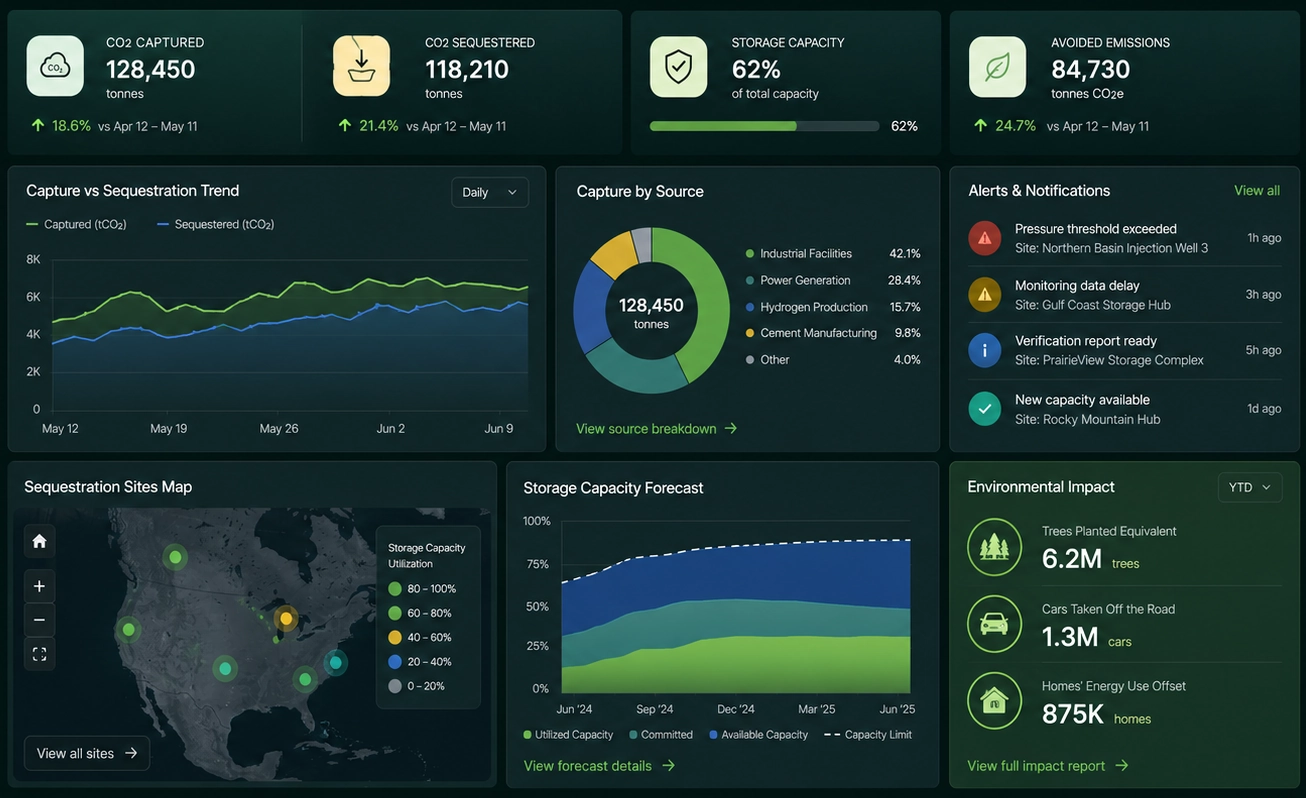
StyleBI provided a centralized environment where data from multiple systems could be combined into interactive dashboards. Users gained access to operational metrics that previously required multiple reports and applications to analyze.
The improved visibility enabled faster decision-making and helped teams respond more effectively to changing operating conditions.
Improving Dashboard Customization
The company's departments had very different reporting needs. Executives required high-level strategic summaries. Engineers focused on operational efficiency metrics. Environmental compliance teams tracked monitoring and reporting requirements. Maintenance personnel needed equipment reliability information.
Under the previous system, creating dashboards tailored to each audience often required extensive effort. Users frequently had to work with generic reports that did not fully address their specific requirements.
StyleBI offered significantly greater dashboard customization capabilities. Teams could create role-specific dashboards that displayed the most relevant information for their responsibilities. Interactive visualizations allowed users to explore details while maintaining an overall view of performance.
This flexibility improved user satisfaction and increased adoption throughout the organization.
Enabling Self-Service Analytics
A major challenge with the previous platform was the reliance on technical specialists for report development. Whenever departments needed new metrics, modified visualizations, or additional analyses, they typically submitted requests to the analytics team.
As demand grew, report development backlogs became increasingly common. Business users often waited extended periods for relatively simple changes.
StyleBI's self-service analytics capabilities significantly reduced this dependency. Business users gained the ability to build dashboards, modify visualizations, and explore data using intuitive drag-and-drop tools.
Instead of relying entirely on developers and analysts, departments could answer many of their own questions independently. This accelerated decision-making while allowing technical resources to focus on more advanced analytical projects.

Connecting Data Across Multiple Systems
Carbon capture operations depend on information stored across numerous systems. Process historians track operational performance. Environmental monitoring systems record emissions and storage metrics. Enterprise applications manage financial data and business processes.
Generating comprehensive insights often required combining information from multiple sources. This proved challenging within the company's previous environment.
StyleBI's data integration and mashup capabilities enabled analysts to connect diverse systems and create unified views of business performance. Operational, financial, maintenance, and environmental data could be analyzed together within a single dashboard.
This holistic perspective helped users identify relationships and trends that previously remained hidden.
Accelerating Analytics Development
The CCS industry continues to evolve rapidly. New regulations, technologies, and business opportunities create constant demand for updated analytics and reporting capabilities.
The company needed a platform that would allow it to respond quickly to changing requirements. Under the previous system, dashboard development often involved lengthy implementation cycles.
StyleBI's visual design environment streamlined dashboard creation and report development. Reusable components and intuitive development tools reduced the time required to deliver new analytics solutions.
As a result, departments could gain access to critical information faster and adapt more quickly to changing business conditions.

Supporting Executive Decision-Making
Executives required visibility into a wide range of strategic metrics, including capture volumes, sequestration effectiveness, project economics, operational performance, and regulatory compliance.
Before the migration, assembling executive reports often involved gathering information from multiple systems and manually consolidating data.
StyleBI provided executive dashboards that delivered a comprehensive view of organizational performance. Leaders could monitor key indicators in real time and drill into specific areas when additional detail was needed.
This enhanced visibility supported more informed decisions regarding investments, operational improvements, and growth initiatives.
Strengthening Regulatory Compliance Reporting
Compliance reporting represents a critical responsibility for carbon capture and sequestration providers. Organizations must demonstrate accurate measurement and verification of captured and stored carbon dioxide.
The environmental compliance team required reliable reporting processes that could support audits, inspections, and regulatory submissions.
StyleBI simplified these activities by centralizing relevant data and automating many reporting tasks. Compliance teams gained easier access to required information while reducing the effort needed to prepare reports.
Improved reporting consistency also strengthened confidence in regulatory submissions and internal reviews.

Preparing For Future Growth
The company anticipated substantial growth over the coming years. New facilities, expanded infrastructure, and additional sequestration projects would significantly increase data volumes and analytical requirements.
Leadership wanted confidence that the selected platform could scale alongside the business.
StyleBI's architecture provided the flexibility needed to accommodate growing user populations, larger datasets, and increasingly sophisticated analytical workloads. The company could continue expanding its analytics capabilities without worrying about outgrowing the platform.
This scalability helped ensure that analytics would remain a business enabler rather than becoming an operational constraint.
Reducing Total Cost Of Ownership
Beyond functionality, the company carefully evaluated the financial implications of each platform. Management considered software licensing, implementation costs, ongoing administration, training requirements, and long-term scalability.
StyleBI's ability to consolidate reporting, dashboards, and self-service analytics within a single platform contributed to a lower overall cost profile. The organization reduced dependence on multiple reporting tools and minimized the need for extensive custom development.
In addition, the increased productivity of business users and analysts generated operational efficiencies that extended well beyond software licensing costs.
Results Of The Migration
Following the transition to StyleBI, the company experienced measurable improvements across its operations. Dashboard development became faster, users gained greater independence, and executives obtained more timely access to critical information.
Engineering teams improved visibility into facility performance. Compliance groups streamlined reporting activities. Analysts spent less time fulfilling routine report requests and more time supporting strategic initiatives.
The organization also established a stronger analytical foundation capable of supporting future expansion throughout its carbon capture and sequestration operations.
More Flexible, Scalable, and User-Friendly
Carbon capture and sequestration companies operate in an increasingly data-driven environment where operational performance, environmental compliance, and financial success depend on timely access to accurate information.
By switching from Smashing to StyleBI, this organization gained a more flexible, scalable, and user-friendly visual analysis platform. The migration improved dashboard customization, self-service analytics, data integration, executive reporting, and compliance monitoring.
Most importantly, the company transformed analytics into a strategic capability that supports every level of the business. With StyleBI in place, the organization is better equipped to optimize operations, support growth, meet regulatory requirements, and maximize the value of its carbon capture and sequestration investments.