Production Dashboard Example
Enhance your business with InetSoft's StyleBI platform. This platform allows users of all skill levels to create interactive dashboards which are shareable across all devices.
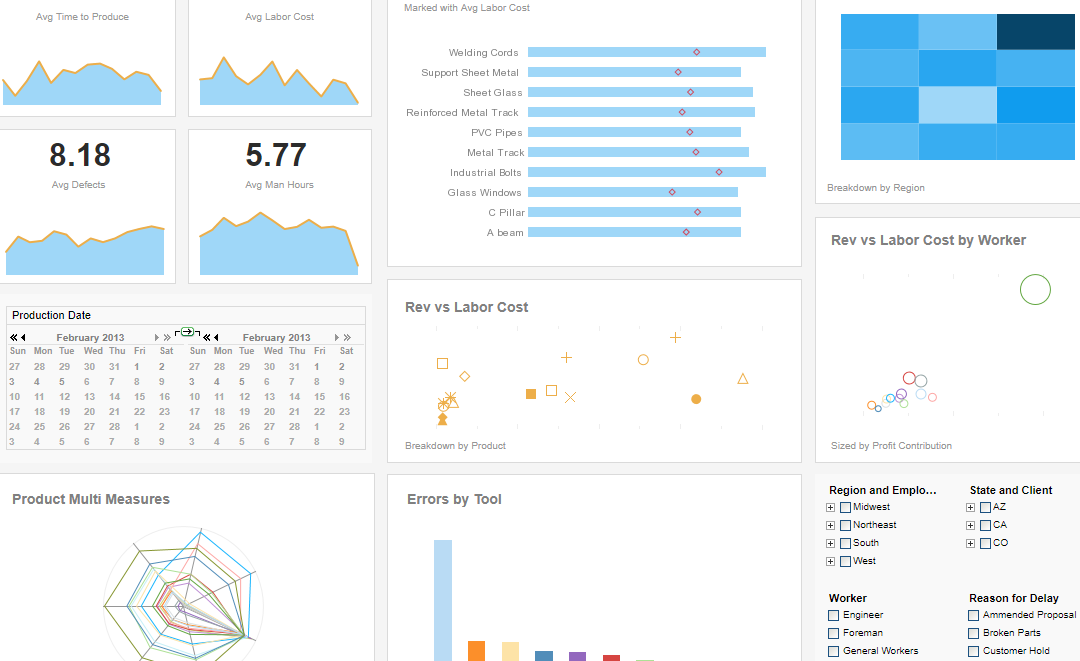
Using production performance data to create metrics for companywide use, InetSoft's production dashboard application measures output performance and identifies input problems, enabling production managers to face any challenge with ease. Designed with accessibility in mind, businesses can easily adopt this solution.
The sample dashboard displayed enables the production manager to track the following:
- Number of goods being produced without error
- Delays caused by machine downtime
- Errors caused by workers
Whereas an executive of the company can:
- View company profits by product type
- Find out who are the major customers
- Evaluate safety procedures by measuring worker injuries
InetSoft's Advantages
With a manufacturing and production dashboard created utilizing InetSoft's BI tool, companies can manage and audit the manufacturing process. Workers and managers are able to communicate and monitor their activity, as well as receive real-time alerts of under-performance or deviations from plans. Businesses have the advantage of developing and progressing confidently knowing they are on the right path.
Industry KPI Articles and Summaries
-
Track Burn Rate And Runway Consistently
This article explains why startups need a disciplined KPI framework to avoid financial surprises and extend operating runway. It emphasizes recurring monitoring of cash flow, burn rate, gross margin, and customer acquisition cost to support healthy growth. The guidance connects metric tracking to better budgeting, fundraising readiness, and resource allocation decisions. It also highlights how poor financial visibility is one of the most common causes of startup failure. Teams that operationalize these KPIs can identify risk early and act before small issues become major setbacks.
-
Gauge Engagement Traffic And Lead Quality
This article outlines a KPI model for content marketing teams that need clearer attribution and performance reporting. It focuses on practical measures such as engagement trends, conversion rates, qualified leads, and channel-level contribution. The guidance explains how the right chart selection improves interpretation speed for both executives and campaign operators. It also stresses that dashboard value depends on aligning metrics with business outcomes rather than vanity numbers. Organizations using this approach can optimize content investments and improve campaign ROI over time.
-
Measure Claims Accuracy And Turnaround Quality
This article describes KPI priorities for insurance operations where speed and correctness directly affect customer trust. It highlights claims processing time, cycle time, accuracy rate, and error frequency as core performance measures. The article explains how these metrics expose workflow bottlenecks and compliance gaps across intake, adjudication, and payment stages. It also shows how tighter measurement helps teams reduce rework and improve service consistency. Insurers that track these indicators well can raise operational efficiency while improving claimant experience.
-
Improve Daily Active User Retention Curves
This article presents KPI categories for gaming application developers who need to balance growth, engagement, and monetization. It covers DAU, MAU, session length, installs, and cohort retention as foundational indicators. The guidance explains how these metrics reveal both short-term campaign impact and long-term product stickiness. It also connects KPI interpretation to product iteration decisions such as feature tuning and onboarding improvements. Teams that monitor these trends systematically can retain more players and scale acquisition more efficiently.
-
Optimize Asset Availability With Maintenance Metrics
This article details how enterprise asset teams use KPI tracking to improve reliability and reduce downtime risk. It emphasizes asset utilization, availability, mean time between failures, and mean time to repair. The article explains that combining these indicators creates a balanced view of performance and maintenance effectiveness. It also shows how KPI trends support better planning for labor, parts, and preventive interventions. Organizations applying these measures can increase uptime and improve return on asset-heavy operations.
-
Reduce Wind Turbine Downtime Through Forecasting
This article focuses on KPI tracking for mobile wind turbine service teams operating across distributed sites. It highlights availability, downtime, and failure interval metrics as the basis for reliability management. The page explains how mobile analytics access helps technicians and managers respond faster when performance degrades. It also connects KPI monitoring to stronger maintenance scheduling and better field productivity. Utility operators using these measures can increase energy output while reducing avoidable service delays.
-
Track Refinancing Success Rate And Savings
This article describes KPI strategy for debt refinancing organizations that need clear proof of customer financial impact. It emphasizes portfolio value, refinancing success rate, and average interest reduction as core outcomes. The guidance shows how these indicators help quantify both operational effectiveness and customer benefit. It also points to KPI visibility as a way to improve prioritization and process refinement across underwriting and advisory workflows. Firms that manage these metrics well can improve win rates and strengthen client trust.
-
Monitor On Time Performance And Capacity
This article outlines KPI frameworks rail operators use to maintain reliability, safety, and financial health. It highlights on-time performance, schedule adherence, and utilization metrics as daily operating essentials. The guidance explains how these indicators reveal service friction points and inform route-level planning decisions. It also links KPI tracking to customer satisfaction, regulatory accountability, and cost control. Transit teams that use this KPI discipline can improve service consistency while managing system complexity more effectively.
-
Lower Cart Abandonment With Checkout Insights
This article explains which e-commerce KPIs matter most when optimizing shopping cart performance and conversion flow. It emphasizes conversion rate, abandonment rate, average order value, and checkout progression metrics. The article shows how these indicators identify friction caused by pricing presentation, shipping surprises, and payment steps. It also reinforces the value of comparing KPI movement after UX and promotion changes. Retail teams that act on these metrics can increase completed orders and improve overall online revenue efficiency.
-
Analyze Booking Value Listing Growth Trends
This article presents KPI priorities for homestay marketplace analysts balancing supply growth and booking quality. It covers total bookings, gross booking value, net booking revenue, and listing growth rate. The page explains how these metrics connect marketplace liquidity with monetization performance. It also highlights KPI segmentation as critical for understanding host-side and guest-side behavior changes. Platforms that continuously track these measures can improve growth strategy and strengthen marketplace health.
-
Track Infrastructure Quality And Service Reliability
This article explains how city managers use KPI systems to monitor livability, efficiency, and long-term planning progress. It highlights economic indicators, infrastructure condition, utility reliability, and service delivery outcomes. The guidance shows how these measures support smarter budgeting and objective prioritization across departments. It also emphasizes KPI visibility as essential for public accountability and transparent performance communication. Municipal teams using this framework can allocate resources more effectively and improve resident outcomes.
-
Increase Basket Size Through Merchandising KPIs
This article details KPI tracking for grocery operations where margin and throughput depend on daily execution quality. It emphasizes sales revenue, sales growth, basket size, and inventory-related measures for fast decision cycles. The page explains how a unified dashboard helps managers react quickly to demand shifts and assortment issues. It also links KPI reviews to improved promotion planning and staffing alignment. Grocery leaders who monitor these indicators consistently can improve profitability while maintaining better customer experience.