An Eco‑Friendly Packaging Company’s Switch from From Astrato to StyleBI for BI Software
GreenPack Solutions is a mid-sized manufacturer of eco‑friendly packaging materials, supplying compostable mailers, molded fiber trays, and plant-based films to consumer brands across North America and Europe. As demand for sustainable packaging surged, so did the complexity of its operations: new product lines, multi-country regulations, volatile raw material prices, and a rapidly expanding customer base. Leadership knew that decisions about capacity, pricing, and sustainability claims could no longer be made on spreadsheets and siloed reports.
A few years earlier, GreenPack had adopted Astrato as its primary business intelligence (BI) front end. Astrato gave the team a modern, cloud-based visualization layer and helped them move beyond static reports. But as the company’s data landscape and stakeholder needs evolved, Astrato’s limitations became more visible. When the time came to re-evaluate their analytics stack, GreenPack chose to migrate to StyleBI, seeking deeper modeling flexibility, stronger self-service capabilities, and a platform that could keep pace with their sustainability-driven growth.
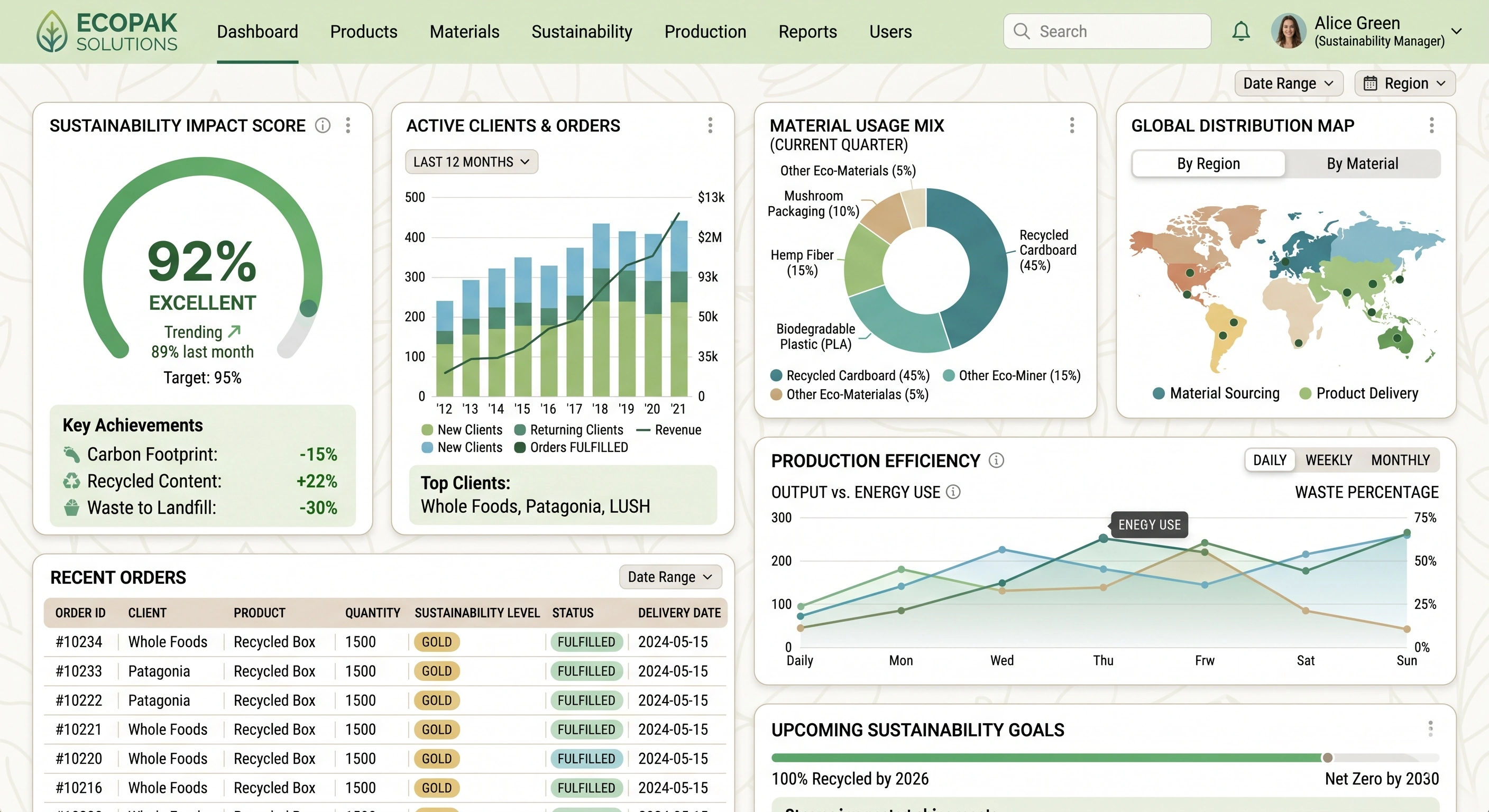

Why Astrato Started to Fall Short
Astrato initially appealed to GreenPack because of its tight integration with cloud data sources and its visually polished dashboards. For the operations and sales teams, it was a clear step up from emailed spreadsheets and ad hoc exports from the ERP system. However, as more departments tried to use the platform, several pain points emerged.
First, the company’s data model had grown more complex. GreenPack tracked not only standard metrics like revenue, margin, and on-time delivery, but also lifecycle emissions, recycled content percentages, and compliance indicators for different regions. Building and maintaining these metrics in Astrato required a level of technical skill that many business users did not have. The BI team became a bottleneck, constantly fielding requests for new calculated fields, filters, and variants of existing dashboards.
Second, Astrato’s governance model did not fully align with GreenPack’s needs. As more users created their own dashboards, it became difficult to ensure that everyone was working from the same definitions of “carbon intensity per unit,” “recycled content share,” or “on-time in-full.” Different teams sometimes used slightly different formulas or filters, leading to conflicting numbers in meetings and eroding trust in the data.
Third, the company wanted to embed analytics more deeply into its customer portal and internal applications. Astrato’s embedding options were serviceable but limited in terms of customization and control over the user experience. GreenPack’s product and IT teams wanted a BI platform that could act as a true analytics engine behind multiple applications, not just a standalone dashboard layer.

Why StyleBI Emerged as the Right Fit
When GreenPack evaluated alternatives, they focused on three criteria: modeling flexibility, governed self-service, and embeddable analytics. StyleBI stood out because it combined a robust semantic layer with a visual, web-based environment that non-technical users could navigate without sacrificing control or consistency.
The semantic layer was particularly important. GreenPack’s data team could define core business entities—such as product families, material types, plants, customers, and regions—along with standardized measures for cost, emissions, and service levels. Once defined, these metrics became reusable building blocks that business users could drag and drop into their own dashboards and reports. This approach reduced the risk of metric drift and ensured that sustainability KPIs were calculated consistently across the organization.
StyleBI’s self-service capabilities also aligned with GreenPack’s culture. Sustainability managers, plant supervisors, and account executives could build their own views without writing SQL or complex expressions. The interface allowed them to filter by material composition, packaging format, or customer segment, and to slice performance by plant, region, or time period. The BI team shifted from being report builders to being enablers and stewards of the data model.
Finally, StyleBI’s embedding options gave GreenPack the flexibility it needed. The company could integrate interactive dashboards directly into its customer portal, allowing brand clients to monitor their packaging mix, emissions trends, and on-time delivery performance. Internally, the operations team embedded StyleBI views into their production scheduling tools, giving planners real-time visibility into capacity utilization and order backlogs.

Planning the Migration from Astrato to StyleBI
GreenPack approached the migration as both a technical project and a change management initiative. Rather than simply recreating every Astrato dashboard in StyleBI, they used the transition as an opportunity to rationalize and streamline their analytics portfolio.
The first step was to inventory existing Astrato content. The BI team cataloged dashboards, reports, and data sources, tagging each asset by owner, department, usage frequency, and business purpose. Many dashboards were duplicates or minor variations of each other, created over time to answer slightly different questions. This inventory helped the team identify which content truly needed to be migrated and which could be consolidated or retired.
Next, they designed the StyleBI semantic model. Working with finance, operations, and sustainability leaders, the data team defined a core set of dimensions and measures that would serve as the foundation for most analyses. For example, they standardized the calculation of “emissions per thousand units,” “recycled content percentage,” and “on-time in-full by customer.” These definitions were documented and agreed upon before any dashboards were built.
With the semantic model in place, the team began rebuilding priority dashboards in StyleBI. They started with a small set of high-impact use cases: executive performance overviews, plant operations dashboards, and sustainability scorecards. For each, they worked closely with business stakeholders to refine layouts, filters, and drill paths, ensuring that the new dashboards were not just replicas of the old ones but improvements in clarity and usability.
Throughout the migration, GreenPack ran Astrato and StyleBI in parallel. Users could continue to rely on familiar Astrato dashboards while gradually adopting the new StyleBI views. This reduced disruption and allowed the team to validate that numbers matched across platforms before decommissioning the old environment.
Impact on Operations and Sustainability Decision-Making
Within months of going live with StyleBI, GreenPack began to see tangible benefits. One of the most visible changes was in plant operations. Supervisors now had a single, consolidated dashboard showing throughput, scrap rates, energy consumption, and emissions intensity by line and shift. Because the data was refreshed frequently and presented in a consistent format, supervisors could spot anomalies quickly and take corrective action.
For example, one plant noticed that a particular line’s emissions per thousand units had drifted upward over several weeks. Using StyleBI’s drill-down capabilities, the team traced the issue to a change in material mix and a subtle shift in machine settings. Adjusting the process brought emissions back in line and reduced energy costs, a win for both sustainability and profitability.
On the commercial side, account executives used StyleBI to have more informed conversations with customers. Embedded dashboards in the customer portal allowed brands to see how their packaging portfolio was evolving: the share of recycled content, the balance between different packaging formats, and the emissions associated with each product line. When customers asked about the impact of switching from one material to another, account executives could use StyleBI scenarios to illustrate trade-offs between cost, lead time, and environmental impact.
The sustainability team, meanwhile, gained a more reliable foundation for reporting and goal tracking. Because key metrics were defined centrally in the semantic layer, they no longer had to reconcile conflicting numbers from different reports. They could track progress toward emissions reduction targets, recycled content goals, and waste reduction initiatives with greater confidence and transparency.

Cultural Shift: From Reports to Conversations
Perhaps the most important change was cultural. Under the old setup, analytics often felt like a separate activity—something done by analysts and presented to others. With StyleBI, data became more embedded in everyday conversations. Plant meetings, sales reviews, and sustainability check-ins all revolved around live dashboards that participants could interact with directly.
Non-technical users felt more ownership of the numbers because they could explore them without waiting for a specialist to build a custom report. At the same time, the governance built into the semantic model ensured that this freedom did not come at the cost of consistency. Everyone was “speaking the same language” when it came to metrics, which reduced friction and sped up decision-making.
For GreenPack, the move from Astrato to StyleBI was not just a tool swap; it was a strategic shift in how the company used data to drive its mission. In an industry where sustainability claims must be backed by credible, granular evidence, having a BI platform that can unify operations, finance, and environmental metrics is a competitive advantage. StyleBI gave GreenPack the structure, flexibility, and reach it needed to turn its growing data assets into a clearer, more actionable picture of how to build a more sustainable packaging future.