Designing Parameter Reports: How Dynamic Inputs Transform Reporting Efficiency and Accuracy
Parameter reports have become an essential capability in modern Business Intelligence environments.
As organizations generate more data and require increasingly personalized insights, the ability to dynamically filter, customize, and automate report output has shifted from a convenience to a necessity.
Parameterized reporting allows a single report template to serve many audiences, adapt to different analytical needs, and support large-scale automation without sacrificing accuracy or consistency.
This article explores the principles behind parameter reports, the benefits they deliver, and how InetSoft’s BI platform enables organizations to design and deploy them effectively.

Understanding Parameter Reports
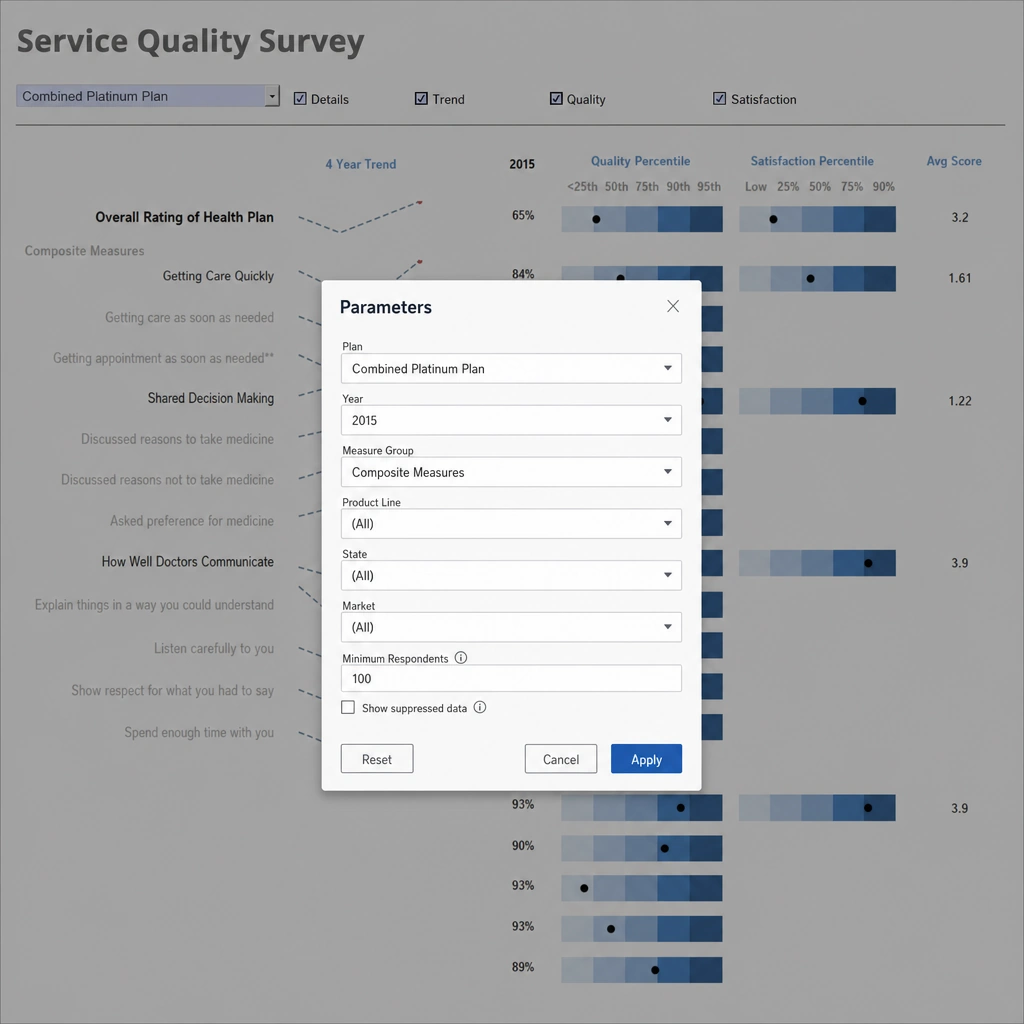
A parameter report is a report whose content, structure, or output changes based on user-supplied inputs. These inputs—known as parameters—can include dates, product categories, geographic regions, customer IDs, threshold values, or any other variable that influences the data being displayed. Instead of creating dozens or hundreds of static reports, organizations can build a single parameter-driven template that adapts to the needs of each user or scenario.
Parameters can control far more than simple filtering. They can determine which visualizations appear, which data sources are queried, how calculations are performed, and even which layout is used. This flexibility makes parameter reports a powerful tool for both analysts and operational teams who need fast, accurate, and tailored insights.
Why Parameter Reports Matter
The value of parameter reports lies in their ability to reduce redundancy, improve accuracy, and streamline reporting workflows. Without parameterization, organizations often rely on manual processes to generate customized reports for different departments, clients, or time periods. These manual steps introduce risk, consume time, and create inconsistencies.
Parameter reports solve these challenges by enabling:
- Dynamic Filtering: Users can specify exactly which data they want to see, reducing noise and improving clarity.
- Template Reuse: A single report design can serve many use cases, reducing development and maintenance effort.
- Automation: Reports can be generated in bulk for different parameter values, supporting large-scale distribution.
- Consistency: Standardized templates ensure that all users see metrics defined in the same way.
- Personalization: Each user receives a report tailored to their role, region, or responsibility.
These advantages make parameter reports especially valuable in industries such as finance, retail, healthcare, logistics, and manufacturing—where timely, accurate, and role-specific insights are essential.

Core Principles of Effective Parameter Report Design
Clear Parameter Definitions
The first step in designing a parameter report is defining which inputs matter. Parameters should reflect real decision points: date ranges, product lines, customer segments, or operational thresholds. Each parameter must be clearly labeled, intuitive to use, and aligned with the user’s workflow. Ambiguous or unnecessary parameters can confuse users and reduce adoption.
Logical Parameter Dependencies
Some parameters depend on others. For example, selecting a region may determine which cities are available. Effective parameter design accounts for these relationships and ensures that users only see valid options. This reduces errors and improves the overall experience.
Consistent Visual and Data Standards
Even though parameter reports are dynamic, they must maintain consistent visual and data standards. Colors, chart types, KPI definitions, and layout patterns should remain stable across parameter selections. This consistency helps users interpret results quickly and trust the data.
Performance Optimization
Parameter reports often query large datasets or run complex calculations. Efficient data modeling, indexing, caching, and query optimization are essential to ensure that parameter changes produce results quickly. Slow performance discourages use and undermines the value of parameterization.

Scalable Automation
One of the greatest strengths of parameter reports is their ability to support automated report generation. When designing templates, it is important to consider how they will behave when executed repeatedly with different parameter values. Templates must be robust, predictable, and capable of handling edge cases.
Use Cases for Parameter Reports
Role-Based Dashboards
Organizations often need dashboards tailored to different roles—executives, managers, analysts, and operators. Parameter reports allow a single dashboard template to adapt to each role by adjusting KPIs, filters, and detail levels. This reduces development time and ensures consistent metric definitions across the organization.
Client or Account Reporting
Service providers frequently generate reports for multiple clients or accounts. Parameterization enables automated production of individualized reports without manual intervention. Each client receives a customized report based on their unique identifier, while the underlying template remains the same.
Operational Monitoring
Operational teams often need to monitor specific assets, locations, or processes. Parameter reports allow users to select the exact unit they want to analyze—such as a warehouse, machine, or route—without requiring separate dashboards for each.
Financial and Budget Reporting
Finance teams rely on parameter reports to analyze different time periods, departments, cost centers, or forecast scenarios. Parameters make it easy to switch between views without duplicating report structures.
Regulatory and Compliance Reporting
Many industries require standardized reports that vary only by region, facility, or reporting period. Parameterization ensures consistency while enabling efficient production of required documents.
How InetSoft Supports Parameter Reports
InetSoft’s BI platform is designed to make parameter reporting both powerful and accessible. Its flexible architecture, intuitive design tools, and robust data modeling capabilities allow organizations to build parameter-driven reports that scale across teams and use cases.
Dynamic Parameter Controls
InetSoft provides a wide range of parameter input types, including dropdowns, date pickers, sliders, checkboxes, and text fields. These controls can be bound to data sources, enabling dynamic population of parameter values based on real-time data. This ensures that users always see valid and relevant options.

Adaptive Report Templates
InetSoft’s report designer allows developers to create templates that adapt to parameter selections. Visual components can be shown or hidden based on parameter values, and calculations can adjust dynamically. This enables highly personalized reporting experiences without requiring multiple versions of the same report.
Enterprise-Grade Data Modeling
InetSoft’s data mashup engine supports complex transformations, joins, and hierarchies that power parameter-driven logic. Clean, well-structured data models ensure that parameter changes produce accurate and consistent results. This foundation is essential for organizations that rely on parameter reports for critical decision-making.
Automated Report Generation
InetSoft supports automated scheduling and distribution of parameter reports. Organizations can generate hundreds or thousands of customized reports by supplying different parameter values—ideal for client reporting, compliance documentation, or large-scale operational monitoring. This automation reduces manual effort and eliminates the risk of human error.
Embedded and Self-Service Experiences
Parameter reports built in InetSoft can be embedded into applications or exposed through self-service interfaces. This allows users to adjust parameters directly within their workflow, making insights more accessible and actionable. Self-service parameterization empowers non-technical users to explore data without relying on analysts or IT teams.

The Strategic Value of Parameter Reports
Parameter reports are more than a technical feature—they are a strategic capability that enhances organizational agility. By enabling dynamic filtering, personalized insights, and large-scale automation, parameter reports help teams make faster, more accurate decisions. They reduce redundancy, improve consistency, and ensure that every user receives the information they need in a format that supports their responsibilities.
InetSoft’s BI platform amplifies these benefits by providing the tools, flexibility, and performance required to design parameter reports that scale. Whether supporting executives, analysts, or operational teams, InetSoft enables organizations to deliver tailored insights with precision and efficiency.
As data volumes grow and reporting demands become more complex, parameter reports will continue to play a central role in modern analytics strategies. Organizations that invest in strong parameter design and robust BI tools will be better equipped to navigate uncertainty, optimize performance, and maintain a competitive edge.