Maritime Port Traffic and Weather Dashboards
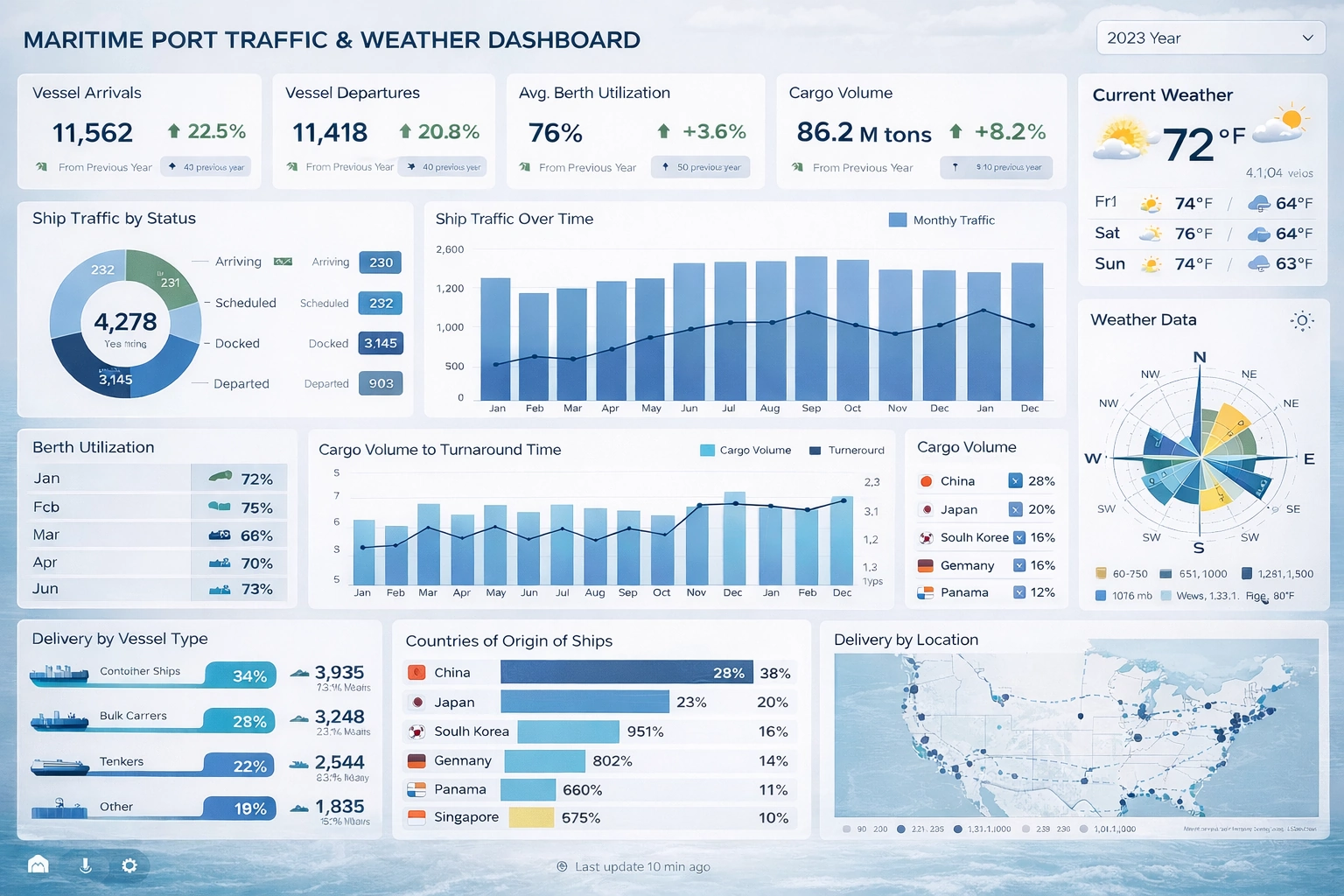
The Maritime Port Traffic and Weather Dashboard presents a comprehensive operational view of vessel activity, cargo movement, berth utilization, and environmental conditions within a single, unified interface.
The dashboard integrates operational throughput data with live weather intelligence, reflecting the reality that port performance is deeply influenced by environmental conditions.
The sections below break down traffic patterns, berth efficiency, cargo performance, vessel mix, and geographic origins to support both operational control and strategic planning.

Executive Key Performance Indicators
Across the top row, the dashboard highlights essential performance indicators. These include Vessel Arrivals, Vessel Departures, Average Berth Utilization, Cargo Volume, and Current Weather conditions. Presenting these indicators first establishes immediate situational awareness. For example, Vessel Arrivals and Vessel Departures offer insight into traffic balance. A sustained gap between arrivals and departures may indicate congestion risk or berthing inefficiencies.
Average Berth Utilization reflects how effectively dock infrastructure is being used. A value that is too low may suggest underutilized capacity, while sustained utilization above optimal thresholds can signal bottlenecks or delayed turnaround times. Cargo Volume, expressed in metric tons, quantifies throughput and provides a macro-level performance benchmark. This metric is often used in executive reporting and long-term planning.
The Current Weather panel introduces operational context. Temperature, forecast conditions, and visual weather cues remind operators that wind, storms, and visibility directly influence docking operations, pilot scheduling, and cargo handling safety. Integrating weather data at the top level reinforces its strategic importance rather than treating it as secondary information.

Ship Traffic by Status
The Ship Traffic by Status visualization categorizes vessels as Arriving, Scheduled, Docked, and Departed. A circular chart format provides proportional awareness, while numeric callouts ensure precision. This breakdown is critical for daily coordination. Docked vessels represent active berth occupancy. Scheduled vessels represent upcoming demand. Arriving vessels indicate near-term operational load.
From an operational perspective, this panel allows dispatchers and harbor control teams to anticipate berth allocation adjustments. If the number of arriving vessels significantly exceeds departures, preemptive scheduling changes may be required. The dashboard transforms what might otherwise be a static reporting tool into a dynamic control surface.
Ship Traffic Over Time
The Ship Traffic Over Time chart illustrates monthly vessel volume trends. By combining column bars for total monthly traffic with a line overlay for trend progression, the visualization communicates both absolute scale and directional momentum. Seasonal patterns become immediately visible. Many ports experience cyclical peaks driven by agricultural exports, holiday retail imports, or energy demand.
Trend visualization supports forecasting. If traffic steadily increases from mid-year through autumn, staffing, tug allocation, and crane scheduling can be proactively adjusted. Historical comparisons also support capital planning decisions. Long-term growth patterns may justify berth expansion or dredging projects.
Berth Utilization by Month
The Berth Utilization section presents a month-by-month percentage breakdown. This panel supports granular operational review. Sudden dips in utilization may correlate with adverse weather events, labor constraints, or reduced vessel arrivals. Conversely, sustained high utilization can highlight peak congestion periods.
By aligning utilization trends with the Ship Traffic Over Time chart, port managers can analyze whether infrastructure capacity aligns with vessel inflow. If traffic rises but utilization remains stable, it may indicate improved efficiency. If both increase sharply, expansion strategies may need consideration.

Cargo Volume to Turnaround Time
The Cargo Volume to Turnaround Time chart explores the relationship between cargo throughput and vessel turnaround efficiency. Bars represent cargo volume, while a line indicates average turnaround duration. This dual-axis approach is particularly valuable because throughput alone does not measure operational excellence.
A port can move high cargo volumes but still suffer from excessive turnaround times, reducing overall competitiveness. By visualizing these metrics together, stakeholders can detect whether cargo increases correspond with efficiency improvements or operational strain. Ideally, rising cargo volume should not proportionally increase turnaround time.
Wind Rose and Weather Data
A defining feature of this dashboard is the Wind Rose chart within the Weather Data section. The wind rose visualizes wind direction and relative frequency, arranged radially by compass orientation. This chart is especially relevant in maritime environments. Wind direction influences docking maneuvers, tugboat requirements, and crane safety thresholds.
Unlike a simple wind speed indicator, the wind rose communicates directional distribution over time. If prevailing winds come predominantly from the northwest, certain berths may require adjusted approach protocols. High crosswinds can limit crane operation and container stacking height. Integrating this chart alongside operational metrics highlights the interdependence of environmental and logistical variables.
Delivery by Vessel Type
The Delivery by Vessel Type panel categorizes traffic into Container Ships, Bulk Carriers, Tankers, and Other vessel classifications. Each category displays both percentage share and total vessel count. This segmentation supports capacity planning and infrastructure alignment.
Container terminals require gantry cranes and yard stacking capacity. Bulk carriers demand conveyor systems and storage silos. Tankers necessitate pipeline and safety infrastructure. By monitoring the distribution of vessel types, port authorities can allocate resources effectively and identify structural demand shifts.

Countries of Origin of Ships
The Countries of Origin of Ships chart replaces the previously unclear bottom-row visualization with a relevant and readable bar chart. This chart lists major origin countries such as China, Japan, South Korea, Germany, Panama, and Singapore, along with percentage shares of total arrivals.
This information is strategically important. Trade relationships influence port traffic composition. A surge in vessels from a specific country may correlate with seasonal export cycles or geopolitical trade developments. Understanding origin distribution also supports customs staffing, language support requirements, and compliance monitoring.
Additionally, diversification of origin countries can indicate economic resilience. A port heavily dependent on a single trade partner may face vulnerability during economic downturns or policy shifts. The clarity of this chart enables rapid executive interpretation without visual ambiguity.
Delivery by Location Map
The Delivery by Location panel displays a geographic distribution map highlighting vessel destinations or inland distribution routes. Geographic visualization enhances spatial awareness. Clusters may reveal dominant shipping corridors or high-frequency trade lanes.
Mapping data visually allows decision-makers to identify regional concentration patterns. For example, dense clustering along specific coastlines may suggest opportunities for new feeder services or expanded intermodal connectivity. Geographic dashboards are especially valuable in maritime logistics because shipping inherently operates across spatial networks.

Design and Usability Considerations
The dashboard employs a structured grid layout to prevent visual overload. Each panel is clearly labeled, typography is legible, and numerical values are spelled correctly. The widescreen 1600 by 900 format ensures that all components remain visible without cropping, making it suitable for wall-mounted operations centers or executive boardrooms.
Color selection emphasizes marine tones, reinforcing thematic coherence while maintaining professional neutrality. Distinct color contrasts differentiate metrics without introducing unnecessary visual noise. The hierarchy flows logically from high-level KPIs at the top to operational and analytical breakdowns below.
Operational Impact
A dashboard of this nature serves multiple stakeholders simultaneously. Harbor masters rely on it for immediate traffic awareness. Operations managers use it to coordinate berth assignments and cargo handling resources. Executives reference it for strategic capacity evaluation. Meteorological integration ensures safety compliance and proactive risk mitigation.
In modern port management, data fragmentation creates inefficiencies. By consolidating vessel, cargo, infrastructure, and environmental data into one coherent interface, the dashboard reduces cognitive friction. Decisions can be made faster and with greater confidence because context is readily available.
Strategic Value
Beyond daily operations, the dashboard supports long-term strategic analysis. Historical trend interpretation informs infrastructure investment decisions. Trade origin analysis guides partnership development. Weather pattern monitoring can justify capital expenditure in wind-resistant crane systems or expanded sheltered berths.
Ports compete globally. Efficiency, reliability, and transparency influence shipping line loyalty. A well-designed traffic and weather dashboard enhances operational transparency and fosters performance benchmarking. When integrated with predictive analytics, such dashboards can evolve into forecasting platforms capable of anticipating congestion and weather-related disruptions.

how integrated data visualization strengthens Maritime Operations
The Maritime Port Traffic and Weather Dashboard exemplifies how integrated data visualization strengthens maritime operations. By combining traffic metrics, cargo throughput, berth utilization, vessel segmentation, geographic mapping, origin analysis, and advanced weather visualization including a wind rose chart, the dashboard delivers a complete operational narrative. Clear labeling, legible formatting, and structured layout ensure that insights are accessible without interpretation ambiguity. In an industry where timing, safety, and efficiency determine competitiveness, such a unified dashboard becomes an indispensable operational instrument.
External Resources for Further Reading
- Marine Insight – Articles and technical explanations on port operations and maritime logistics.
- World Shipping Council – Industry insights on global shipping trends and container transport.
- National Oceanic and Atmospheric Administration (NOAA) – Authoritative resources on marine weather forecasting and wind analysis.
- UNCTAD Ports and Maritime Transport – Research and statistics on global port performance and trade flows.