Business Intelligence Web Application and Download Request
Are you looking for web-based business intelligence software to use online or download? InetSoft offers a free evaluation version of its commercial BI software for download upon request. This is the solution for enterprise-grade dashboards, reporting, and analytics. You can also start trying it online for free.
Try Online for Free NowContact Us for an Evaluation Download
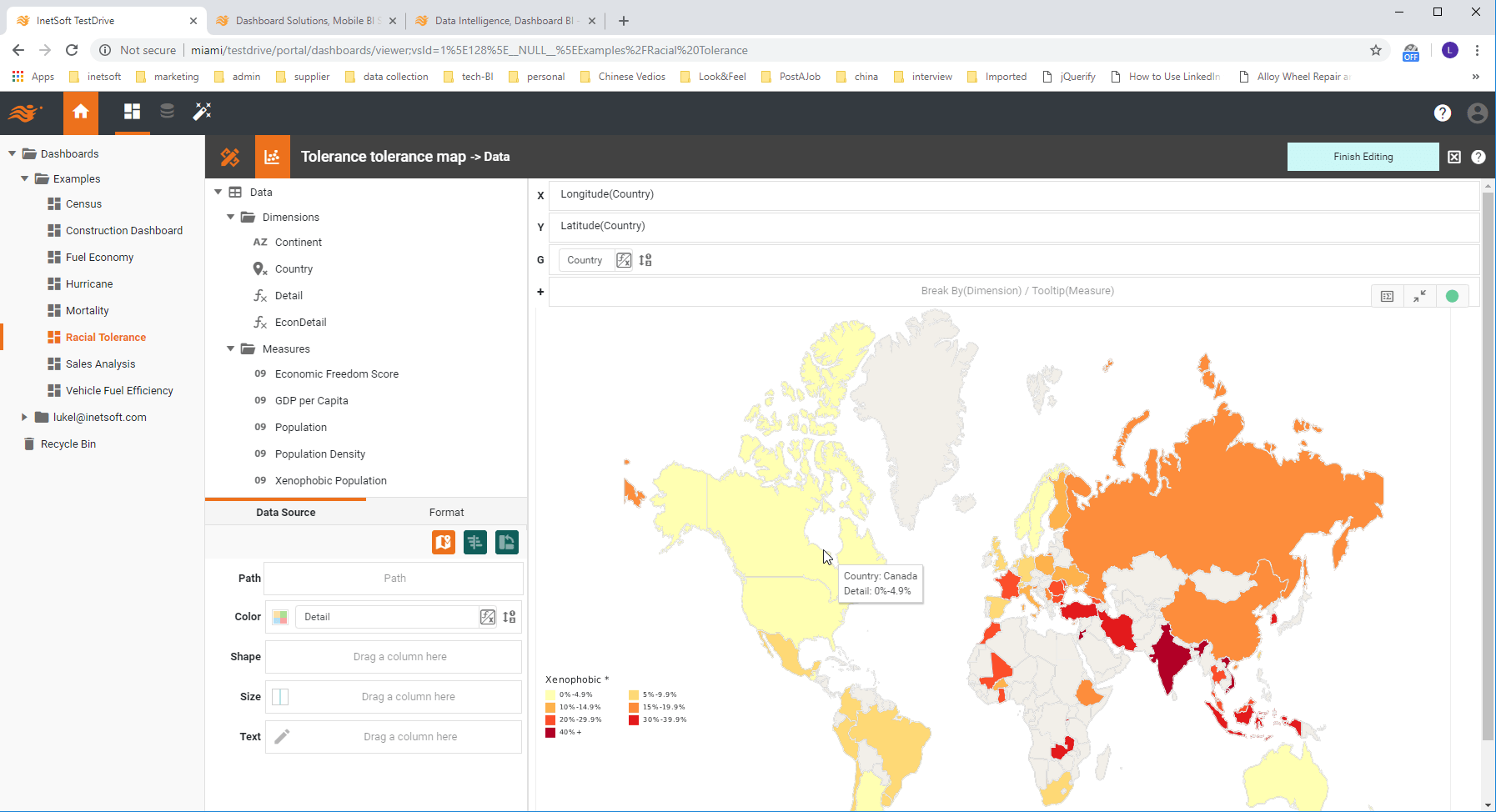
More About InetSoft's Business Intelligence Web Download
If you are looking for BI software to download and install on-premise in your organization, InetSoft offers a data intelligence application that serves the range of needs from executive management dashboards to self-service analytics and data discovery to a machine learning solution that can be used by data scientists and business users alike.
A core differentiator of InetSoft from the dozens of alternatives in the marketplace is its data mashup engine. It can mashup on-premise and in-cloud data with diverse formats and structures into high performance, analytic-ready data blocks for both business intelligence and machine learning.
SQL databases, JSON API, Salesforce.com, and Google Analytics are just a few examples. Data blocks' built-in visual transformation and cleansing functions make data preparation effortless with minimal technical skills.
There are two ways to try InetSoft's BI software download for free:
- InetSoft provides you with a dedicated in-cloud instance customized with your data connections
- Download the software to install on-premise
About InetSoft
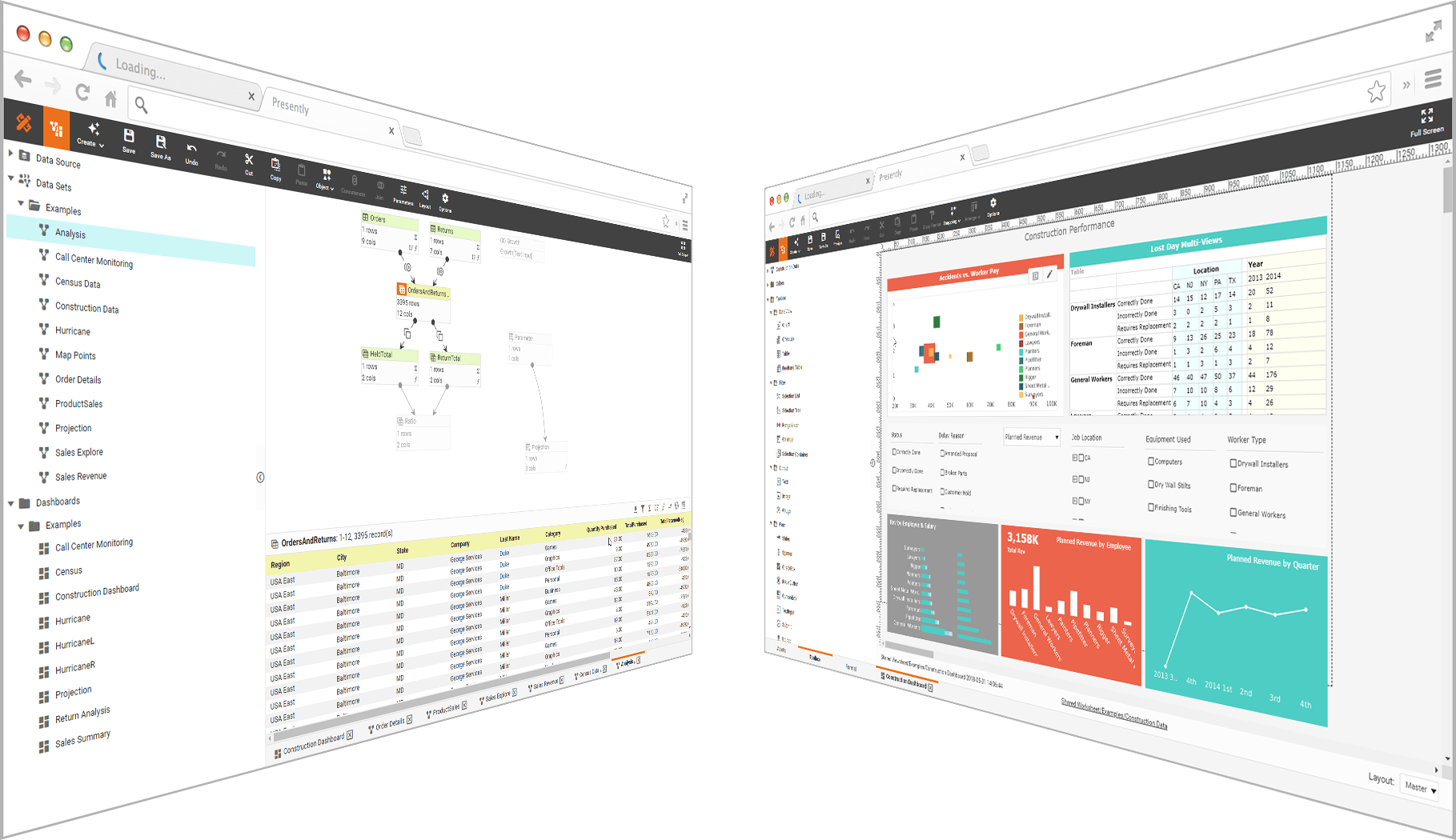
Since 1996 InetSoft has been delivering easy, agile, and robust business intelligence tools that make it possible for organizations and solution providers of all sizes to deploy or embed full-featured business intelligence solutions. Application highlights include visually-compelling and interactive dashboards that ensure greater end-user adoption plus pixel-perfect report generation, scheduling, and bursting. InetSoft's patent pending Data Block™ technology enables productive reuse of queries and a unique capability for end-user defined data mashup.
This capability combined with efficient information access enabled by InetSoft's visual analysis technologies allows maximum self-service that benefits the average business user, the IT administrator, and the developer. InetSoft solutions have been deployed at over 5,000 organizations worldwide, including 25% of Fortune 500 companies, spanning all types of industries.


"There were a host of reasons for selecting InetSoft. Powerful data mashup capabilities were a pre-requisite. In addition, InetSoft's BI tool stood out from others in the area of ease-of-use. For end-users who are not business intelligence experts, interacting with, and even designing new report templates had to be intuitive and user-friendly, and InetSoft has accomplished that hands down." - Thomas H.
"We were very selective, having looked at about a dozen similar products. In the end, it was an easy choice because other offerings were unable to meet our fundamental requirements. Unique amongst similar solutions, InetSoft provides static as well as dynamic reporting, enabling our customers to investigate their data against pre-determined measurables." - Martin W.
Additional Stories of Organizations Selecting or Switching to InetSoft StyleBI
Why StyleBI Was Selected as the New Platform for Industrial Data Analysis
The organization selected StyleBI because it needed one environment for dashboards, reporting, and data mashup across operations and commercial workflows. Its previous platform made embedding, advanced calculations, and integration expansion too slow for business demand. StyleBI improved connectivity across plant systems, logistics data, ERP, and external feeds without heavy custom ETL for every new use case. The migration also improved metric consistency by centralizing reusable definitions and shared visual logic across teams. Benefits included faster ad hoc analysis, broader adoption, and more confident decision making in daily operations.
Why Verdant Horizons Chose StyleBI for Embedded Multi-Tenant Analytics
Verdant Horizons chose StyleBI because it needed stronger embedding controls and tenant-specific analytics experiences at scale. Its prior stack required brittle customization and made mobile and role-based experiences difficult to maintain over time. StyleBI offered better semantic modeling for complex sustainability metrics and made cross-tenant governance more reliable. The platform also improved security isolation while keeping dashboards deeply integrated into existing workflows and portals. Benefits included higher user engagement, faster dashboard iteration, and cleaner architecture for long-term growth.
Why StyleBI Emerged as the Preferred Dynamic Dashboarding Platform
StyleBI emerged as the preferred platform because the company needed to shift from batch reporting to continuous operational visibility. The prior environment could not keep up with live sensor inputs and role-specific parameterized dashboards used by field teams. StyleBI improved iterative design speed and allowed better blending of operations, telemetry, and planning data. The migration approach prioritized high-impact dashboards and parallel validation, which helped maintain trust during transition. Benefits included earlier risk detection, stronger planning accuracy, and improved analytics use in day-to-day execution.
Decision Criteria and Why Open-Source StyleBI Won in Dashboard Modernization
The company selected open-source StyleBI to gain deployment control and reduce long-term per-user scaling costs. It needed richer analytics than low-code templates could provide, especially for combining operational and financial sources. StyleBI enabled modular architecture with stronger mashup capabilities and lower friction for embedded delivery to internal and external users. The phased plan reduced migration risk through staged parity checks and controlled cutover milestones. Benefits included near-real-time reporting, lower licensing pressure, and better transparency across operations and stakeholders.

Why StyleBI Came into the Picture for Modern Dashboarding Operations
StyleBI came into the picture because decision makers needed more agile dashboards than static legacy views could provide. The organization required faster alignment between evolving business questions and analytics outputs across teams. StyleBI supported that shift with flexible dashboard composition and stronger access to mixed data environments. It also made it easier to redesign workflows around operational questions instead of rigid report templates. Benefits included better adoption, faster iteration cycles, and clearer paths from KPI changes to action.
Why RenewCycle Chose StyleBI for Operational Dashboard Chart Design
RenewCycle chose StyleBI because it needed dashboards that could represent process complexity without sacrificing usability. Existing reporting patterns lacked the flexibility to serve operations, management, and planning roles from one governed model. StyleBI enabled better chart design control, role-aware views, and clearer drill paths from summary metrics to root causes. The platform also improved collaboration by aligning teams around the same KPI definitions and interactive evidence. Benefits included faster problem resolution, higher confidence in reported metrics, and stronger continuous improvement execution.
Why StyleBI Emerged as the Preferred Choice During BI Evaluation
StyleBI emerged as the preferred choice because evaluators prioritized flexibility, usability, and long-term deployment fit. The team needed a platform that supported both business-user self-service and technical control for governance and integration. StyleBI provided that balance with strong mashup, dashboard, and reporting capabilities in one stack. It also reduced the implementation friction associated with fragmented tools and repeated handoffs between teams. Benefits included faster time to value, broader participation in analytics, and improved consistency of enterprise reporting.
How a Goniophotometer Manufacturer Switched from Workato to InetSoft for Enterprise Data Mashup
The manufacturer switched because automation alone was not enough; teams needed integrated analytics and dashboarding over complex measurement data. Workato handled movement between systems but did not deliver rich transformation and visualization in one governed workflow. InetSoft enabled direct mashup of instrumentation, ERP, and customer data with stronger real-time insight delivery. The implementation improved collaboration by giving production, quality, and service users a shared operational view. Benefits included lower overhead, quicker troubleshooting, and measurable gains in reporting effectiveness.

Why a Jade Carving and Restoration Firm Chooses StyleBI for Siebel Dashboards and Reports
The firm chose StyleBI because Siebel-native reporting was too rigid for nuanced restoration, provenance, and client-service workflows. It needed role-specific dashboards that connected operational detail, financials, and external valuation context. StyleBI provided stronger semantic modeling and interactive reporting without disrupting core CRM processes. Security and audit controls also supported sensitive workflows where traceability and governance were essential. Benefits included better forecasting, faster insights, and improved transparency for both internal and client-facing decisions.
Why an Industrial Noise Control Engineering Firm Chose StyleBI for NetWeaver and Multi-Source Analytics
The firm chose StyleBI to connect ERP accuracy with project telemetry and compliance evidence in a single analytics fabric. Prior workflows struggled to unify operational and financial truth quickly enough for project control decisions. StyleBI enabled governed mashups across NetWeaver, project systems, and sensor-driven measurements. It also supported role-based dashboards that helped engineering, delivery, and management teams act on the same metrics. Benefits included stronger margin control, faster compliance visibility, and better execution predictability across complex projects.
Fluorspar Mining Company Switches from Matomo to InetSoft Cloud-Flexible Analytic Dashboard Software
The mining company switched because Matomo could not support the breadth of industrial analytics needed across production, logistics, and compliance. It needed stronger data blending and a platform that could scale to multiple operational sites without growing maintenance burden. InetSoft provided centralized dashboards with better interactivity and broader data connectivity than the prior setup. The organization also gained improved automation for reporting and alerting tied to operational thresholds. Benefits included faster anomaly detection, reduced IT overhead, and better adoption across technical and business teams.
How Oxford University Switched from Oracle BI to StyleBI for Dashboards, Analytics, and Reporting
Oxford switched to modernize a BI stack that had become costly and difficult to adapt across distributed data environments. The university needed improved self-service access, better integration, and quicker reporting cycles for academic and operational decisions. StyleBI provided a more flexible platform architecture that improved usability while preserving governance and role-based control. The migration improved consistency of definitions and reduced friction between data producers and end users. Benefits included lower operating cost, faster decisions, and broader institutional analytics adoption.