Dynamic Dashboarding Software - Values
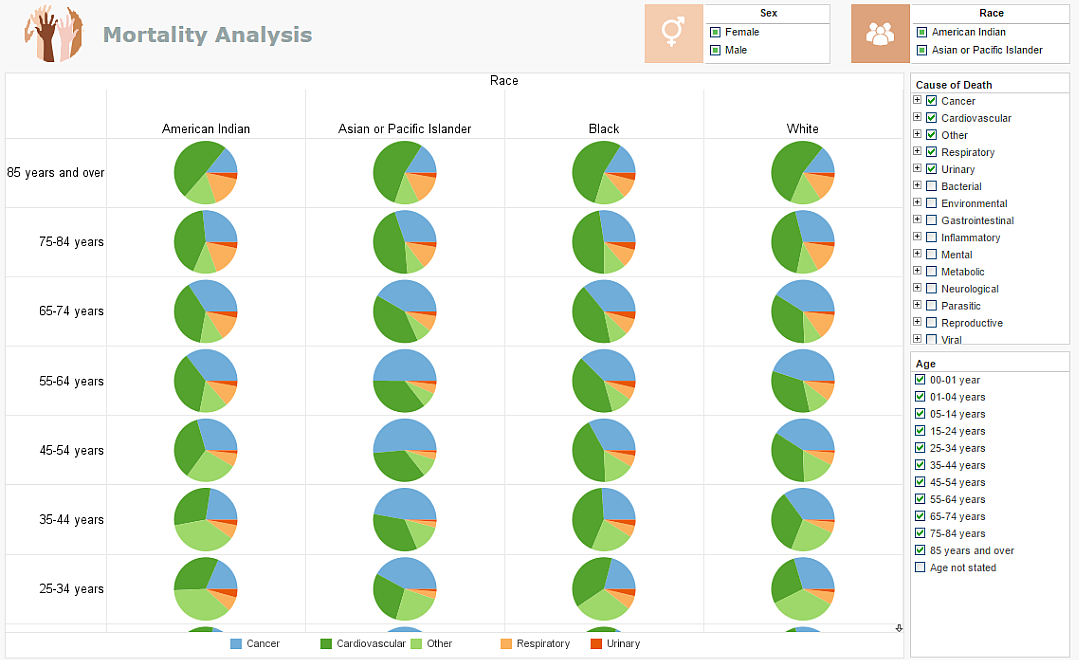
Matching values within dynamic dashboard software allows you to link complex and seemingly unrelated information into an elegant data-filled tapestry. View the example below to learn more about the Style Intelligence solution.
When you link an input control with a component property, you should ensure that the input control evaluates to a permissible value for the particular property. There are three main cases.
If a property requires a numerical value, the input control should provide an appropriate numerical value.
For example, the ‘Ranking’ property in the Chart data binding requires an integer value. An appropriate control for this property would therefore be a Spinner with ‘Increment’ property set to an integer value.

If a property has a ‘True’ or ‘False’ setting, the input control should provide a Boolean value.
For example, the ‘Enabled’ property expects a Boolean value ‘true’ or ‘false’. An appropriate control for this property would therefore be a RadioButton with embedded list values {true, false}, and with ‘Data Type’ set to ‘Boolean’.
If a property requires one of a fixed set of strings, the input control should provide a string from the set.
For example, the ‘Visible’ property requires one of the strings ‘Show’, ‘Hide’, or ‘Hide on Print and Export’. The input control must therefore return one of these strings. An appropriate control for this property would therefore be a RadioButton with embedded list values {‘Show’, ‘Hide’, ‘Hide on Print and Export’}, and with ‘Data Type’ set to ‘String’.

Industry KPI Focused Articles on InetSoft
-
Which KPIs to Put on an FMCG Dashboard?
This article explores key performance indicators relevant to fast‑moving consumer goods (FMCG) operations, where speed and inventory turnover are critical. It highlights metrics such as average time to sell, out‑of‑stock rate, and cash conversion cycle, showing how these influence freshness, capital use and supply chain efficiency. The piece draws attention to how a shorter sale cycle and minimal stockout occurrences directly impact profitability and customer satisfaction in the FMCG industry. Visualizations supporting these KPIs help demonstrate where delays or bottlenecks occur and how to allocate resources. The discussion guides FMCG managers on translating these operational metrics into actionable insights via dashboards.
-
What KPIs Are Used on a Fund Management Company’s Dashboard?
This article presents the KPIs used by fund management firms to track portfolio performance, risk, and operational efficiency. Key metrics include assets under management (AUM) growth, information ratio, return on investment (ROI), liquidity ratios, and client retention rate. The write‑up explains how tracking these indicators helps fund firms analyse investor acquisition, cost control, risk‑adjusted returns and benchmark comparison. The article also emphasises the importance of measuring trade execution efficiency, expense ratio and portfolio diversification. It offers guidance on how dashboards can unify investment, operational and compliance metrics into a coherent view for decision‑makers.
-
What KPIs and Analytics Does an Accounting Analyst Use?
This article examines key performance indicators and analytics relevant to the accounting function, such as profitability ratios, liquidity ratios, efficiency ratios and debt management ratios. It explains how these financial metrics give insight into cost structures, working capital health, and strategic financial positioning. The write‑up outlines how accounting analysts use dashboards to visualise metrics such as current ratio, debt‑to‑equity ratio, accounts receivable turnover and net profit margin. The discussion emphasises how timely access to these KPIs through dashboards helps organisations pivot more quickly and protect financial stability. Guidance is given on structuring such dashboards to deliver insight across management layers.
-
What KPIs and Analytics Does a Customer Experience Operations Analyst Use?
The article covers KPIs tied to customer experience and operations disciplines, such as Net Promoter Score (NPS), Customer Satisfaction Score (CSAT), Customer Effort Score (CES), first contact resolution (FCR) and churn rate. It describes how these metrics help evaluate loyalty, service quality, and retention, and how they can be visualised in dashboards to surface problem areas in support or service workflows. The write‑up explores how linking these KPIs with operational data (e.g., average handle time) adds depth to the experience analysis. It offers use‑cases for identifying high‑value customer segments and tailoring interventions accordingly. The article emphasises combining experience metrics with behavioural data for richer analytics.
-
What KPIs and Analytics Are Used on a Service Level Monitoring Dashboard?
This article focuses on KPIs used for monitoring service levels and operational availability within IT and service operations, including service uptime, downtime duration and SLA compliance. It explains how dashboards track these indicators to support reliable delivery and customer satisfaction. The piece emphasises the role of visualising incident patterns, response trends and backlog accumulation to pre‑empt service degradation. It provides insight into how dashboards help connect operational events to service health and performance. The article shows how KPI dashboards support service management by translating technical metrics into business‑relevant views.
-
What KPIs and Analytics Do Data Operations Professionals Use?
This article addresses KPIs and analytics for data‑operations teams, focusing on metrics such as data accuracy, availability, processing speed, storage efficiency, and compliance. It explains how dashboards in this space provide visibility into pipeline health, data quality, throughput and governance. The write‑up describes how metrics like data error rate, latency, and data monetisation tie operational choices to performance outcomes. It offers suggestions on how to visualise these metrics in dashboards that span infrastructure, processes and business impact. The article highlights the importance of aligning data‑ops KPIs with broader organisational goals.
-
What KPIs and Analytics Are Used on Requirements Management Dashboards?
This article explores KPIs and analytics tailored for requirements management in software development or product delivery contexts, such as requirement coverage, change‑request approval rate, test‑coverage and stakeholder satisfaction. It outlines how dashboards assist teams in monitoring progress, scope creep, quality of deliverables and cost management. The piece emphasises that capturing trend analysis and validation metrics supports proactive risk mitigation. It also describes how KPIs across schedule, cost, quality and stakeholder alignment can be blended in dashboards. The article gives developers and product managers a blueprint for right‑sized metrics for tracking requirement workflows.
-
What KPIs and Analytics Are Used on Capital Program Management Dashboards?
This article addresses KPIs relevant to capital program and large‑scale infrastructure management, such as budget variance, earned value analysis (EVA), schedule performance index (SPI) and cost performance index (CPI). It explains how dashboards give project and programme leaders a live view of cost, schedule, scope and risk across initiatives. The write‑up shows how aligning KPIs with strategic outcomes helps boards understand progress and make resource decisions. It emphasises the value of integrating cost‑control, earned value metrics and risk indicators into enterprise dashboards. The article serves as a guide for programme offices seeking to monitor large investments via actionable metrics.
-
What KPIs and Analytics Are Used on Endpoint Protection Software Dashboards?
This article examines how security operations teams use KPIs and analytics, highlighting metrics such as threat detection rate, incident response time, real‑time monitoring and vulnerability remediation rate. It explains how dashboards enable security leaders to monitor operational effectiveness, risk exposure and compliance at a glance. The write‑up illustrates how combining real‑time security events with trend‑based KPIs supports proactive defense. It emphasises the need for visualising both performance and risk indicators in unified dashboards. The article closes with suggestions for building security operations dashboards that align metrics with business outcomes.
-
What KPIs and Analytics Are Used on a Magazine Publisher’s Dashboard?
This article explores how magazine publishers—both print and digital—track KPIs such as page views, time on page, bounce rate, scroll depth, subscription conversion and citation counts. It explains how dashboards deliver insight into content engagement, audience behaviour and monetisation effectiveness. The piece highlights how publishers can use these metrics to optimise content strategy, digital reach and conversion funnels. It also shows how blending editorial and advertising KPIs on a dashboard supports revenue growth and cost management. The article guides publishers on setting and tracking meaningful performance indicators tailored to their business model.
-
What KPIs and Analytics Does an Investment Operations Analyst Use?
This article delves into KPIs and analytics for investment operations analysts, covering trade execution efficiency, portfolio performance, cost per trade, straight‑through processing (STP) rate and regulatory compliance metrics. It explains how dashboards help investment operations teams monitor settlement cycle times, error rates, risk‑adjusted returns and operational throughput. The write‑up emphasises the value of aligning operational KPIs with strategic investment and risk management goals. It also discusses how dashboards help identify bottlenecks, reduce cost per trade and improve operational transparency. The article offers practical guidance for building dashboards that support the operational side of investment services, not just asset performance.
-
What KPIs and Analytics Are Used by Billing Operations Analysts?
This article focuses on KPIs and analytics used by billing operations professionals, such as billing accuracy rate, invoice error rate, billing cycle time, days sales outstanding (DSO), cash flow and vendor invoice accuracy. It explains how dashboards reveal process inefficiencies, highlight revenue leakage, measure collection performance and support continuous improvement. The piece emphasises how parsing billing metrics visually helps identify cost and revenue risks before they become embedded problems. It also describes how combining financial, customer satisfaction and operational KPIs in dashboards supports holistic billing performance monitoring. The article serves billing operations teams looking to translate process metrics into actionable dashboards for financial health.