Can you have a single dashboard cover both executive level metrics as well as detailed operational KPI’s?
Below is the continuation of the transcript of a Webinar hosted by InetSoft on the topic of "Best Practices for Key Performance Indicators." The presenter is Mark Flaherty, CMO at InetSoft.
Mark Flaherty (MF): It’s probably not a good idea to mix up the audiences and intentions of dashboards. It doesn’t make sense for senior executives to drill down too granularly. Do they have time to really look at the details of every marketing campaign. Would they understand what they are looking at? Summary-level views are best for them.
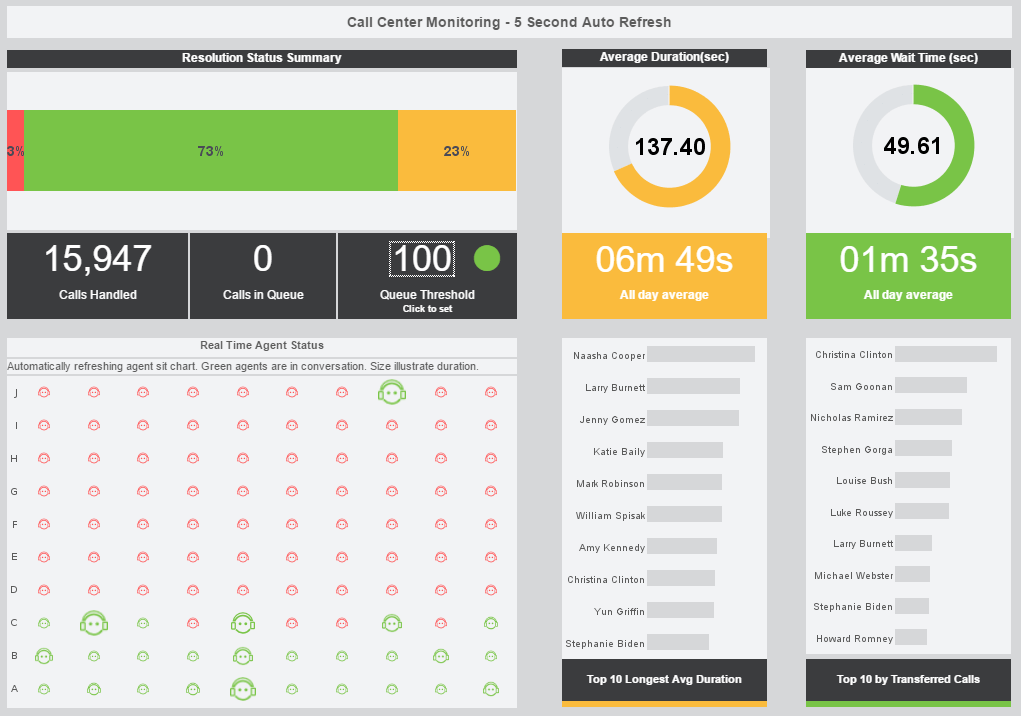
For instance, in customer service, how many complaints are coming in every day. What are the main sources, the call center, the agents, the field reps? Those are the summary level kind of key performance indicators that management needs to see.
It’s always a good idea for an operational employee to understand the impact of their own operational performance metrics, the ones they are managed by, on the overall goals of the company to understand how they play a part in the company’s success. But they don’t need to be seeing on a daily basis how those executive level metrics are performing.
| #1 Ranking: Read how InetSoft was rated #1 for user adoption in G2's user survey-based index |
|
Read More |
Let’s talk about the difference between the presentation layer of KPIs and the back-end. There is a very tight relationship between performance management and master data management, meaning if you’re defining the key metrics top to bottom that will help us perform better as a company, those metrics better be right. They better be accurate. Make sure the quality of the data, the integrity of the data, is there to make sure that performance is being managed properly.
Who Is the Best Person to Select the KPIs for a Sales Management Dashboard?
Selecting the KPIs for a sales management dashboard is a critical task that requires a deep understanding of the organization's sales objectives, strategic priorities, and operational processes. The best person to undertake this responsibility is often a cross-functional team comprising individuals with expertise in sales, marketing, finance, and data analytics. Sales managers or directors play a central role in this process due to their intimate knowledge of the sales pipeline, customer relationships, and revenue targets. Their insights into the day-to-day operations of the sales team, as well as their understanding of key performance drivers and challenges, are invaluable in identifying the most relevant and actionable KPIs. Additionally, involving representatives from other departments such as marketing and finance ensures alignment with broader organizational goals and facilitates the selection of KPIs that provide a holistic view of sales performance and its impact on the business as a whole.
Furthermore, collaboration with sales representatives and front-line staff is essential in ensuring that the selected KPIs accurately reflect the realities of the sales process and resonate with those responsible for achieving the targets. Salespeople possess unique insights into customer interactions, market dynamics, and product performance, making their input invaluable in identifying the most meaningful metrics to track. By involving a diverse range of stakeholders in the selection process, organizations can foster buy-in and ownership of the sales management dashboard, driving greater accountability, transparency, and ultimately, improved performance across the sales function. Therefore, while sales managers play a central role in selecting KPIs for a sales management dashboard, a collaborative and cross-functional approach ensures that the dashboard effectively captures the multifaceted nature of sales performance and supports data-driven decision-making at all levels of the organization.
Who Is the Best Person to Select the KPIs for an Order Fulfillment Dashboard?
Selecting the KPIs for an order fulfillment dashboard requires input from various stakeholders involved in the order processing and fulfillment process. The best person or team for this task typically includes individuals with expertise in supply chain management, logistics, operations, and customer service. Among these, the supply chain manager or director often plays a central role due to their comprehensive understanding of the end-to-end order fulfillment process, from order receipt to delivery. Their insights into inventory management, warehouse operations, transportation logistics, and supplier relationships are crucial in identifying the most relevant KPIs that align with the organization's strategic objectives and customer service goals. In addition to supply chain professionals, involvement from customer service representatives and sales personnel is essential in selecting KPIs that prioritize customer satisfaction and service levels.
Customer service representatives interact directly with customers and are therefore well-positioned to provide insights into common issues, customer preferences, and service expectations. Sales personnel can offer insights into customer demand patterns, order volumes, and product popularity, which are valuable in determining KPIs related to order processing efficiency and inventory management. Furthermore, collaboration with IT and data analytics teams is crucial to ensure that the selected KPIs are measurable, actionable, and can be effectively tracked and analyzed using the organization's data systems and technology infrastructure. By involving a diverse range of stakeholders in the selection process, organizations can ensure that the order fulfillment dashboard reflects the multifaceted nature of the fulfillment process and provides actionable insights to drive continuous improvement and customer satisfaction.